Why AI Pilots Stall After POC (And How to Fix It)
95% of AI investments return nothing - MIT and Gartner identify four structural killers after POC.


Introduction
Somewhere in every enterprise right now, a pilot that worked is quietly dying. The demo succeeded. Stakeholders approved it. And then, months later, it never became a production system - not because the technology failed, but because nobody had priced, governed, or architected for what production actually demands. This is not a rare outcome. It is the modal outcome. The research from Gartner, MIT, and McKinsey converges on the same uncomfortable finding: a working pilot tells you almost nothing about whether an AI proof of concept (POC) will reach production. Between POC and production sits a structural valley, and what determines who crosses it is predictable well before the pilot even launches - often before the enterprise AI strategy behind it is even finalized. This article examines why that valley exists, what actually kills AI pilot projects after they've already proven themselves, and what separates the minority of organizations that reach enterprise AI adoption at scale.
Why AI-Powered Customer Journey Mapping Is Becoming Essential for Enterprise Growth. Explore the latest insights here!
The POC Graveyard, Quantified
The unsettling question every CIO should be asking isn't "did the pilot work?" It's "if the technology was fine and the demo succeeded, what exactly killed it afterward?"
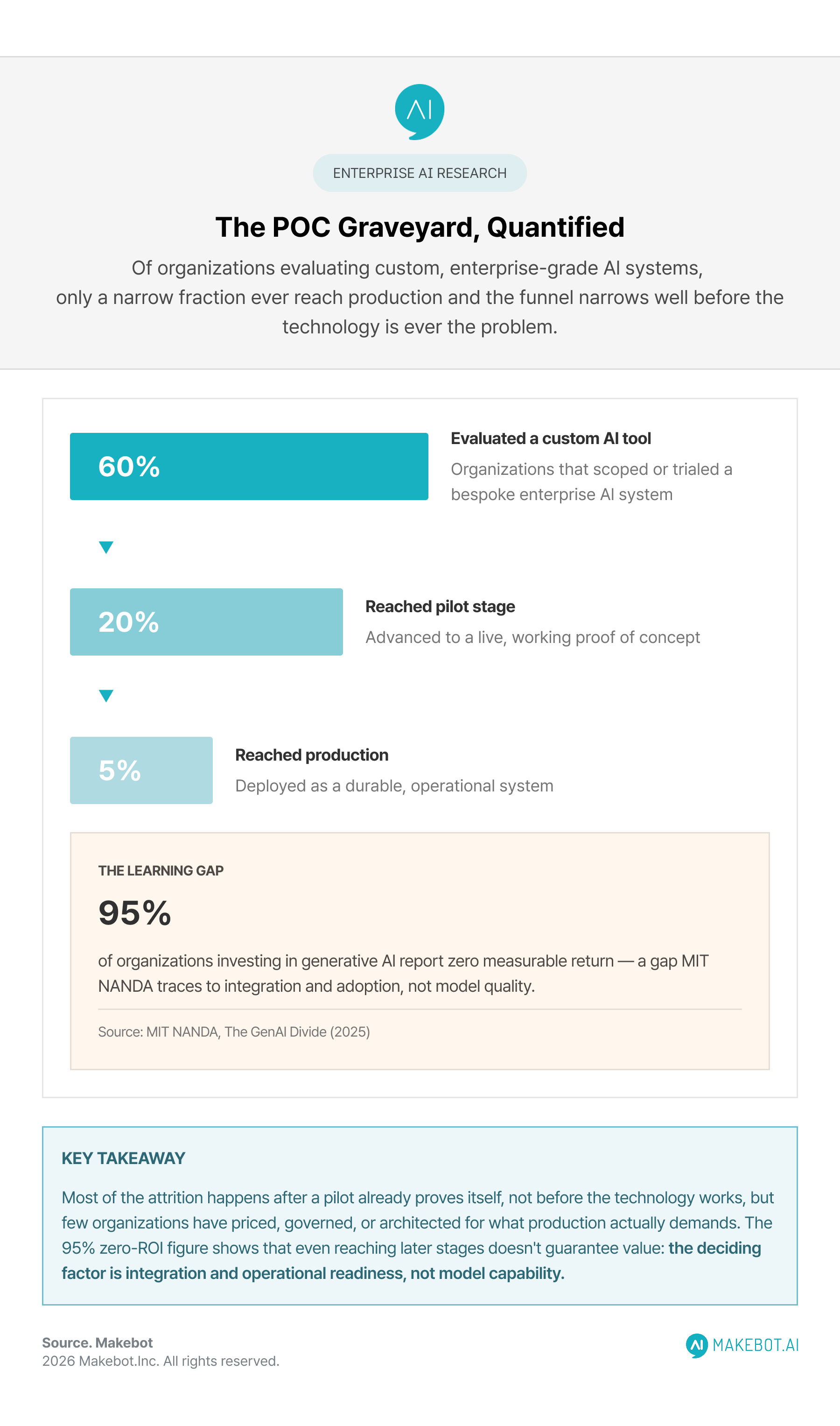
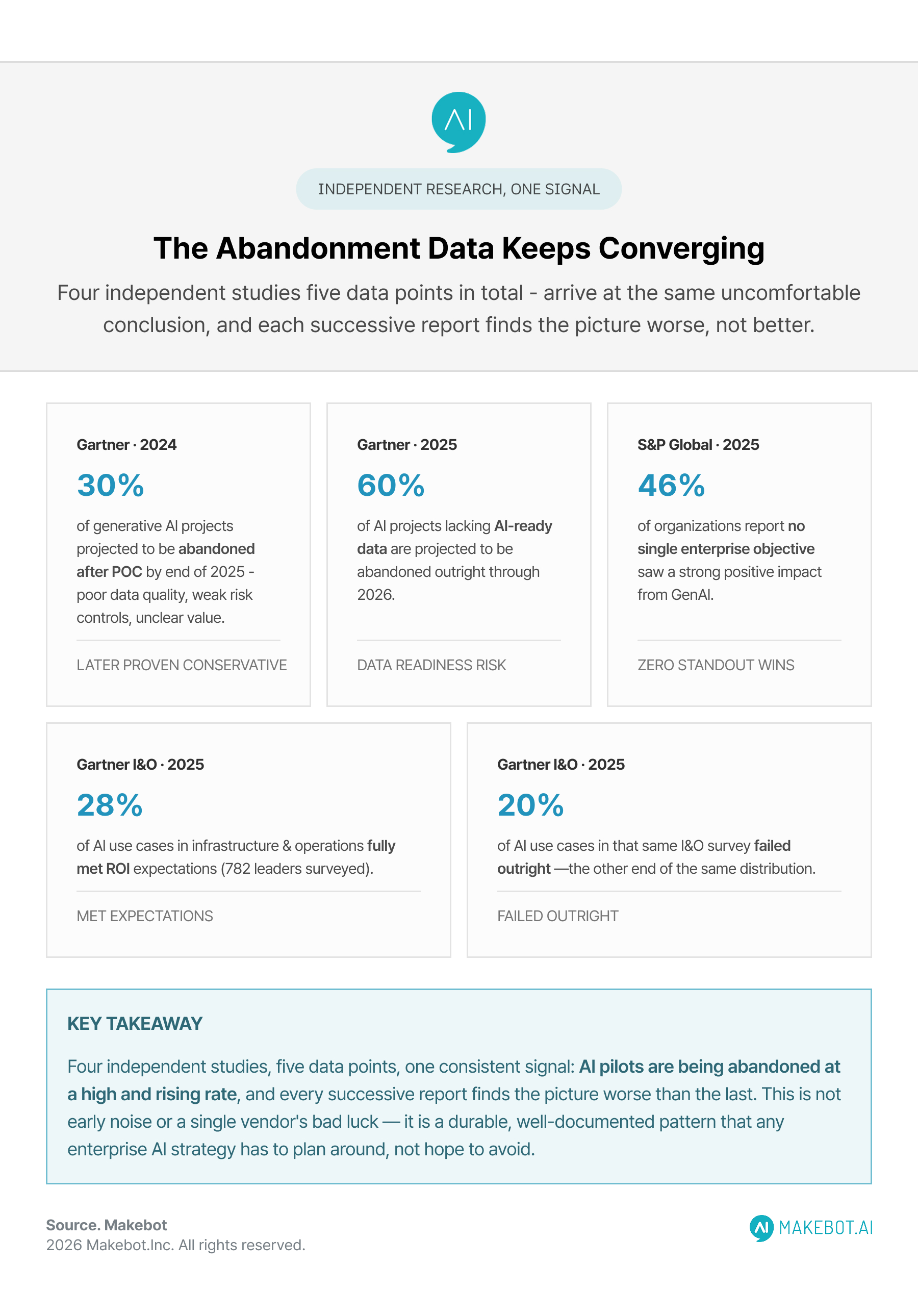
Gartner projected that at least 30% of generative AI projects would be abandoned after proof of concept by the end of 2025, driven by poor data quality, inadequate risk controls, escalating costs, and unclear business value. That figure has since proven conservative. S&P Global Market Intelligence found that 46% of organizations investing in generative AI report that no single enterprise objective has seen a "strong positive impact," and Gartner has separately projected that through 2026, 60% of AI projects lacking AI-ready data will be abandoned outright. Narrowing the lens to a specific function tells the same story: a Gartner survey of 782 infrastructure and operations (I&O) leaders, fielded in late 2025, found only 28% of AI use cases in that function fully met ROI expectations, while 20% failed outright. MIT NANDA's The GenAI Divide research - based on interviews with 52 organizations, a survey of 153 senior leaders, and analysis of 300+ public AI initiatives - found a starker funnel specifically for custom, enterprise-grade AI systems: 60% of organizations evaluated such tools, only 20% reached pilot stage, and just 5% reached production, with 95% of organizations investing in generative AI reporting zero measurable return.
These numbers describe an industry-wide pattern, not isolated bad luck - and the trend across 2025 and 2026 has consistently moved in one direction: worse than first projected, not better.
How Generative AI Is Reshaping Brand Strategy and Digital Advertising. Read the expert analysis here!
The Ceiling Pattern: When the Simple Bot Ships and the Serious One Stalls
Not every AI pilot dies - and that distinction is the most useful thing this data can teach a decision-maker.
Consider a pattern common across large enterprises: a procurement division at a large manufacturer builds an internal Q&A assistant on a hosted commercial model, with a basic guardrail between the internal network and the external LLM. Staff ask questions, the bot surfaces answers from uploaded documents, adoption is strong, and the AI deployment ships successfully. This isn't a failure - it's proof the visible layer of AI application development can work when the stakes are proportional.
The ceiling appears at the next step. The organization tries to deepen the system: fine-grained permissions so departments see only their own documents, fully closed-network operation so no data touches an external model, audit-grade logging for compliance review, HR-driven access changes when employees change roles. That is where the self-built effort stops advancing. The simple version shipped. The serious version stalled - not from a technical defect, but because the requirements of enterprise AI implementation at depth were never priced into the original build.
7 Proven Factors That Drive AI ROI in 2026, According to a Survey of 1,000+ Executives. Discover what’s next here!
Why the Gap Is Structural, Not Incremental
The instinct, once a pilot stalls, is to treat the gap as a sprint - a few more sprints of engineering, and production is one release away. This instinct is precisely what MIT NANDA's research identifies as the "learning gap": the assumption that a system optimized to demo well will also integrate, adapt, and hold up under real operational load.
A pilot is evaluated against a narrow, controlled question: does this work for a small group under known conditions? Production asks a different question entirely: does this hold up as one of the enterprise's AI production systems - under real data volume, real risk exposure, real cost curves, and real organizational change, indefinitely, without the original team present? Those are not the same claim, and closing the distance between them is not a matter of finishing what's already 90% built. It is a different kind of project.
APAC AI Outlook 2026 Signals AI's Breakout Moment as a New Revenue Driver. Explore the future of AI here!
The Four Predictable Killers
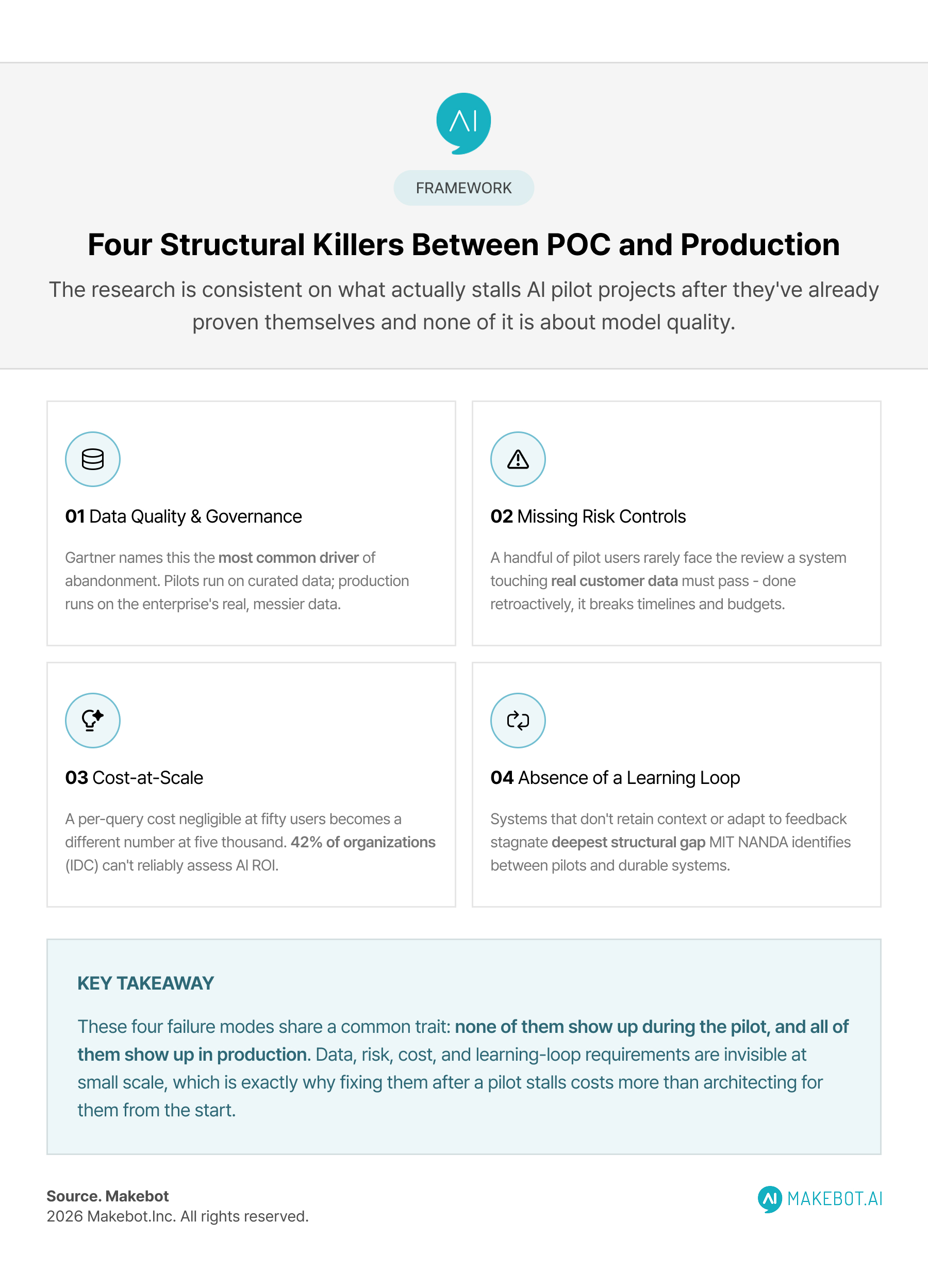
The research is consistent on what actually kills AI pilot projects between POC and production. These four AI implementation challenges are structural, and none of them are about model quality.
- Data quality and governance. Gartner names this as the most common driver of GenAI project abandonment - pilots run on curated, cleaned datasets; production runs on the enterprise's actual data, which is rarely as clean.
- Missing risk controls. A pilot with a handful of test users rarely faces the compliance and security review a system touching real customer data must pass - and that review, done retroactively, is where timelines and budgets break.
- Cost-at-scale. A per-query cost that is negligible at fifty pilot users becomes a materially different number at five thousand production users. IDC research found that 42% of organizations worldwide report that assessing the ROI of their AI investments is difficult or even impossible - a measurement gap that hides exactly this problem until it's a budget crisis.
- The absence of a learning loop. Systems that don't retain context, adapt to feedback, or accumulate institutional knowledge stagnate. MIT NANDA identifies this as the deepest and most common structural gap between pilots and durable production systems.
Gartner Predicts That Agentic AI Will Solve 80 Percent of Customer Problems by 2029. See how enterprises are transforming here!
The Build-vs-Buy Data
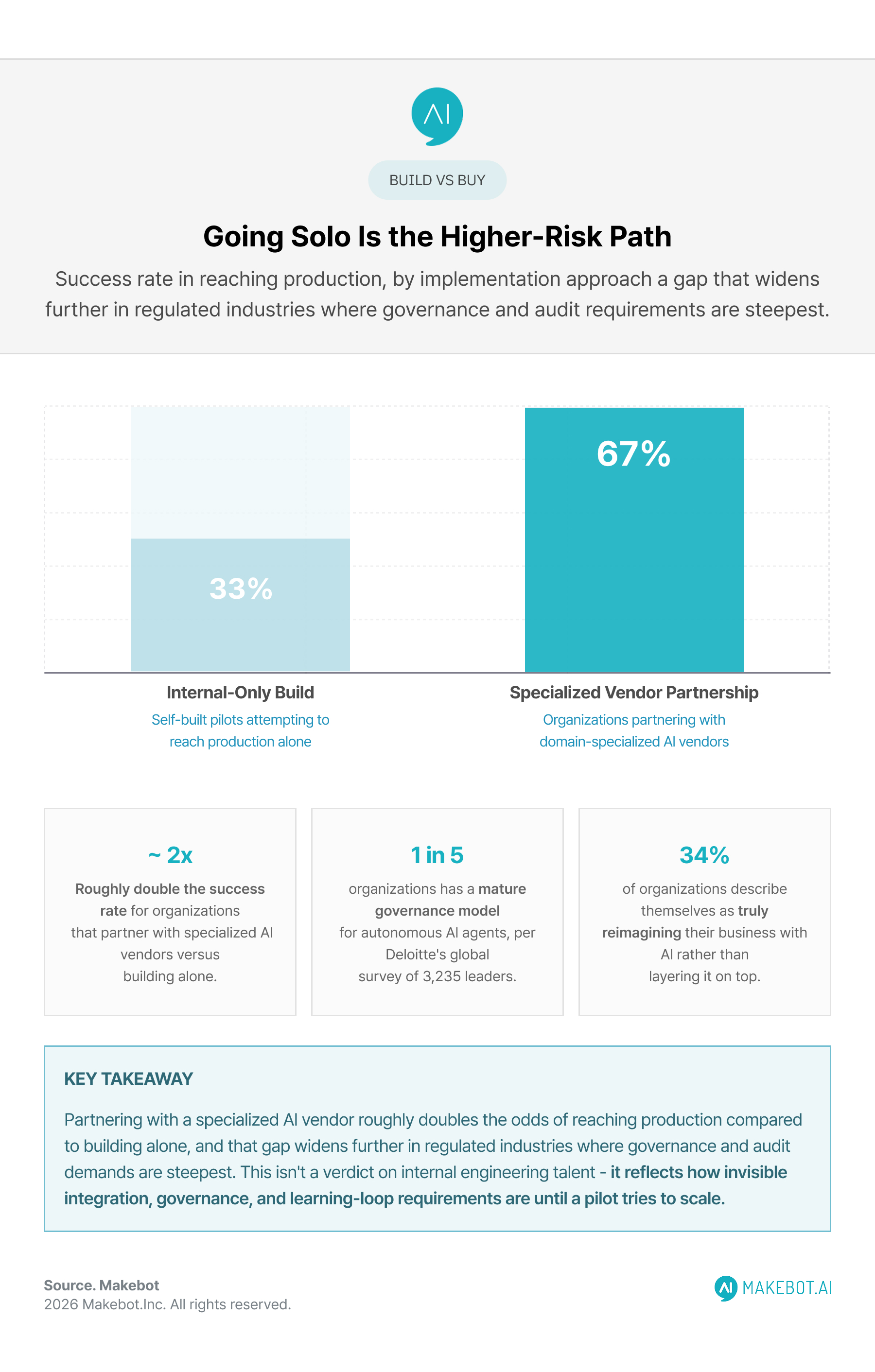
The counterintuitive finding leaders most need to hear: going solo is statistically the higher-risk path for enterprise AI transformation, and the data on this is unusually direct.
MIT NANDA found that organizations partnering with specialized AI vendors succeeded roughly 67% of the time, compared to roughly one-third for internal-only builds - a gap that widens further in regulated industries, where the governance and audit requirements are steepest. Deloitte's most recent State of AI in the Enterprise survey, fielded across 3,235 leaders in 24 countries, found that only 34% of organizations describe themselves as truly reimagining their business with AI, and just one in five has a mature governance model for autonomous AI agents. This is not a verdict on internal engineering talent. It is a statement about infrastructure: internal builds tend to underestimate integration, governance, and the learning loop specifically because those requirements are invisible until a pilot tries to become a production system.
Agentic AI vs Generative AI: Why the Difference Will Define Enterprise Strategy in 2026. Learn how industry leaders are adapting here!
Survivability = Domain Specificity × Workflow Integration
The organizations that cross the divide share a pattern that has little to do with which model they use and everything to do with how they approached the 90% beneath the demo.
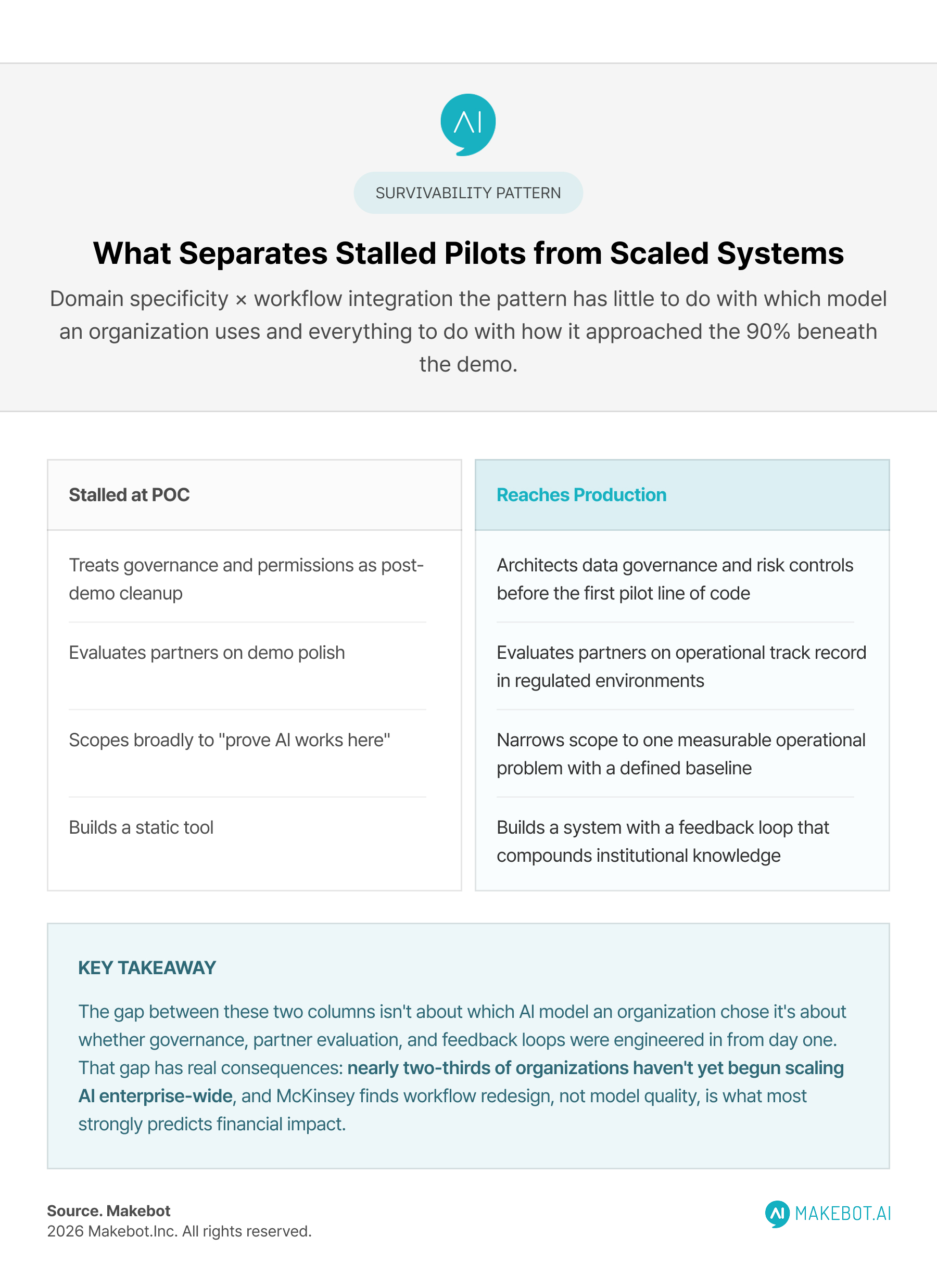
McKinsey's most recent State of AI survey found that nearly two-thirds of organizations have not yet begun scaling AI across the enterprise, even as adoption approaches near-universal levels - a scaling gap, not an adoption gap. The differentiator McKinsey identifies as most strongly correlated with enterprise-level financial impact is workflow redesign: organizations that rebuild the workflow around AI, rather than bolting AI onto an unchanged process, are the ones reporting EBIT impact.
Microsoft CEO Satya Nadella On How AI Is Transforming Organizations, Teams And Leadership. Explore the data and findings here!
So What Do We Do?
The gap between a working pilot and a production system cannot be closed by adding headcount to an existing effort or iterating faster on the same architecture. AI operationalization requires a different starting point, set before the pilot is greenlit rather than after it stalls.
- Define success criteria and data readiness before piloting - not after the demo succeeds. Unclear business value and poor data quality are the two most-cited killers across Gartner's and MIT's research.
- Architect governance and risk controls from day one. Retrofitting compliance onto a system built for a demo consistently costs more than building it in from the start.
- Model cost-at-scale before committing budget. A pilot's economics rarely predict production economics; IDC's finding that 42% of organizations can't reliably assess AI ROI is itself a warning sign to correct early.
- Evaluate partners on survivability data, not sales decks. MIT NANDA's finding that specialized partnerships succeed at roughly double the rate of internal builds is a risk-allocation data point every CIO can use in a build-vs-buy decision.
This is hard to get right alone - and the organizations attempting it alone are disproportionately represented in the 95% MIT NANDA documents as delivering no measurable impact. Makebot has engineered exactly this shape of problem across 1,000+ enterprises in finance, public sector, and healthcare: a HybridRAG-powered knowledge and governance loop, deployed in closed networks with permission-aware search and audit-grade logging, built to compound organizational knowledge rather than reset it with every session. The infrastructure question isn't whether your pilot can work - it already has. It's whether you have a system engineered to survive contact with production, or a partner who already does.
Showcasing Korea’s AI Innovation: Makebot’s HybridRAG Framework Presented at SIGIR 2025 in Italy. Read here!
The gap between a successful pilot and a production system is structural — and it is solvable. Makebot has solved it across 1,000+ enterprises in healthcare, finance, and the public sector, deploying HybridRAG-powered knowledge systems with permission-aware search, closed-network operation, and audit-grade logging built in from day one — not retrofitted after the demo.










.jpg)

What Happens to Marketing When the C-Suite Starts Using AI Every Day?







Why AI Shopping Assistants Will Replace Traditional Ecommerce Search






.jpg)
























Why Generative AI Projects Fail and How to Achieve Scalable AI Success











.jpg)

.png)