Why Hospital Knowledge Is Still Trapped in PDFs-and How Enterprise AI Changes That
80% of hospital data is trapped in PDFs - enterprise RAG is the bridge physicians can't wait for.


Introduction
Walk into the health information management office of almost any hospital and you'll find the same paradox: petabytes of clinical intelligence, most of it unreachable. Discharge summaries, policy binders, credentialing files, and infection-control protocols exist, but as scanned PDFs, fax remnants, and static documents that no search bar can meaningfully parse. This isn't a technology gap from decades past-it's the default state of hospital knowledge today, even as generative AI reshapes other industries. The result is measurable: clinicians burn hours hunting for answers that already exist somewhere in the building. This article examines why hospital knowledge management has lagged, what the latest enterprise AI adoption data reveals about closing that gap, and which organizational and technical factors separate health systems capturing real ROI from those still stuck in pilot purgatory.
New Studies Show AI Can Improve Medication Safety by Detecting Prescription Risks Earlier. Explore the latest insights here!
The Hidden Cost of Hospital Knowledge Trapped in PDFs
Healthcare doesn't have a data shortage-it has a data accessibility shortage. Industry research from IDC puts the share of unstructured healthcare information at roughly 80%, spanning typed notes, scanned forms, radiology images, and PDFs that were never designed to be searched, only stored. That imbalance compounds daily: a single health system can generate tens of petabytes of clinical and operational data, but most of it sits outside any system capable of answering a plain-language question.
The clinical cost is well documented. AMA Organizational Biopsy data shows physicians average 57.8 hours of work per week, yet only 27.2 hours go to direct patient care-with 13 hours consumed by indirect care tasks like documentation and order entry, and 7.3 hours by pure administrative burden. This isn't a staffing problem alone; it's a hospital knowledge management problem. When policy documents, protocols, and prior clinical context exist only as static PDFs scattered across shared drives and legacy portals, every clinician re-solves the same retrieval problem dozens of times a day.
- 80% of healthcare data is unstructured and effectively unsearchable (IDC).
- 20.9% of physicians still spend 8+ hours weekly on EHR work after hours-unchanged since 2022 (AMA).
- Healthcare data breaches now average $7.42 million per incident, the costliest of any industry for 14 consecutive years, citing IBM's 2025 Cost of a Data Breach Report, a risk that grows when knowledge lives in ungoverned files rather than access-controlled systems.
Can AI Health Assistants Reduce Unnecessary Clinic Visits? What Early Data Suggests. Continue reading here!
Why Generative AI in Healthcare Alone Isn't Enough
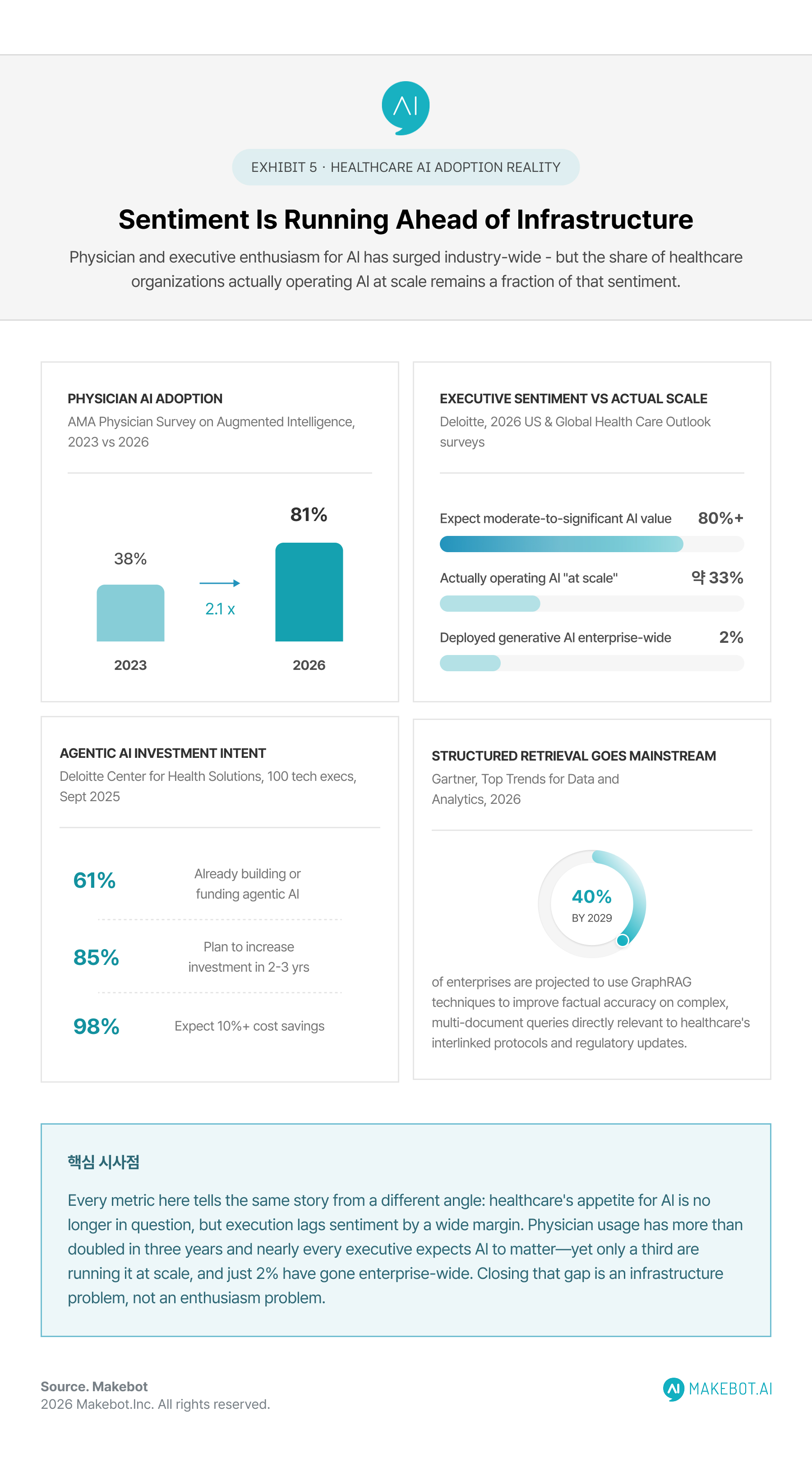
Generative AI in healthcare has moved from novelty to expectation almost overnight. The AMA's 2026 Physician Survey on Augmented Intelligence found that 81% of physicians now use AI professionally, more than double the 38% recorded when the AMA first asked in 2023. Deloitte's 2026 US Health Care Outlook Survey-which polled 120 C-suite executives across health plans and health systems-found a similar shift in sentiment: more than 80% expect both generative and agentic AI to deliver moderate-to-significant value this year, even though only about a third of those same organizations report using AI at scale.
Sentiment is running ahead of infrastructure elsewhere in the industry too. Deloitte's broader 2026 Global Health Care Outlook, which surveyed health systems across the United States and other countries, found that only about 30% currently operate generative AI at scale in select areas, and just 2% have deployed it enterprise-wide. A healthcare LLM that can write fluent text is not the same as one that can correctly answer "what's our current sepsis escalation protocol," because that answer depends on retrieving the right, current, institution-specific PDF-something a general-purpose model was never trained to do reliably. This is precisely the failure mode MIT's Project NANDA identified across industries: generic AI tools excel at flexible, individual tasks but stall inside enterprise workflows because they don't retain institutional context or adapt to how the organization actually operates.
1 in 7 People Have Used AI Instead of Seeing a Health Provider, Study Finds. Discover more here!
RAG in Healthcare: How Enterprise RAG Turns PDFs into Answers
This is where RAG in healthcare-retrieval-augmented generation-changes the equation. Rather than relying on a model's frozen training data, RAG architectures retrieve relevant passages from an organization's own documents at the moment of the query, then generate an answer grounded in that retrieved content. For a hospital, that means a healthcare AI chatbot can pull the exact paragraph from the current infection-control policy PDF instead of guessing from outdated general knowledge.
Gartner now frames this category-enterprise AI search-as a foundational layer for AI assistants and agents, describing these platforms as tools that "enable retrieval and synthesis of information across enterprise repositories" so people and machines can act on it. Gartner further projects that 40% of enterprises will use GraphRAG techniques by 2029 to improve factual accuracy on complex, interconnected queries-directly relevant to healthcare, where a single clinical question often depends on multiple linked documents (a protocol, an amendment, a regulatory update).
What makes enterprise RAG distinct from consumer chatbot use is governance:
- Source grounding - every answer traces back to a specific, versioned document rather than model memory.
- Access control - retrieval respects role-based permissions, critical in a HIPAA-governed environment.
- Freshness - when a policy PDF updates, the retrieval index updates, instead of waiting on a model retrain.
- Auditability - because outputs cite sources, compliance and quality teams can verify claims after the fact.
Stanford's MedAgentBench: Why Healthcare AI Agents Still Struggle in Real Clinical Workflows. Read here!
From Enterprise Healthcare AI Pilots to Measurable ROI
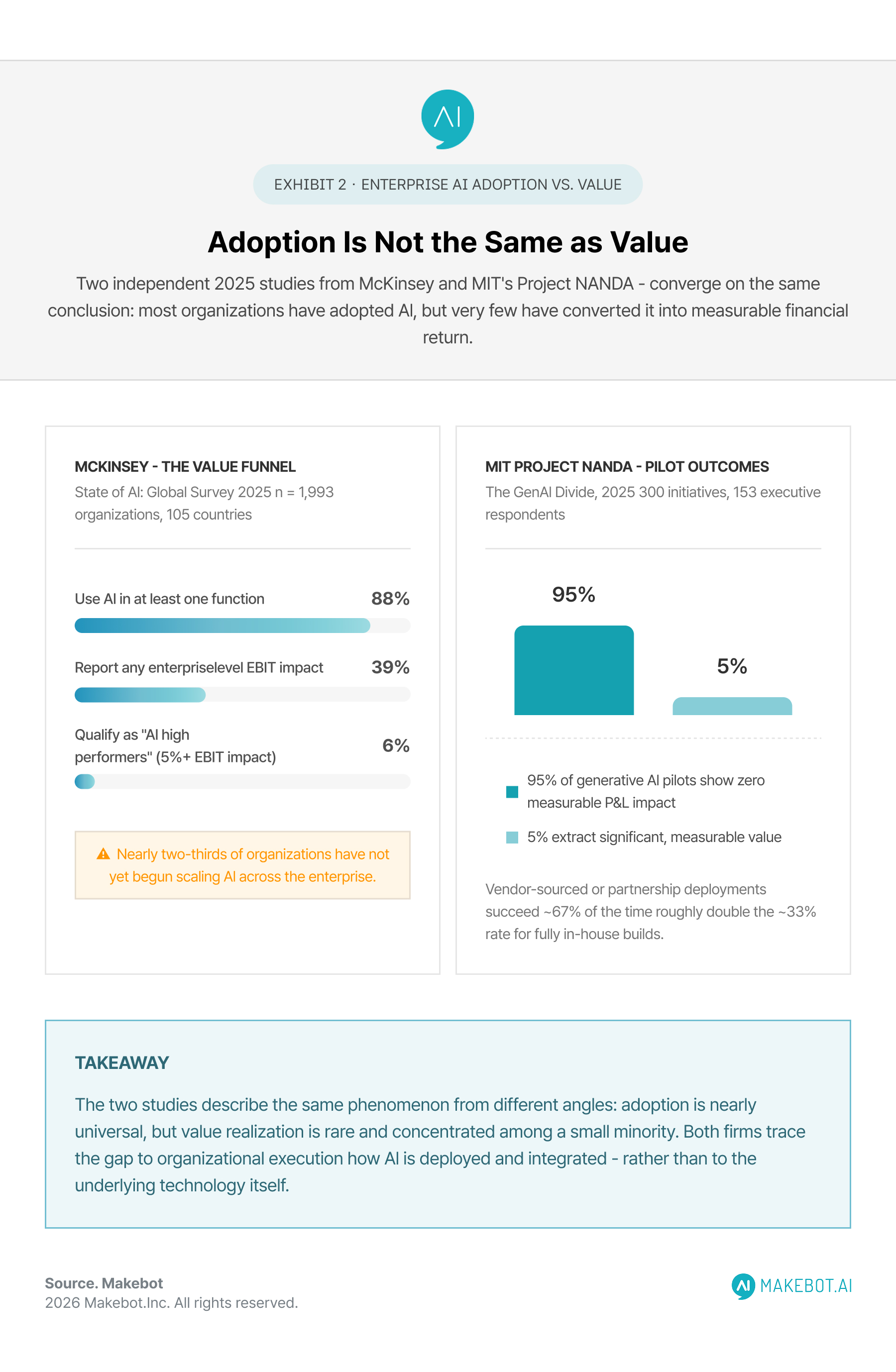
The macro data on AI investment is a useful reality check for any hospital IT leader building a business case. McKinsey's 2025 State of AI survey-1,993 respondents across 105 countries-found that 88% of organizations use AI in at least one business function, up from 78% a year earlier. Yet only 39% report any enterprise-level EBIT impact, and just 6% qualify as "AI high performers" achieving more than 5% EBIT impact. Nearly two-thirds remain stuck running pilots that never scale.
MIT's Project NANDA data is more stark still: across 300 public AI deployments and 153 executive surveys, 95% of generative AI pilots showed zero measurable P&L impact, while just 5% extracted significant value. Notably, the same report found that organizations buying from specialized vendors and forming partnerships succeeded roughly 67% of the time, compared with ~33% for organizations building generative AI systems entirely in-house-a finding with direct relevance for hospitals weighing build-versus-buy decisions on enterprise healthcare AI.
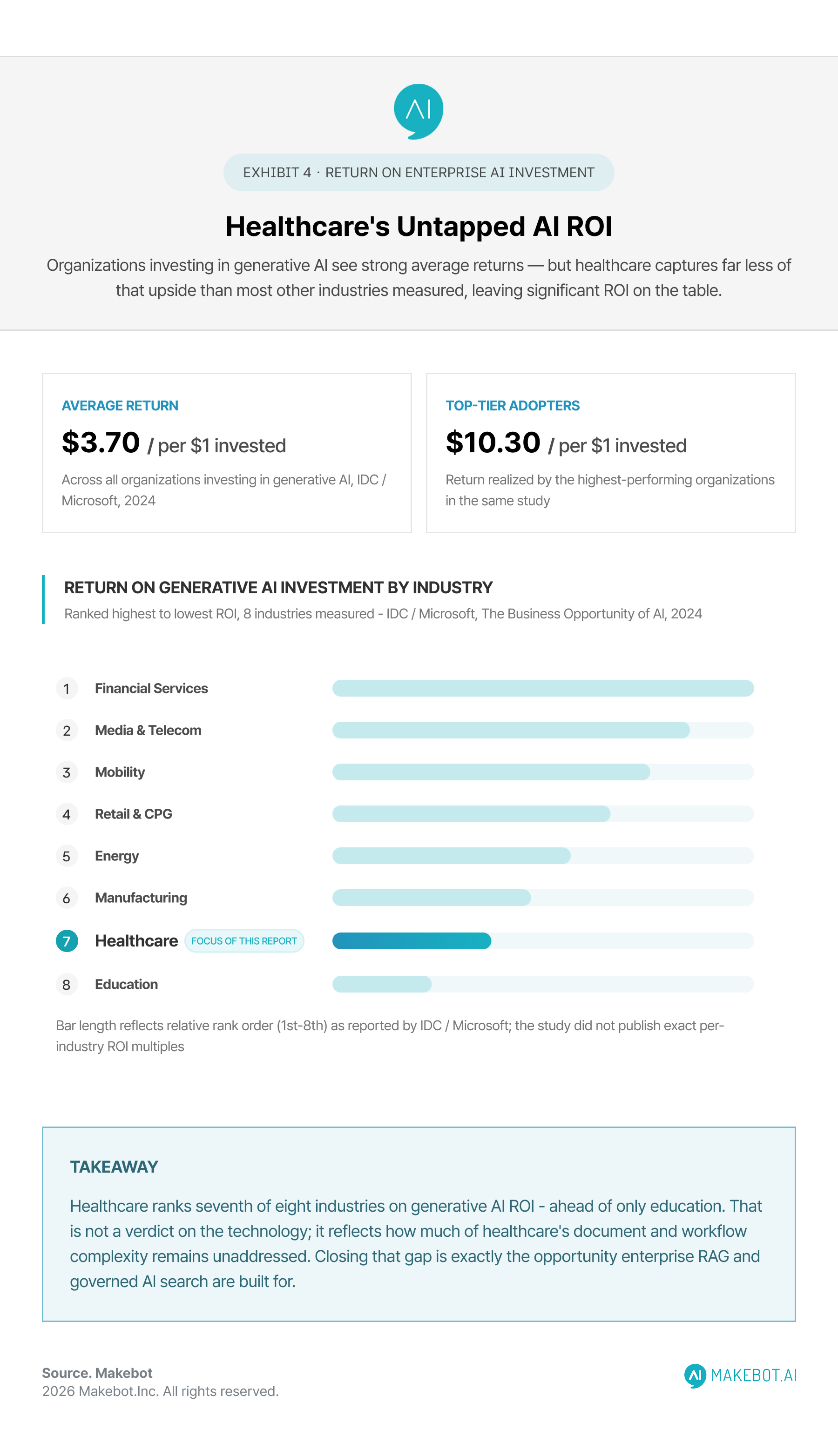
On the positive side, IDC's Microsoft-sponsored Business Opportunity of AI study-based on more than 4,000 business leader interviews-found organizations investing in generative AI see an average $3.70 return for every $1 spent, with top-tier adopters realizing $10.30. Healthcare ranked seventh of the eight industries IDC measured, trailing financial services, media & telecom, mobility, retail & consumer packaged goods, energy, and manufacturing, and ahead of only education-a clear signal that most of the ROI upside in clinical and administrative document workflows is still untapped.
Philips Survey: Most Clinicians Use AI but Lack Formal Training. Learn more here!
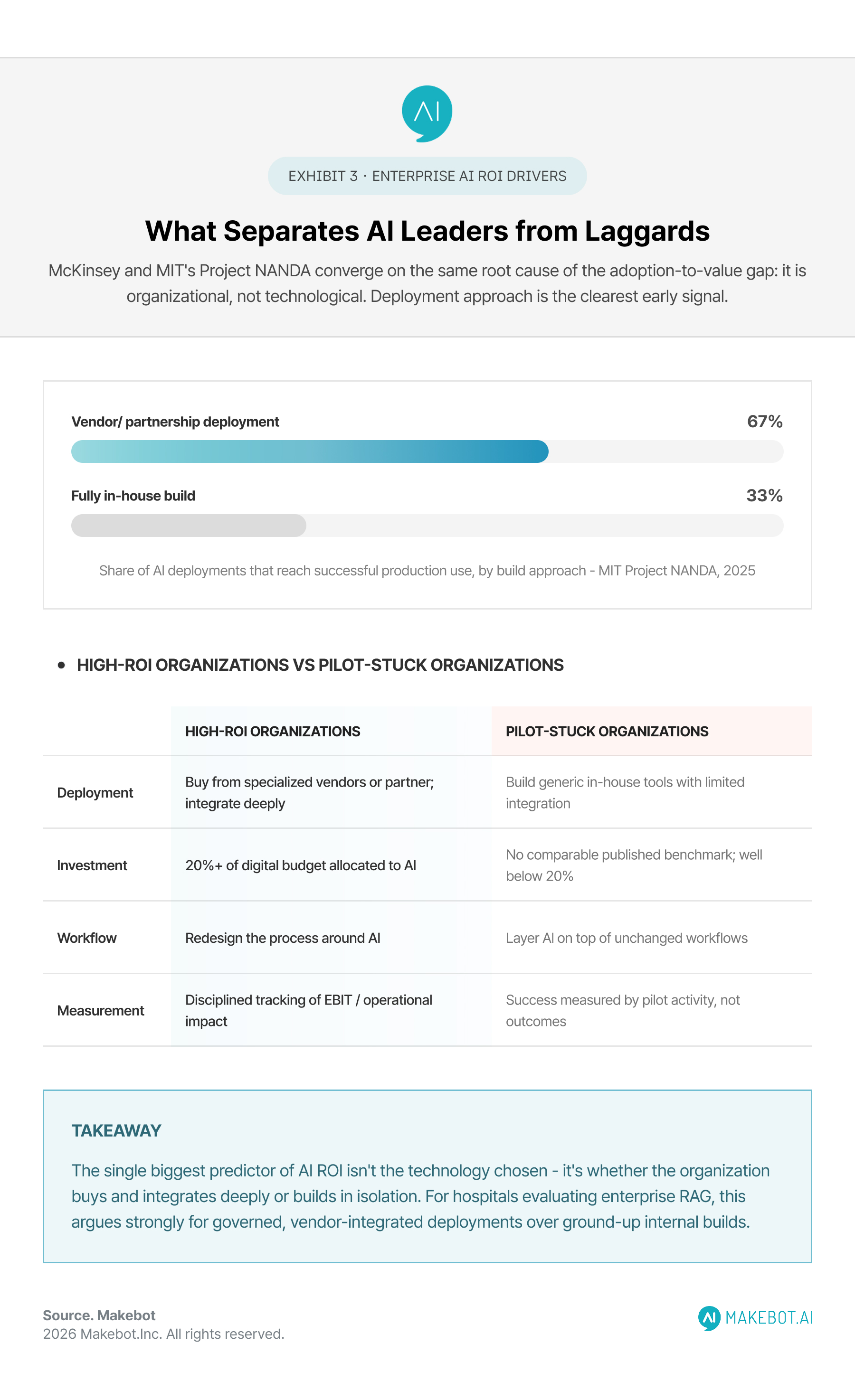
What Separates High-ROI Hospitals From Those Stuck in Pilot Purgatory
Both McKinsey and MIT converge on the same root explanation: the gap between AI adoption and AI value is organizational, not technological. High performers redesign workflows around AI rather than bolting a chatbot onto an unchanged process; laggards treat AI as a feature request.
For hospitals specifically, this plays out in the choice between deploying a narrow healthcare AI chatbot bolted onto an existing intranet versus building a governed healthcare enterprise search layer that spans policy repositories, credentialing files, EHR documentation, and knowledge bases-then measuring time-to-answer and downstream clinical or administrative outcomes.
Why Healthcare AI Governance Matters More as Models Become More Powerful. Explore the full article here!
Building an AI-Powered Hospital Knowledge Search Strategy
Translating the research into practice means treating AI-powered hospital knowledge search as infrastructure, not a single chatbot project. Health systems making real progress tend to follow a consistent sequence:
- Inventory and structure the PDF backlog - classify policies, protocols, and forms by department, sensitivity, and update frequency before indexing them.
- Choose enterprise RAG over a general chatbot - ground every answer in current, versioned institutional documents rather than a static model.
- Build in clinical and compliance review loops - especially for anything touching patient safety, treat AI output as a draft requiring sign-off, not a final answer.
- Start with a high-friction, low-risk use case - administrative policy lookup, credentialing status, or supply-chain documentation tend to show ROI faster than clinical decision support.
- Measure time-to-answer and staff hours reclaimed, not just adoption or usage counts, to avoid mistaking activity for value.
Showcasing Korea’s AI Innovation: Makebot’s HybridRAG Framework Presented at SIGIR 2025 in Italy. Read here!
The Road Ahead: AI in Hospitals as Infrastructure, Not Innovation Theater
The direction of travel is no longer in question. A third, distinct Deloitte survey-of 100 health care technology executives across 50 health systems and 50 health plans, fielded in September 2025-found 61% are already building or funding agentic AI initiatives, and 85% plan to increase that investment over the next two to three years, with 98% expecting at least 10% cost savings from it. The organizations that convert that spending into results will be the ones that stop treating AI in hospitals as a pilot to showcase and start treating it as the connective layer between locked PDFs and the people who need what's inside them. That shift-from experimentation to infrastructure-is the same one separating McKinsey's 6% of high performers and MIT's 5% of successful pilots from everyone else. For hospitals, the prize isn't a flashier chatbot; it's a workforce that stops re-discovering knowledge the institution already has.






.jpg)


What Happens to Marketing When the C-Suite Starts Using AI Every Day?







Why AI Shopping Assistants Will Replace Traditional Ecommerce Search





.jpg)

























Why Generative AI Projects Fail and How to Achieve Scalable AI Success











.jpg)

.png)