Anthropic's New Commerce Blueprint Signals the Next Phase of Agentic Commerce
Anthropic's commerce blueprint targets $5T in redirected retail spend. Only 6% of firms profit.

Key Takeaways
- In September 2026, Anthropic released a blueprint that gives companies ready-made AI agents for shopping and store management, built on its Claude model, with Accenture, Mastercard, and Visa as named launch partners.
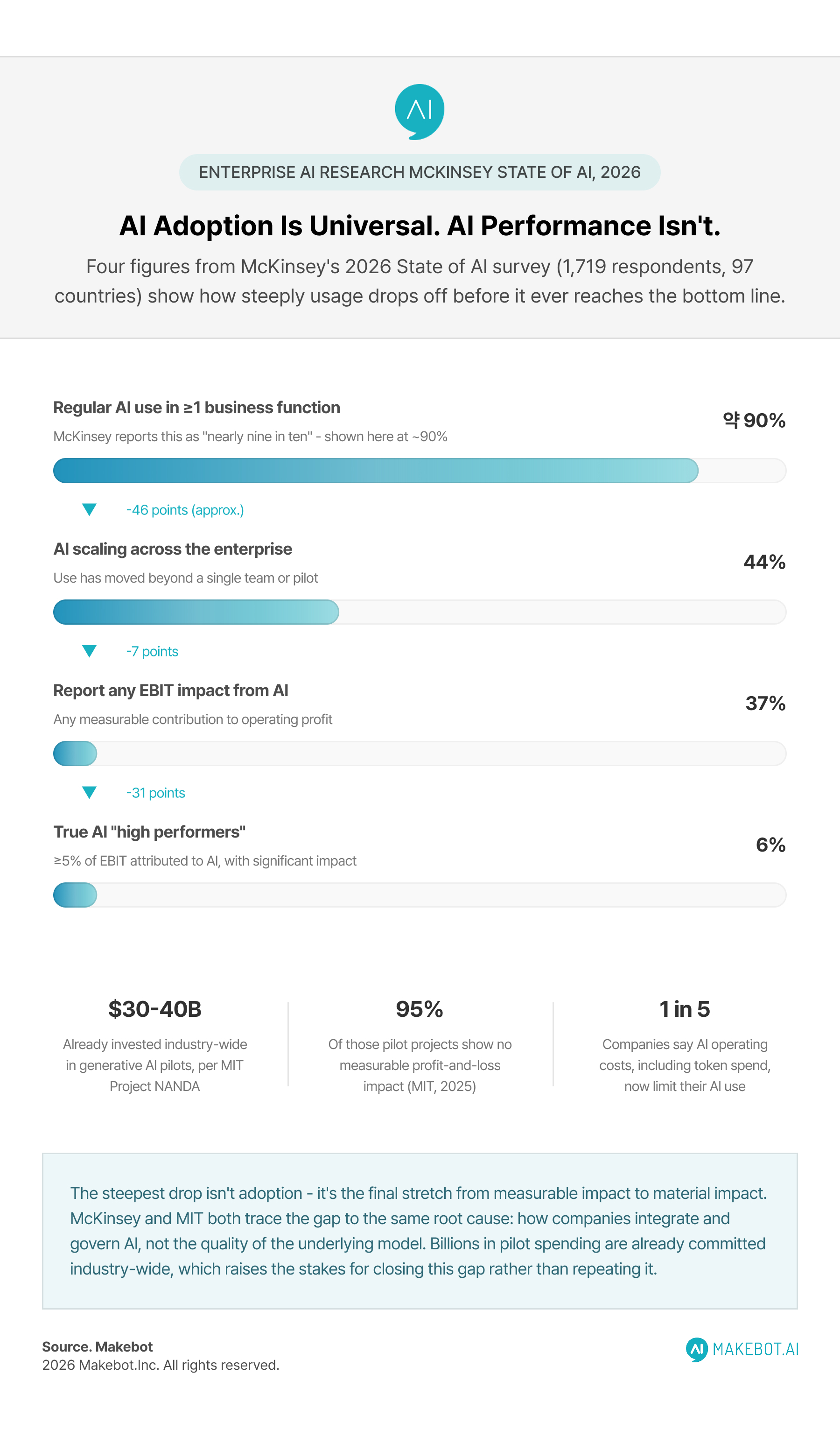
- Companies are spending more on AI than ever, but the payoff is not keeping up. McKinsey's 2026 State of AI survey found that only 37 percent of companies report any real profit impact from AI, and just 6 percent count as true "high performers."
- MIT research says the problem may be even bigger. About 95 percent of company AI test projects fail to bring in measurable financial gains, mostly because of how companies use the tools, not because the tools themselves are weak.
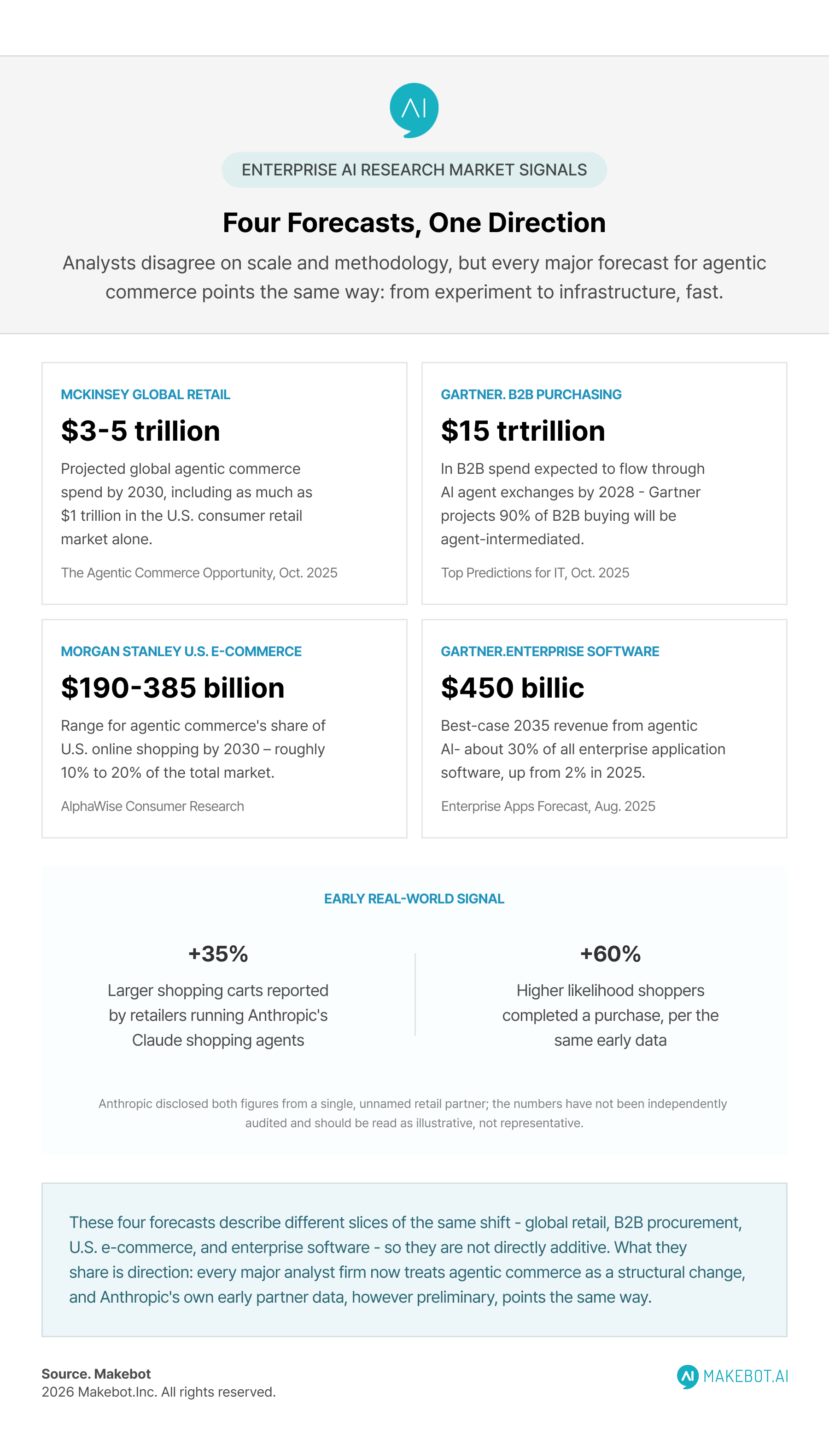
- Analysts think agentic commerce, meaning AI agents that shop or negotiate deals on a person's behalf, could redirect 3 trillion to 5 trillion dollars in global retail spending by 2030, while Gartner expects AI agents to handle 15 trillion dollars in business purchases by 2028.
- What actually separates winners from everyone else is not the AI model. It is deep system connections, pairing in-house staff with outside experts, and fixing basics like checkout and identity verification, which is exactly where Anthropic's blueprint places its bets.
Why Anthropic Released This Blueprint Now
Anthropic did not launch a new AI model on September 2, 2026. It launched a ready-to-use framework for building shopping and store-management agents on Claude, a starter kit that skips months of build work and gets an agent live in days. The timing lines up with the holiday season and a wave of AI shopping agents reshaping how people find products. Named partners Accenture, Mastercard, and Visa are bringing it to their clients, while Shopify already runs live shopping agents on Claude, showing where Anthropic sees the real work: catalogs, payments, and identity.
What Is Actually Inside the Blueprint
The release centers on two separate Anthropic commerce agents, each solving a different problem rather than one chatbot doing everything.
- Shopper agent. Lives inside a retailer's app or website, searches the catalog, builds a cart, and hands off to checkout without completing the purchase itself.
- Merchant agent. Built for store staff, not customers, it flags pricing or marketing moves that a human must approve.
- Working examples, free to copy. Anthropic shipped both for four industries: retail, travel, telecom, and entertainment, runnable through the Claude API, Amazon Bedrock, Microsoft Foundry, or Google Cloud Vertex AI, with the code under an Apache 2.0 license any company can reuse for free.
Anthropic also claims carts up to 35 percent larger and 60 percent higher completion, though that came from one unnamed retail partner and is unverified, one example of commerce AI agents, not a guarantee.
The Bigger Problem: Companies Are Spending More on AI Than They Are Getting Back
Anthropic's blueprint lands inside a real problem: companies keep spending more on AI, but profit is not keeping pace. McKinsey's 2026 survey shows belief in AI outrunning the money it brings in.
- Almost nine in ten companies now use AI regularly somewhere in the business, and 44 percent say it has spread company-wide, up from 38 percent last year.
- Only 37 percent say AI has made a real dent in profit, and just 6 percent count as true "high performers," meaning a profit lift of 5 percent or more.
- Twenty-eight percent now spend over a tenth of their tech budget on AI, and 60 percent plan to spend more next year.
MIT Project NANDA tells a harsher story: despite 30 to 40 billion dollars spent on generative AI, its GenAI Divide report found roughly 95 percent of pilot projects never produced a real financial return, a gap researchers blame on setup, not weak models. That figure comes from an early research note, and some analysts have pushed back on its precision.
Why Some Companies Get Much More Out of AI Than Others
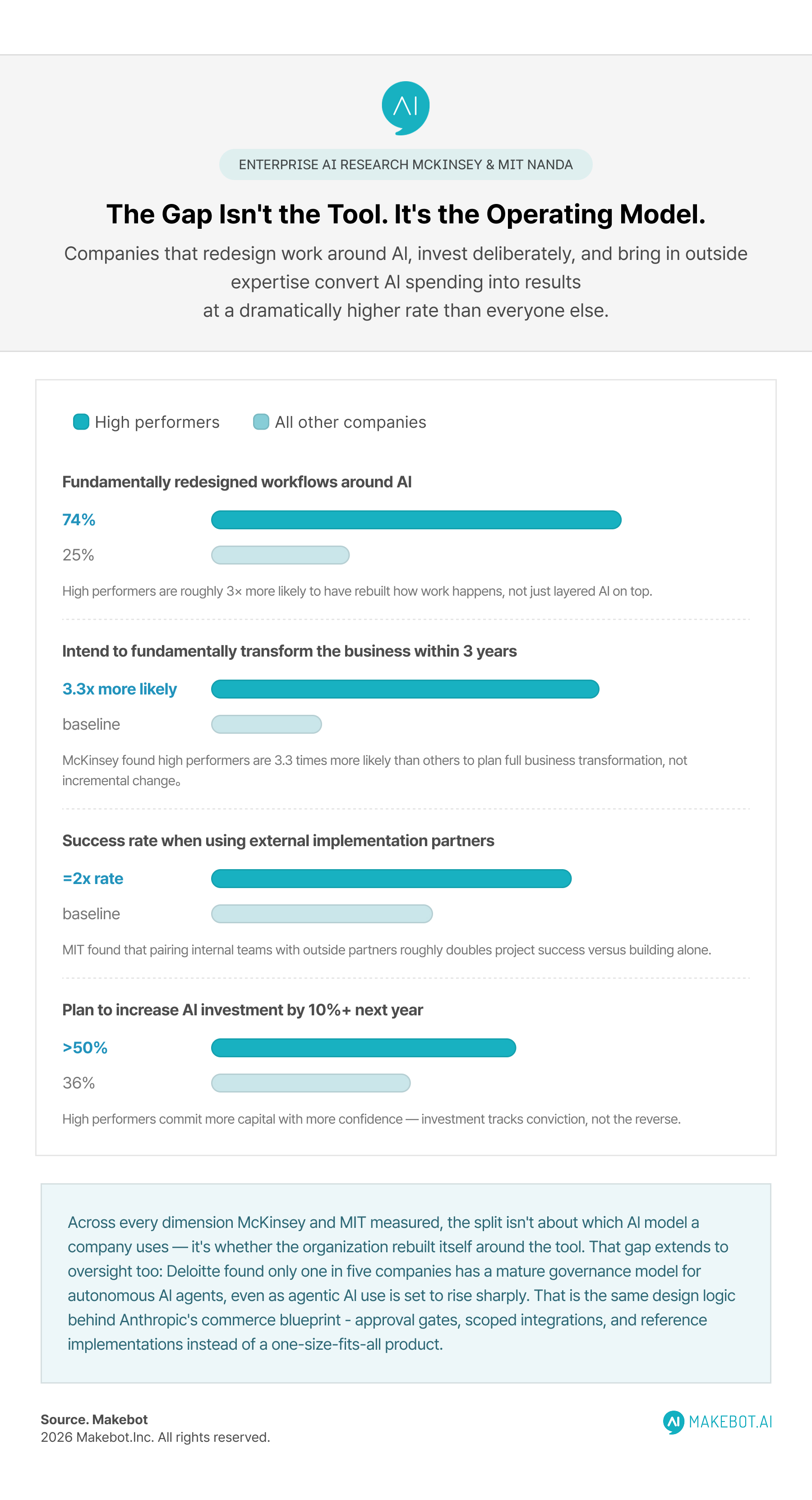
The gap between AI's promise and its payoff is not spread evenly. McKinsey and MIT point to the same few habits separating winners, whether the tool is basic generative AI in e-commerce or a specialized shopping agent.
Technically, the difference is how deeply a tool connects to the business, not which model runs it. MIT found tools without memory fail once they leave the demo stage, and that pairing in-house staff with outside experts roughly doubles the success rate of building alone. Checkout, identity checks, and catalogs decide whether a solid agent converts browsers into buyers.
Organizationally, the gap is wider still. High performers are 3.3 times more likely to plan a full transformation within three years, show clear measurement roughly twice as often, and pursue growth alongside efficiency rather than just cost-cutting. They also more actively guard against AI-specific risks, exactly what Anthropic's merchant agent blocks with human sign-off.
How Big Could Agentic Commerce Actually Get
Every forecast disagrees on the number but agrees on direction: AI-powered commerce is moving from experiment to infrastructure.
- McKinsey estimates up to 1 trillion dollars in United States retail by 2030, and 3 to 5 trillion globally.
- Gartner forecasts 90 percent of B2B purchases running through AI agents by 2028, moving over 15 trillion dollars.
- Morgan Stanley projects 190 to 385 billion dollars in United States online shopping by 2030, roughly 10 to 20 percent of the market, while Gartner's best case puts AI agents at about 30 percent of business software revenue by 2035, up from about 2 percent today.
These numbers explain why Anthropic and its rivals want the infrastructure behind AI product discovery before the market matures.
The Problems Nobody Has Fully Solved Yet
Excitement runs into a messier reality, with structural problems showing up repeatedly.
- Checkout and identity were not built for agents, so conversation-started purchases likely convert differently than referral links.
- Shoppers may not fully trust this yet. Some are not comfortable letting an AI agent handle purchases, which could limit near-term volume.
- Cost and oversight lag behind. About one in five say running costs already limit their AI use, and only one in five has mature governance for autonomous agents, which matters for merchant agents proposing pricing changes.
High Performers Compared to Struggling Companies
The two groups differ on nearly every measure that matters. About 74 percent of high performers have rebuilt workflows around AI, against about 25 percent of struggling companies, and they chase growth and new ideas rather than just cutting costs. High performers mix their own staff with outside experts at about twice the success rate of companies building alone, and guard more actively against agent-specific risks. On spending, they put over 15 percent of their tech budget into AI, and over half plan to spend more, while struggling companies rarely reach 15 percent and only 36 percent plan to increase. This mirrors choices already in Anthropic's blueprint that separate companies that turn AI spending into real results from those that do not.
What This Means If You Are the One Making the Decision
For companies evaluating AI shopping assistants or store-staff tools, the research points to a few practical steps.
- Treat a shopping agent as a systems-integration project, not a model contest: clean data and working checkout matter more than which AI runs the conversation.
- Pair engineers with outside partners who have already built these agents, given the gap MIT found, and decide how to measure profit impact before launch.
- Treat vendor-published numbers, including Anthropic's own cart-size claims, as one example, not a guarantee.
The Bottom Line
Anthropic's commerce blueprint reads less like a product launch and more like a statement of where it thinks this is heading, betting its tools become the foundation others build on. That bet is well timed but not risk-free. Almost every company now uses AI, yet the share turning that use into real profit has barely budged in a year. Companies pulling ahead are not simply using more AI agents; they rebuild how work happens around them. For any company deciding whether to build AI agents for retail on Claude's blueprint, the technology is the easier half of the problem. The harder half is how it organizes around it.
Ready to move past the pilot stage? Makebot helps enterprises design, deploy, and scale production-grade AI agents for retail, healthcare, and customer engagement. Explore what that looks like at Makebot.



.png)







.jpg)


What Happens to Marketing When the C-Suite Starts Using AI Every Day?







Why AI Shopping Assistants Will Replace Traditional Ecommerce Search






.jpg)

























Why Generative AI Projects Fail and How to Achieve Scalable AI Success











.jpg)

.png)