How AI Scheduling and Capacity Agents Became Hospitals' Highest-ROI Investment
AI scheduling lifts staff occupancy 15%. McKinsey and Harvard put the hospital payoff at $120B.

Key Takeaways
- Hospitals could save $60 billion to $120 billion a year, part of a $200 billion to $360 billion opportunity across the whole healthcare system, according to a joint McKinsey and Harvard study. Scheduling and capacity work is one of the two biggest reasons why.
- AI scheduling tools have boosted staff occupancy rates by 10 to 15 percent in healthcare contact centers, according to McKinsey, a real, measurable gain in how existing staff time gets used.
- Only 18 percent of "AI scaler" health systems, meaning systems that have already rolled AI out widely, say they can reliably track its financial return, according to Deloitte's 2026 survey.
- A handful of health systems already have solid numbers to show for it, including Mount Sinai, CommonSpirit Health, and Boston Children's Hospital. What they share is a clear baseline set before they scale anything up.
- Hospitals that buy proven AI tools instead of building their own succeed about twice as often as those that try to build everything in-house, based on MIT's 2025 research.
Introduction
For three years, hospital finance leaders heard that generative AI would change healthcare forever. Most are still waiting for it to show up in their budgets. A 2026 Deloitte survey of health system finance chiefs found that fewer than one in five organizations scaling up AI can show, with real numbers, how much value it added, even as organizational AI adoption has climbed to 88 percent worldwide, per Stanford's 2026 AI Index.
One category keeps beating that trend: AI scheduling and capacity management. Unlike diagnostic tools, capacity agents tackle a problem every hospital measures in dollars: empty beds, unused operating rooms, and patients waiting in hallways. This article looks at the verified data behind why hospital capacity management and AI scheduling in healthcare have quietly become the safest bet in hospital AI spending.
The Hospital Capacity Problem
Hospital capacity is a math problem now, not just a staffing one. ER patients wait longer for a bed, discharges get delayed, and ORs sit unused, all at once, every day. For years, the fix was hiring more coordinators. That has hit a wall: staff shortages, burnout, and rising costs mean most hospitals cannot hire their way out of a capacity crunch anymore. Administrative work alone eats up roughly a quarter of the more than $4 trillion the U.S. spends on healthcare yearly, per McKinsey.
This is where AI hospital operations tools prove their worth: scheduling work is repetitive, rule-based, and data-heavy, exactly what AI handles well. A bed either turns over faster, or it does not.
- Bed turnover and ER boarding are among the most visible failure points in patient care, both tracing back to poor scheduling and slow discharge timing.
- Unused operating room time shows up repeatedly in McKinsey and Harvard's cost analysis. One hospital's ORs looked fully booked on paper, but actual use was only 60 percent; AI scheduling raised open OR time by 30 percent.
- Administrative costs, roughly a quarter of all U.S. healthcare spending, give scheduling automation a bigger pool of savings than narrower clinical AI tools.
Why AI Scheduling Agents Are Different
Old scheduling software just follows rules a person wrote. AI agents in healthcare predict demand, weigh several needs at once (staffing, equipment, patient severity, work-hour limits), and keep adjusting as conditions change, instead of waiting for a manual update.
That matters for the bottom line. McKinsey found that AI-optimized schedules increased staff occupancy rates by 10 to 15 percent in areas like contact centers, a smaller slice of hospital work than bedside care, but a clear sign of the gain AI scheduling can create. A 2026 peer-reviewed study of hospital command centers combining AI with Lean methods found gains equal to more than 30 extra beds, with no new construction.
Cleveland Clinic's Virtual Command Center shows this in practice: Hospital 360 forecasts capacity in real time, Staffing Matrix matches staffing to predicted demand, and OR Stewardship spots unused surgical time. None of it is experimental; it runs daily, which is part of why hospital scheduling automation has matured faster than flashier clinical AI tools.
The ROI Numbers
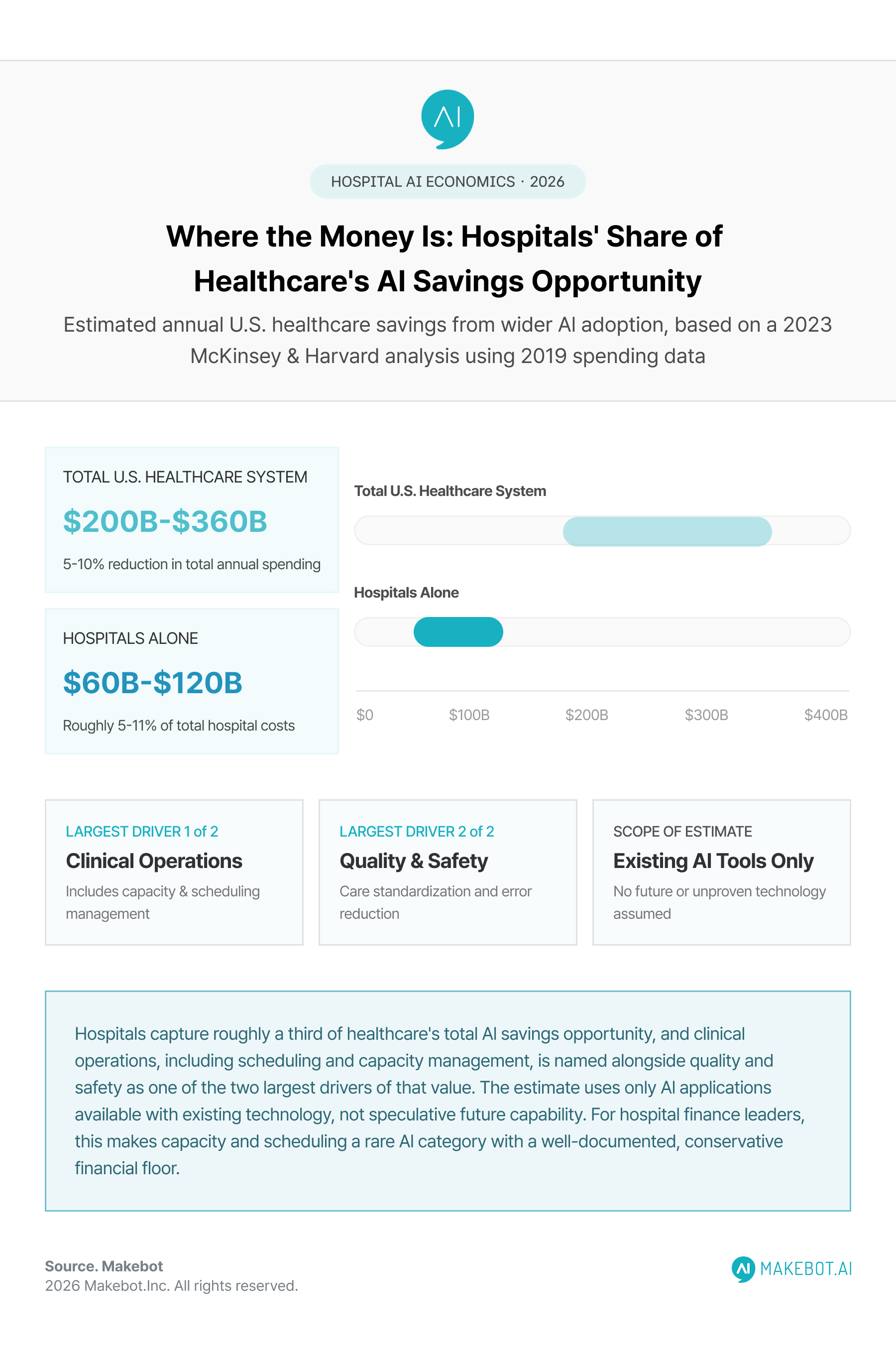
The financial case for AI capacity management rests on carefully checked figures. McKinsey and Harvard researchers estimated, in a 2023 study based on 2019 spending, that wider AI use could save the U.S. healthcare system $200 billion to $360 billion a year. Hospitals alone could save $60 billion to $120 billion a year, roughly 5 to 11 percent of their costs, with clinical operations, including scheduling, named among the two biggest drivers.
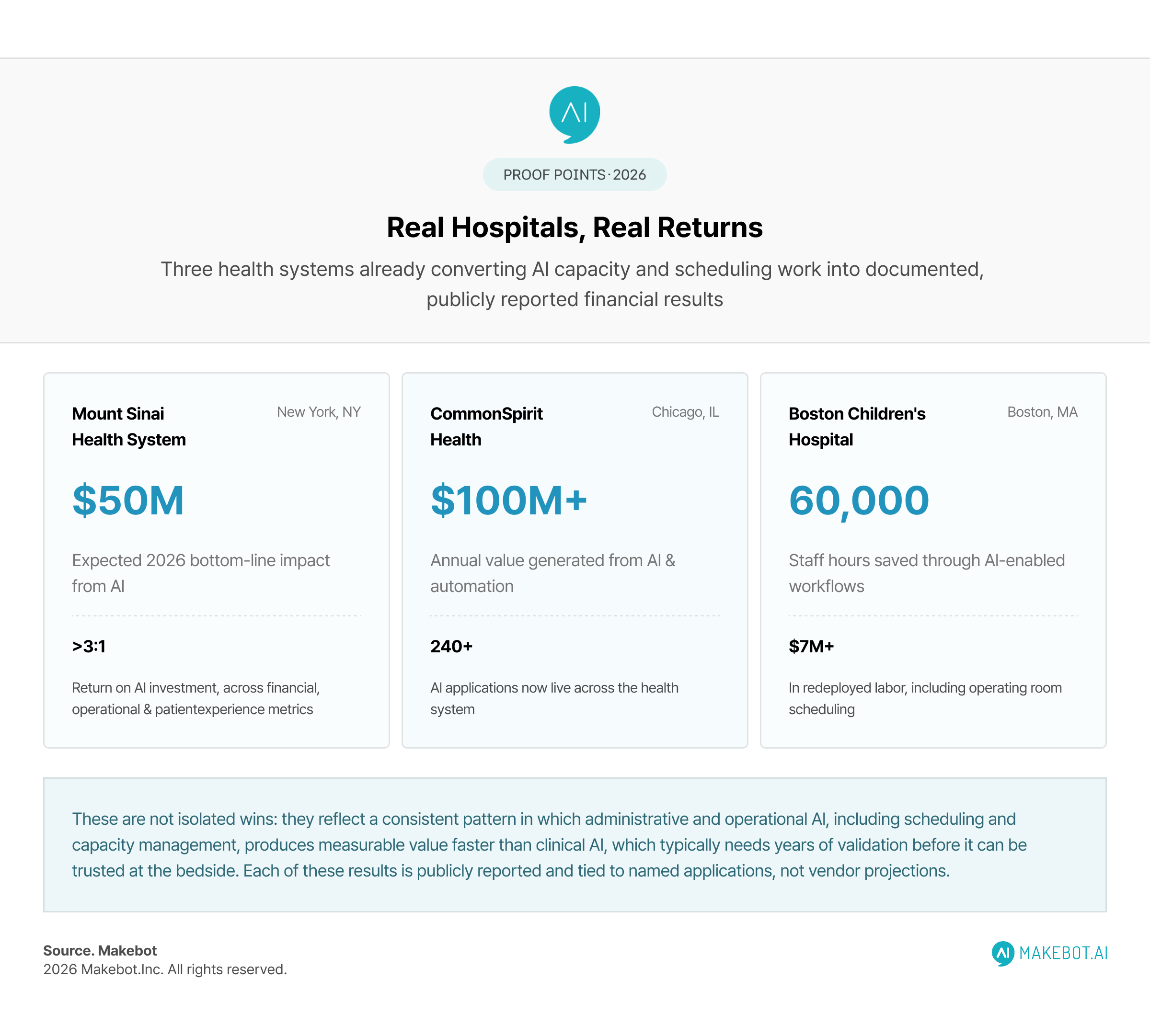
Real hospitals prove this out:
- Mount Sinai Health System expects about $50 million in bottom-line impact from AI in 2026, a return over 3 to 1.
- CommonSpirit Health has generated more than $100 million a year across more than 240 AI applications.
- Boston Children's Hospital has saved roughly 60,000 staff hours, worth more than $7 million, through AI work that includes operating room scheduling.
These are not one-off wins. Operational AI delivers value faster than clinical AI, which needs years of testing before doctors trust it.
Why Some Hospitals Win and Others Do Not
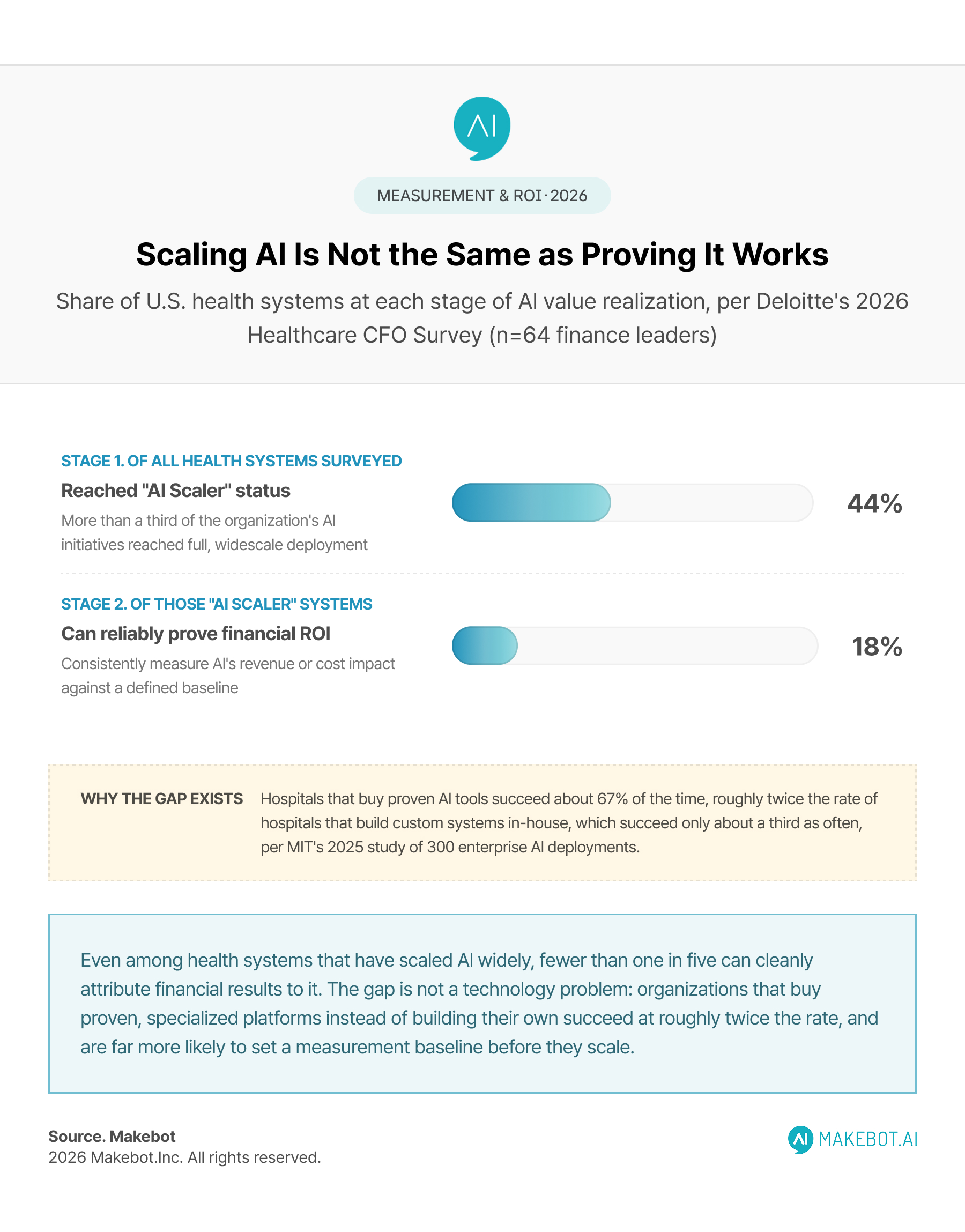
The truth is not that AI fails to help. It is that most hospitals cannot prove it. Deloitte's 2026 CFO survey of 64 finance leaders found 44 percent count as "AI scalers," yet only 18 percent of them could clearly measure AI's effect on revenue or costs against a defined baseline.
That pattern holds across industries. A 2025 MIT study of about 300 public AI projects found 95 percent produced no measurable financial return. The successful few shared habits:
- They bought proven tools instead of building their own; buying or partnering succeeded about 67 percent of the time, versus roughly a third as often for in-house builds.
- They focused on back-office work first, even though most AI budgets chase flashier, customer-facing projects.
- They measured results before scaling, setting a baseline instead of trusting one good story.
This is why healthcare AI automation in scheduling keeps outperforming bigger projects. Deloitte's research on agentic AI shows the same gap: over 80 percent of health system leaders prioritize it for clinical operations, well ahead of the proof needed to back it up.
Why Some Hospitals See Returns While Others Stay Stuck in Pilots
Hospitals getting real returns set a baseline before rollout and give success clear ownership. They choose proven platforms, focus first on scheduling, beds, and OR use, then expand after proving one use case. Finance, ops, and clinical leaders share responsibility.
Hospitals stuck in pilots leave “expected” value untied to a baseline, build everything from scratch, and start with flashy, patient-facing pilots. They run many small pilots without shared learning, while AI remains isolated inside IT. Hospital workflow automation succeeds or stalls on discipline, not technology.
Common Challenges When Scaling
- Data trapped in old systems. Scheduling software and health records often cannot share real-time data, which breaks forecast accuracy.
- Underestimating how much work changes. Skipping workflow redesign is a common reason pilots never grow past one unit.
- Trouble proving what caused the improvement. When several projects touch the same metric, isolating one tool's impact is hard, part of why Deloitte found attribution so weak even among leaders.
- No clear owner. Without finance and operations both backing a project, even a successful pilot often fails to win the sponsorship it needs to expand.
What This Means for Hospital Leaders
Hospitals chasing real AI returns should treat AI capacity management as their starting point, not their biggest bet. The data is clean, the baseline is easy to set, and the value, filled beds, filled OR slots, lower overtime, is hard to argue with once measured properly. This category connects most directly to healthcare operational efficiency in terms a finance committee will approve.
That does not make it small: it sits inside a savings opportunity worth hundreds of billions a year, already producing eight and nine figure results at Mount Sinai and CommonSpirit. The hospitals capturing that value are not the most ambitious about technology; they are the most disciplined about measurement. If generative AI in healthcare is going to close the trust gap Deloitte identified, capacity and scheduling agents will likely be the category that proves the idea works.
The Scheduling Problem Has a Purpose-Built Solution
Hospital scheduling and capacity work is exactly what AI handles best: repetitive, rule-based, and data-driven. Makebot CareAI is a dedicated hospital AI platform trusted by 500+ clinics and hospitals, including Seoul National University Hospital and Severance Hospital. It connects KakaoTalk booking, web chatbot, and 24/7 AI call response into one system with real-time EMR integration, reducing front desk workload by up to 50%, cutting no-shows by 30%, and increasing web booking conversion by 2.5x. Built on HybridRAG technology presented at SIGIR 2025, CareAI answers only from verified hospital data, eliminating hallucination risk in clinical settings. Behind CareAI is Makebot, a leading generative AI and LLM solutions provider trusted by over 1,000 enterprise clients across healthcare, finance, public institutions, and beyond, bringing the same production-grade AI infrastructure to every industry that needs it.
Explore Makebot CareAI for hospitals · Learn about Makebot's enterprise AI platform









.jpg)


What Happens to Marketing When the C-Suite Starts Using AI Every Day?







Why AI Shopping Assistants Will Replace Traditional Ecommerce Search






.jpg)

























Why Generative AI Projects Fail and How to Achieve Scalable AI Success











.jpg)

.png)