Human-AI Collaboration: Elevating CX and EX with Unified Agents
Fragmented AI tools cost enterprises $2.5M annually. Unified CX-EX agents close the gap.

Executive Preview: Enterprise AI Strategy Series
This article is an introductory preview of our full strategy report, “Human-AI Collaboration: Elevating CX and EX with Unified Agents.” Read on for key insights, or download the full whitepaper for detailed architectural frameworks and implementation roadmaps.
Key Takeaways
- Fragmented AI tools and unmonitored automation create a $2.5M annual productivity leak for the average enterprise, while agent turnover costs up to $20,000 per seat.
- Moving from passive chatbots to a Proposal-Based Execution model allows AI to stage high-speed actions while human experts maintain governance and final control.
- The full architectural frameworks, Palantir AIP case study analysis, and step-by-step adoption roadmaps are available exclusively in the full whitepaper.
DOWNLOAD THE FULL WHITEPAPER
Ready to eliminate productivity leaks and scale agentic AI with confidence? Download the complete MakebotAI Whitepaper (Human-AI Collaboration: Elevating Customer and Employee Experience (CX and EX) with Unified Agents) to access our complete implementation roadmaps, governance models, and enterprise architecture frameworks.
👉 [Download the Full Whitepaper: Human-AI Collaboration (PDF)]
The Hidden Cost of Legacy Automation
For years, enterprises treated Customer Experience (CX) and Employee Experience (EX) as disconnected operational silos. Support contact centers deployed standalone chatbots to deflect customer tickets, while internal operations relied on separate wikis, RPA tools, and basic copilots. While these point solutions promised cost savings, their fragmented nature created "Intelligence Islands" that actively degrade operational efficiency.
When customer-facing agents and internal teams operate from disconnected systems, the enterprise suffers from severe structural friction:
- The $2.5M Productivity Leak: Employees lose roughly 1.8 hours every single day searching across fragmented software tools and knowledge bases. For an enterprise with 1,000 knowledge workers, this time drain equates to a staggering $2.5 million loss annually.
- The 70% Efficiency Penalty: According to IBM research, only 29% of IT professionals report that current AI tools save employees time. That leaves 70% of the workforce trapped in manual administrative "swivel-chair" tasks.
- The Agent Turnover Crisis: The operational strain of managing broken workflows drives call center turnover rates higher, with replacing a single support agent costing between $12,000 and $20,000.
The Barrier to Enterprise AI Scaling
Despite widespread enthusiasm for AI integration, most corporate proof-of-concepts never yield measurable financial returns. The main obstacle is no longer the capability of the underlying model, but rather Managed Autonomy.
Launching unmonitored AI agents into live environments creates dangerous operational and regulatory exposure. However, restricting AI to simple Q&A capabilities prevents companies from capturing real business value.
Bridging the Execution Gap in Enterprise AI
Overcoming this challenge requires linking customer support channels directly to operational execution via a unified intelligence core. However, scaling these systems demands maintaining strategic human judgment as workflows become increasingly automated. To explore how organizations navigate the operational risks of automated decision-making and preserve core expertise, read our analysis on how to prevent AI from eroding critical enterprise skills.
To dive into the underlying research data and access our complete total cost of ownership framework, download the complete whitepaper.
Thesis: The Unified Intelligence Core (CX-EX Flywheel)
To eliminate intelligence drift, organizations must unify CX and EX into a single reasoning engine. In this flywheel, CX acts as the real-time sensor capturing customer intent, while EX acts as the actuator executing back-office tasks through shared intelligence.
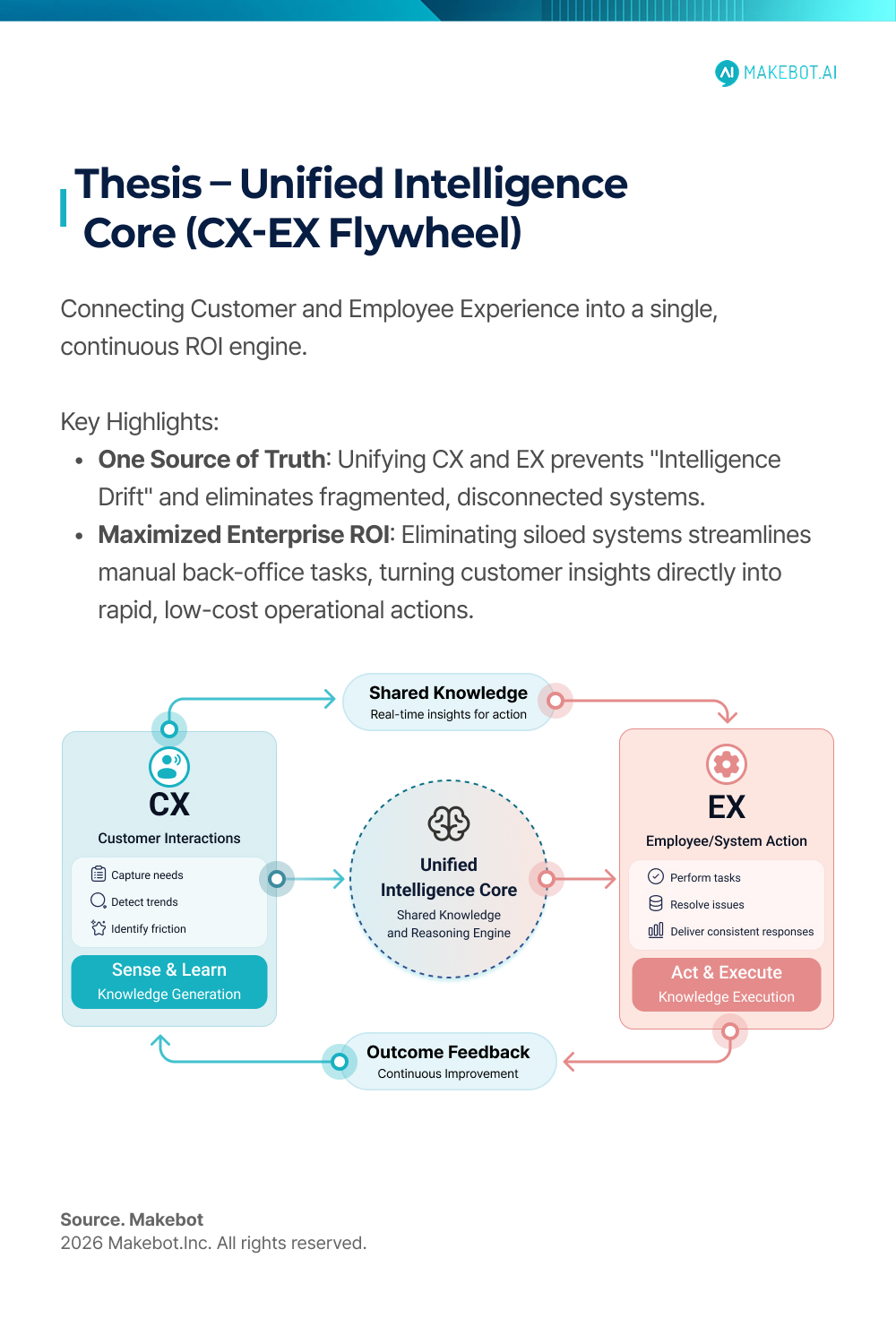
Figure 1: The Unified Intelligence Core synchronizes customer interactions (CX) and back-office execution (EX) into a single reasoning flywheel.
Operating Model: Managed Autonomy and Proposal-Based Execution
Scaling agentic AI safely requires replacing risky unmonitored automation with Proposal-Based Execution. Instead of unilaterally performing actions, the AI generates a staged proposal for human approval. This inversion of control allows a single human expert to verify dozens of complex workflows in minutes, decoupling operational volume from headcount while eliminating hallucination risk.
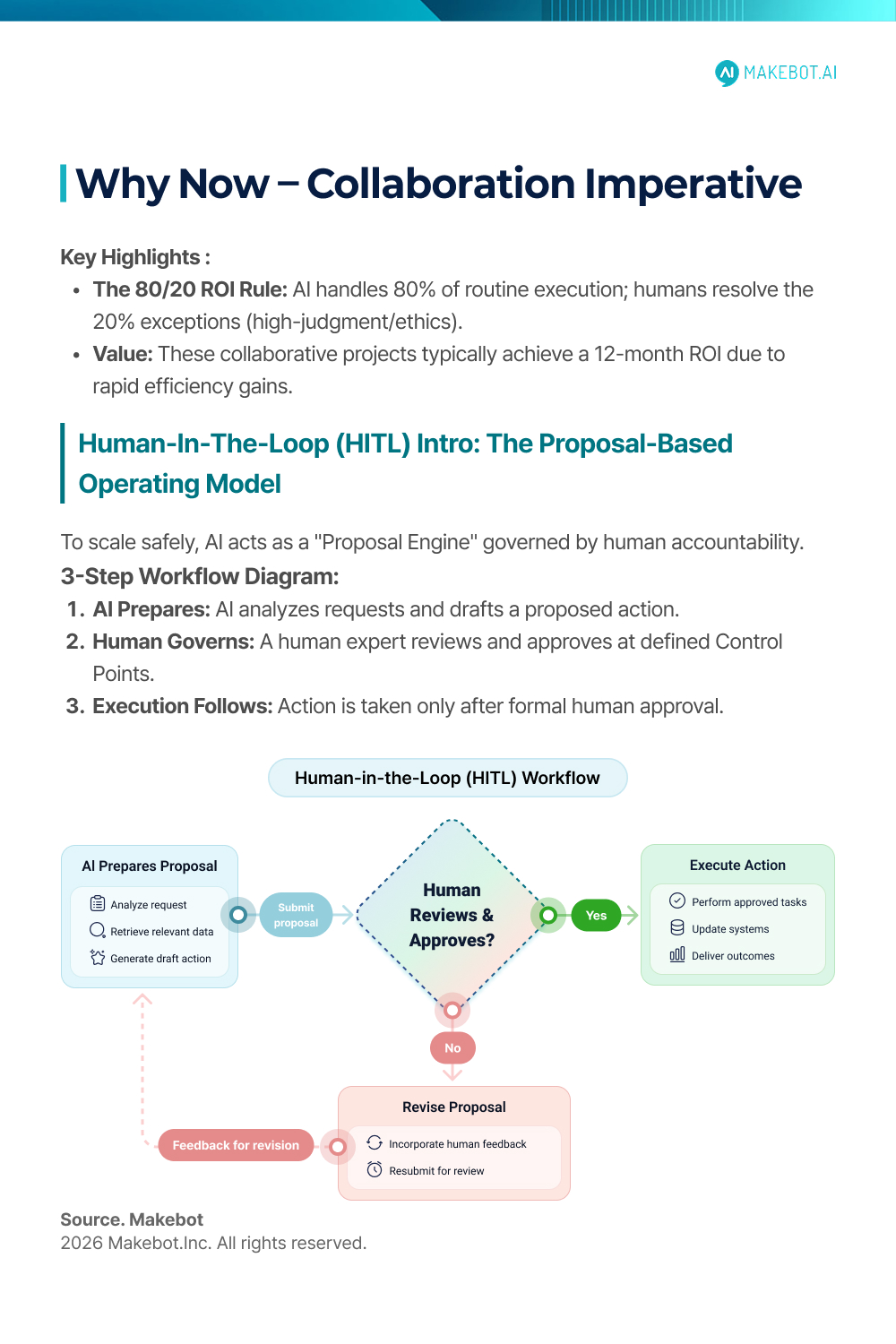
Figure 2: The Human-in-the-Loop (HITL) Proposal-Based Workflow ensures total operational control.
The Adoption Roadmap: From Augmentation to Execution
Transitioning to an AI-driven enterprise is a phased progression:
- Phase 1: Augmentation: AI provides real-time guidance and copilot support.
- Phase 2: Automation: AI handles routine workflows and escalates edge cases.
- Phase 3: Execution: AI operates with high-speed efficiency, gated by mandatory human sign-offs for high-risk decisions.
(Note: The full control point matrix detailing how HITL transforms into a Strategic Governance Layer is available in the full whitepaper.)
Makebot Implementation: MagicTalk, MagicVoice, and MagicWorks
Makebot's core engine brings this framework to life through three dedicated modules: MagicTalk (agent assistance), MagicVoice (autonomous voice resolution), and MagicWorks (back-office execution agents that save managers 5–10 hours per week).
(Note: The full product deployment blueprint mapping MagicTalk, MagicVoice, and MagicWorks across implementation phases is detailed in the full whitepaper.)
Strategic Conclusion: Unlocking the Full Execution Roadmap
Transitioning from fragmented point solutions to a governed, unified agentic architecture represents a fundamental shift in enterprise operating maturity. By treating Human-in-the-Loop not as a temporary patch, but as a permanent trust engine, organizations can scale AI execution across high-compliance domains without exposing the enterprise to operational risk.
What You Will Discover Exclusively in the Full Whitepaper:
- The Complete CX-EX Flywheel Architecture: Deep-dive visual schematics on how customer interactions directly update back-office execution models.
- Palantir AIP Reference Case Study: An in-depth breakdown of how human feedback creates a continuous, positive learning loop for enterprise LLMs.
- The Step-by-Step HITL Lifecycle Framework: Technical specifications for managing proposal states, API execution rails, and audit trails.
- The TCO & ROI Financial Models: Quantitative benchmarks detailing cost-per-interaction reductions, handle time improvements, and headcount scaling metrics.
- The Comprehensive Governance Checklist: Risk management protocols covering policy versioning, audit logging, and data access boundaries.



















What Happens to Marketing When the C-Suite Starts Using AI Every Day?







Why AI Shopping Assistants Will Replace Traditional Ecommerce Search
































Why Generative AI Projects Fail and How to Achieve Scalable AI Success