Why Contact Centers Are Redesigning Human-AI Collaboration Instead of Replacing Agents
85% of contact center leaders are adding agent roles, not cutting them. Only 6% profit from AI.


Key Takeaways
- Most service leaders are giving agents more responsibility, not less. Only 31% have made or planned AI-related layoffs of frontline staff through the first quarter of 2027.
- Real business returns from AI are still rare. Only 37% of companies say AI has contributed to their EBIT (earnings before interest and taxes), and only about 6% qualify as high performers.
- In the AI contact center, value follows redesign. Nearly three-quarters of AI high performers have fundamentally redesigned their workflows, compared with one-quarter of other companies.
- AI agent assist helps new and lower-skilled agents the most, which changes how teams train new staff.
- Contact center automation stalls on people and process, not technology. Agentic AI projects usually stall because of missing coordination, governance, and operating discipline, not weak AI models.
Introduction
Many people predicted that AI would empty out the contact center. The data says otherwise. A Gartner survey of 321 customer service and support leaders found that 85% are giving frontline agents new tasks as AI takes over simpler work. Yet McKinsey's 2026 State of AI survey found that the share of companies seeing a profit impact from AI barely changed in a year.
The companies getting real value from contact center AI are not the ones cutting the most jobs. They are changing how work gets done so that people and AI each do what they do best. That is good human-AI collaboration.
Replacing Agents Sounded Simple. The Data Says Otherwise.
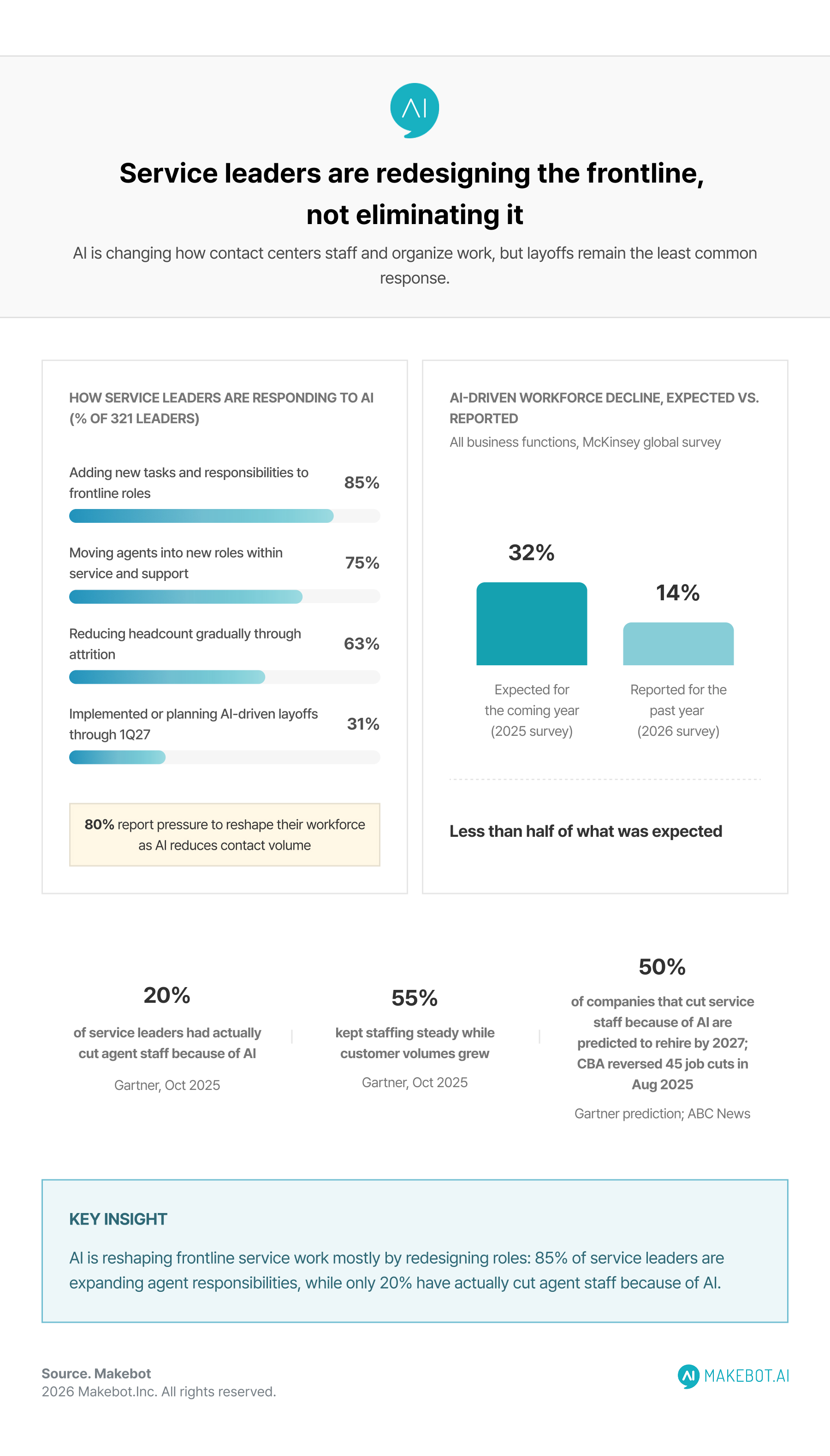
Replacing agents was an easy sell: fewer staff and a lower cost per call. But in Gartner's survey from September to October 2025, 80% of leaders reported pressure to change their workforce as AI reduces contact volumes. Most are redesigning jobs rather than cutting them:
- 85% are adding new responsibilities to frontline roles.
- 75% are moving agents into new roles.
- 63% are shrinking teams slowly by not replacing people who leave.
By October 2025, only 20% of leaders had cut agent staff because of AI, while 55% kept staffing steady as customer volumes grew. McKinsey saw the same gap: only 14% of respondents at companies using AI said AI contributed to a smaller workforce last year, versus 32% who had expected cuts.
When Cutting Jobs Backfires
In August 2025, Commonwealth Bank of Australia reversed its plan to cut 45 customer service jobs after introducing an AI voice bot. According to the Finance Sector Union, call volumes rose instead. Gartner predicts that by 2027, half of the companies that cut service staff because of AI will hire people back for similar work under different job titles.
Why Using AI Does Not Automatically Pay Off
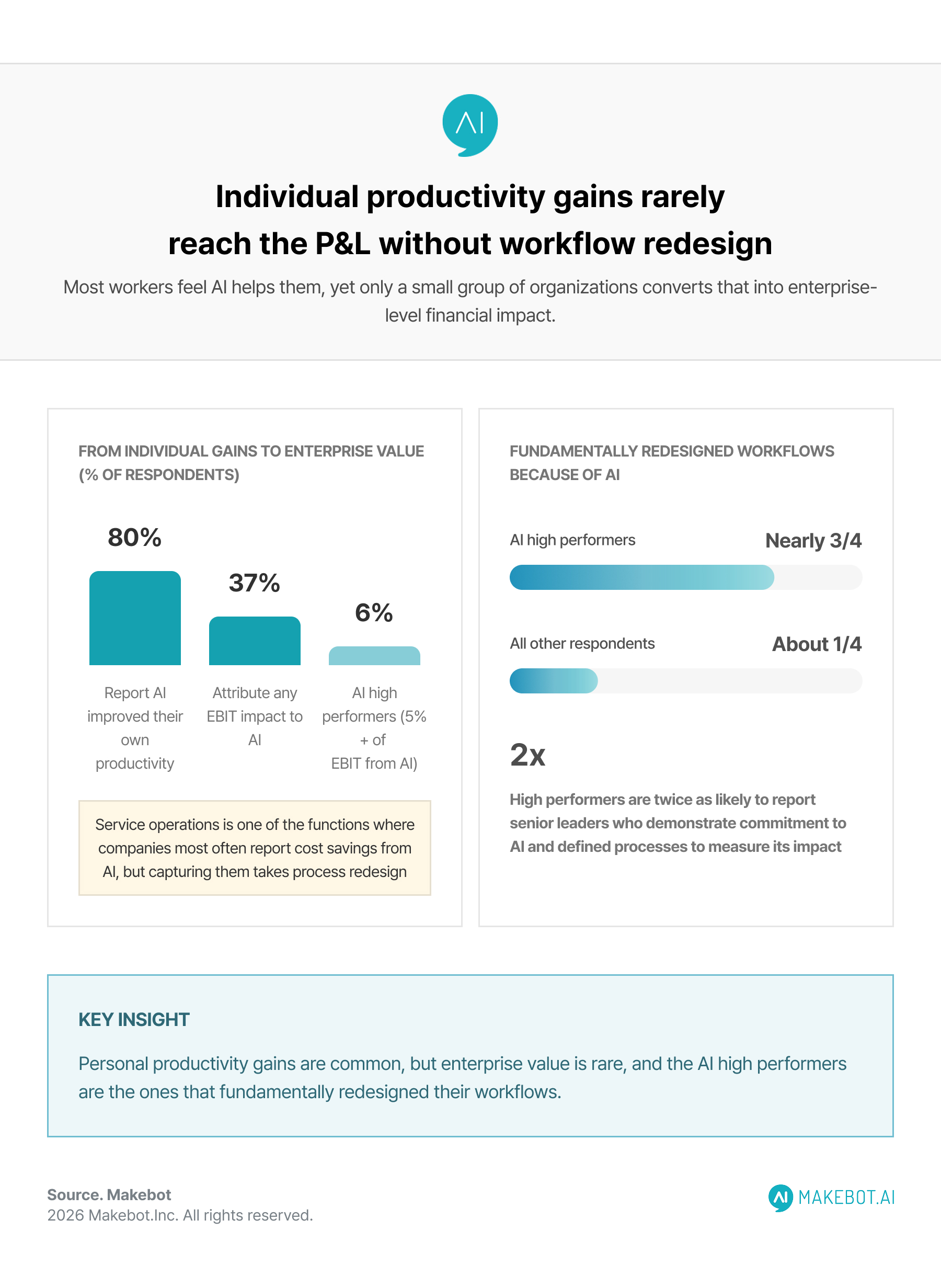
Eight in ten respondents say AI makes them more productive, yet only 37% say it has contributed to their company's earnings. The difference is how work is organized: nearly three-quarters of AI high performers have fundamentally redesigned their workflows because of AI, compared with one-quarter of other companies.
In contact center AI, an AI chatbot added on top of messy customer journeys mostly produces "deflection," keeping contacts away from agents without solving problems. Service operations is one of the areas where companies most often report cost savings from AI, but capturing them takes process redesign, not just installing new software.
What Good Human-AI Collaboration Looks Like
AI Agent Assist Makes Human Agents Better
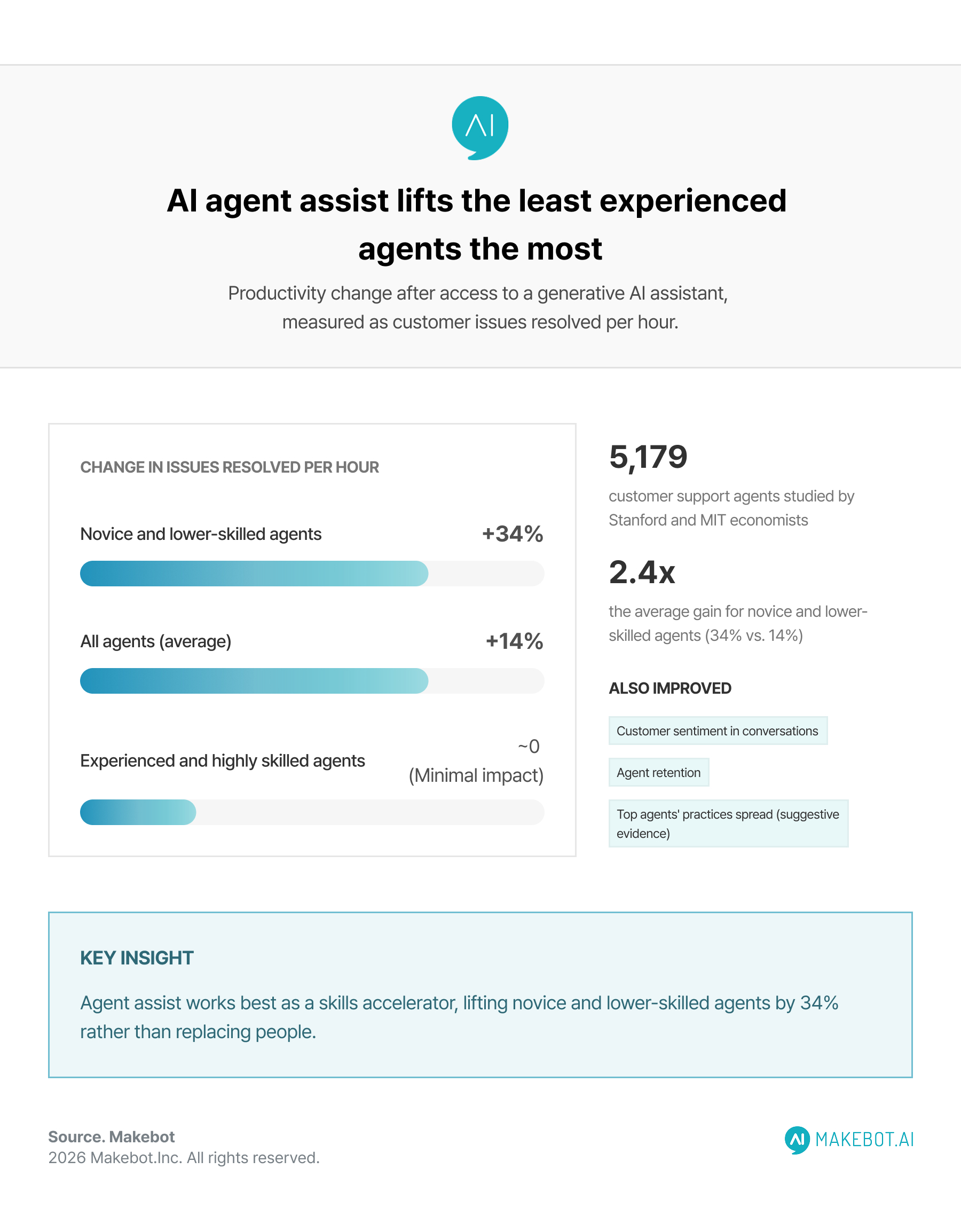
AI agent assist is AI that helps human agents during live conversations. In Generative AI at Work, Stanford and MIT economists analyzed data from 5,179 support agents as an AI assistant was rolled out:
- Agents resolved 14% more issues per hour on average.
- New and lower-skilled agents improved by 34%.
- Customer sentiment and agent retention improved.
The researchers also found suggestive evidence that it spread top agents' habits. Agent assist tools built on a Large Language Model (LLM), AI trained on huge amounts of text, aim to do the same. That is where generative AI in customer service creates lasting value: raising every agent's skill level instead of replacing agents.
AI Handles Routine Work, People Handle the Hard Cases
Chatbots are now the most widely scaled AI tool. AI agents for customer service can complete tasks on their own, such as tracking an order, and McKinsey projects that AI could take on up to 60% of addressable customer care volume. Still, Gartner predicts that no Fortune 500 company will have fully removed human customer service by 2028, because AI often struggles with unusual and high-risk cases.
A strong hybrid model splits the work into four layers:
- Automation: AI resolves simple, repeated requests.
- Assist: AI supports agents during live conversations.
- Human judgment: People handle complaints, emotional moments, and exceptions.
- Oversight: Specialists design and monitor the AI.
Oversight is already creating jobs: 42% of organizations are hiring for new roles such as conversational AI designers and automation analysts.
Leaders vs. Laggards: What Sets the Best AI Contact Centers Apart
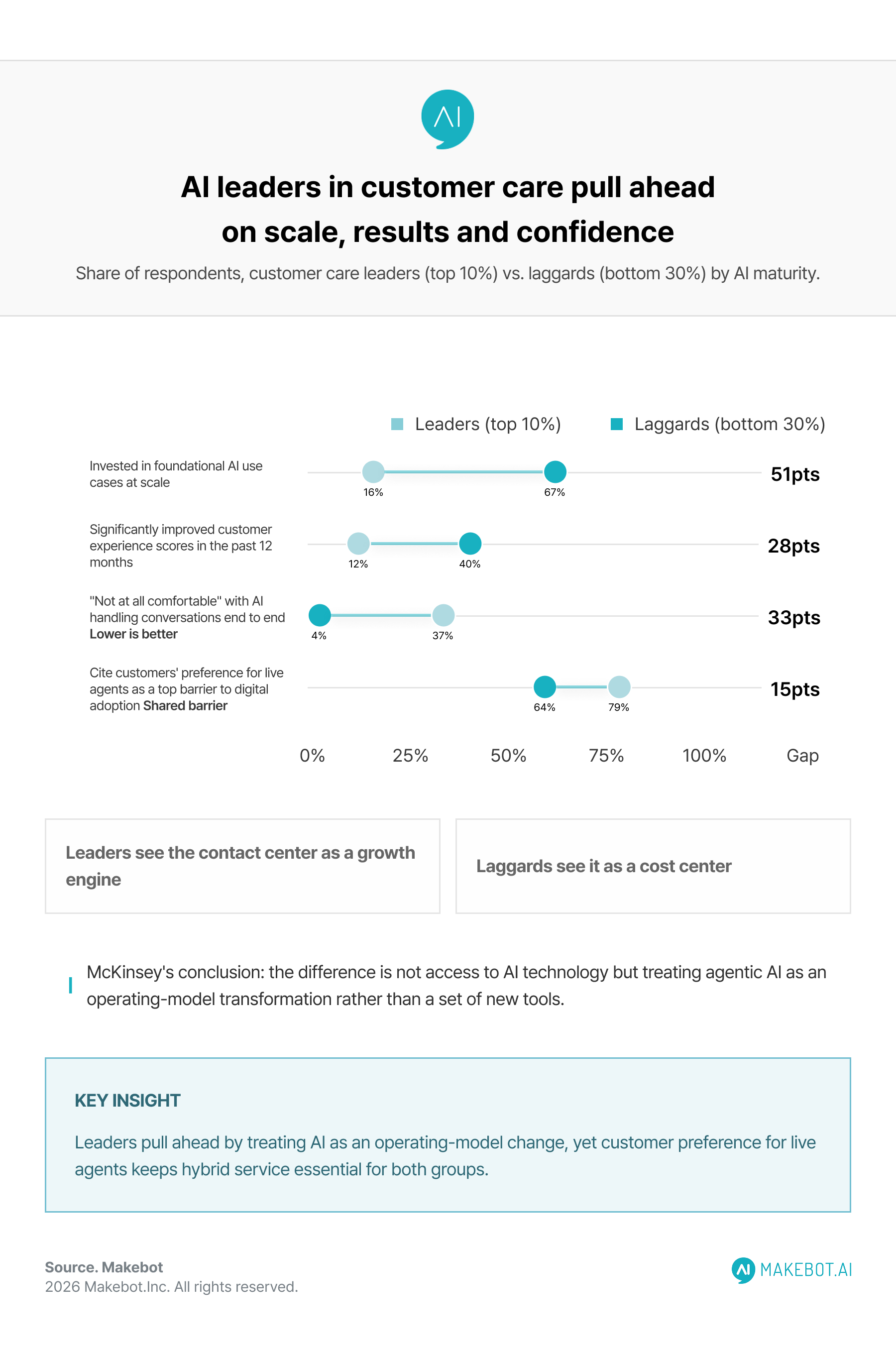
McKinsey's survey of 440 customer care leaders compares the top 10% ("leaders") with the bottom 30% ("laggards") in the AI contact center.
Leaders were far more likely to have invested in foundational AI use cases at scale (67% vs. 16%) and to report significantly improved customer experience scores over the past year (40% vs. 12%). Only 4% of leaders were "not at all comfortable" with AI handling conversations end to end, versus 37% of laggards. Both groups cite customers' preference for live agents as a top barrier to digital adoption (64% of leaders, 79% of laggards). Leaders also see the contact center as a growth engine, while laggards see a cost center.
McKinsey's conclusion: the difference is not access to AI technology but treating agentic AI as an operating-model transformation rather than a set of new tools.
Why Most AI Projects Get Stuck
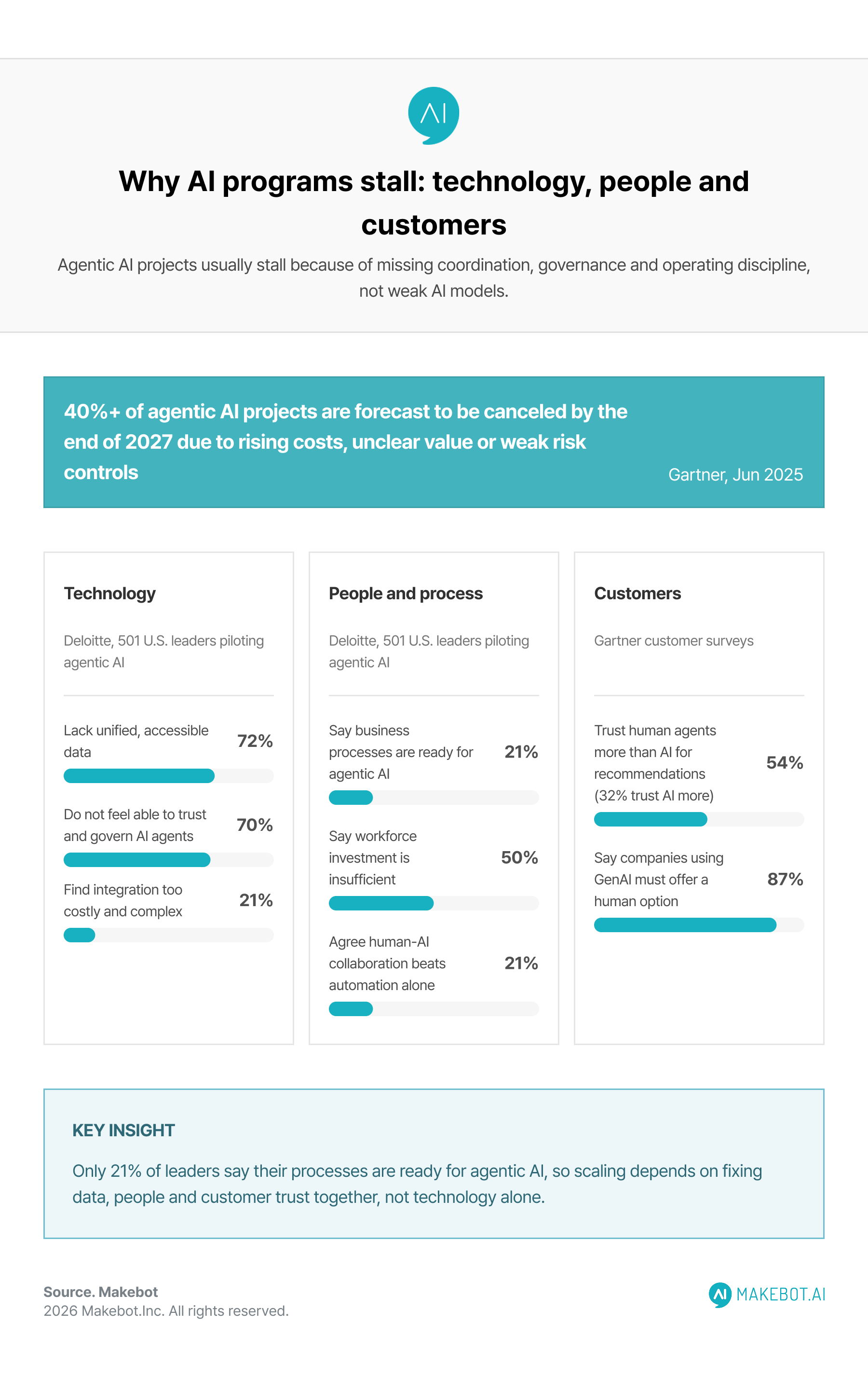
Even well-funded AI programs run into the same obstacles:
- Technology: In a Deloitte survey of 501 U.S. leaders at companies already piloting agentic AI, 72% lack unified, accessible data, 70% do not feel able to trust and govern AI agents, and 67% find integration too costly and complex. In June 2025, Gartner predicted that more than 40% of agentic AI projects will be canceled by the end of 2027.
- People and process: Only 21% of those leaders say their business processes are ready for agentic AI, and half say their companies are not investing enough in preparing workers for AI. Yet 75% agree that human-AI collaboration creates more value than automation by AI agents alone.
- Customers: In a 2025 Gartner survey of 5,801 U.S. customers, 54% trusted human agents more than AI for product or service recommendations (32% trusted AI more). In a 2026 Gartner survey of 3,566 customers, 87% said companies using generative AI must offer a way to reach a human.
An AI customer service strategy that ignores these limits can lose customer trust when it matters most.
A Simple Playbook for Human-AI Collaboration
Companies that want real returns from contact center automation follow similar steps:
- Find the root causes. McKinsey recommends finding out why customers contact you and what they want before choosing technology partners.
- Redesign first, then deploy. Decide what AI owns, what people own, and how handoffs work.
- Start with agent assist. It has shown clear productivity gains at relatively low risk.
- Clean up your knowledge base. Accurate information keeps LLM answers correct.
- Measure outcomes. Track resolution, customer experience, and revenue, not just call time.
Conclusion: The Real Payoff From AI in the Contact Center
The evidence points one way: the value of AI in the contact center does not come from cutting people. Replacement-first plans are already backfiring, while McKinsey's customer care leaders are already showing measurable gains in customer experience, efficiency, workforce productivity, and revenue.
AI customer service investments will be judged by how well they combine machine speed with human judgment. As McKinsey points out, lasting financial results come from transforming how work is done, not from simply adopting AI tools. In the AI contact center, that starts with a better partnership between agents and AI, not a smaller org chart.
Redesigning Human-AI Collaboration
Organizations looking to move beyond AI pilots and build contact center workflows that actually deliver ROI will find a practical starting point with Makebot. Makebot's enterprise AI solutions are designed around the same principle this article outlines: AI that augments human teams rather than replacing them, with measurable results at scale.



















What Happens to Marketing When the C-Suite Starts Using AI Every Day?






Why AI Shopping Assistants Will Replace Traditional Ecommerce Search
































Why Generative AI Projects Fail and How to Achieve Scalable AI Success