Holiday Returns Are a Customer Service Problem: How to Prepare an AI Chatbot for Peak-Season Order, Delivery and Return Inquiries
17% of holiday sales get returned. 71% of shoppers avoid retailers with poor returns experience.


Key Takeaways
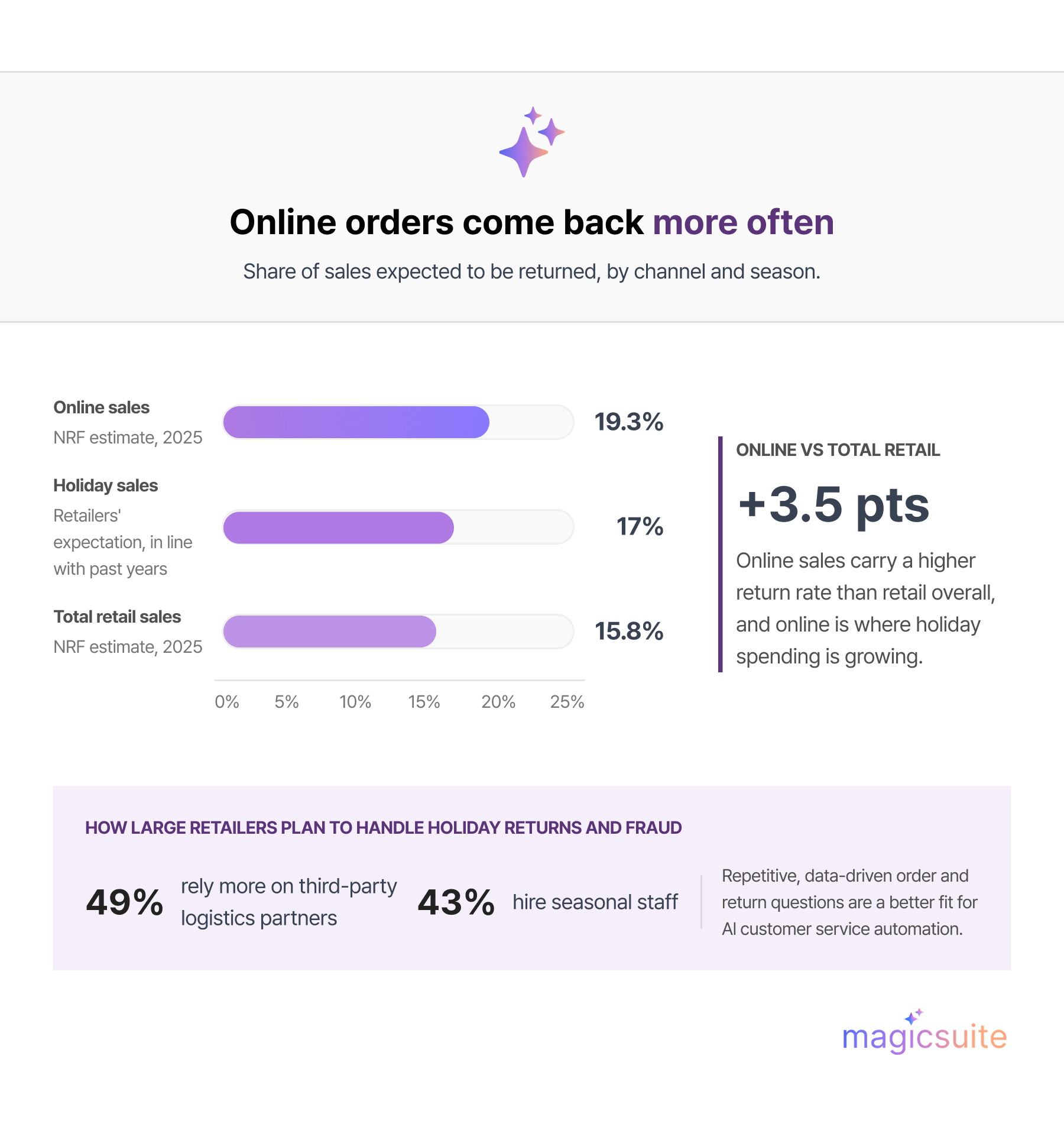
- Retailers expect 17% of holiday sales to be returned, in line with past years, which creates a second rush of questions after the holidays.
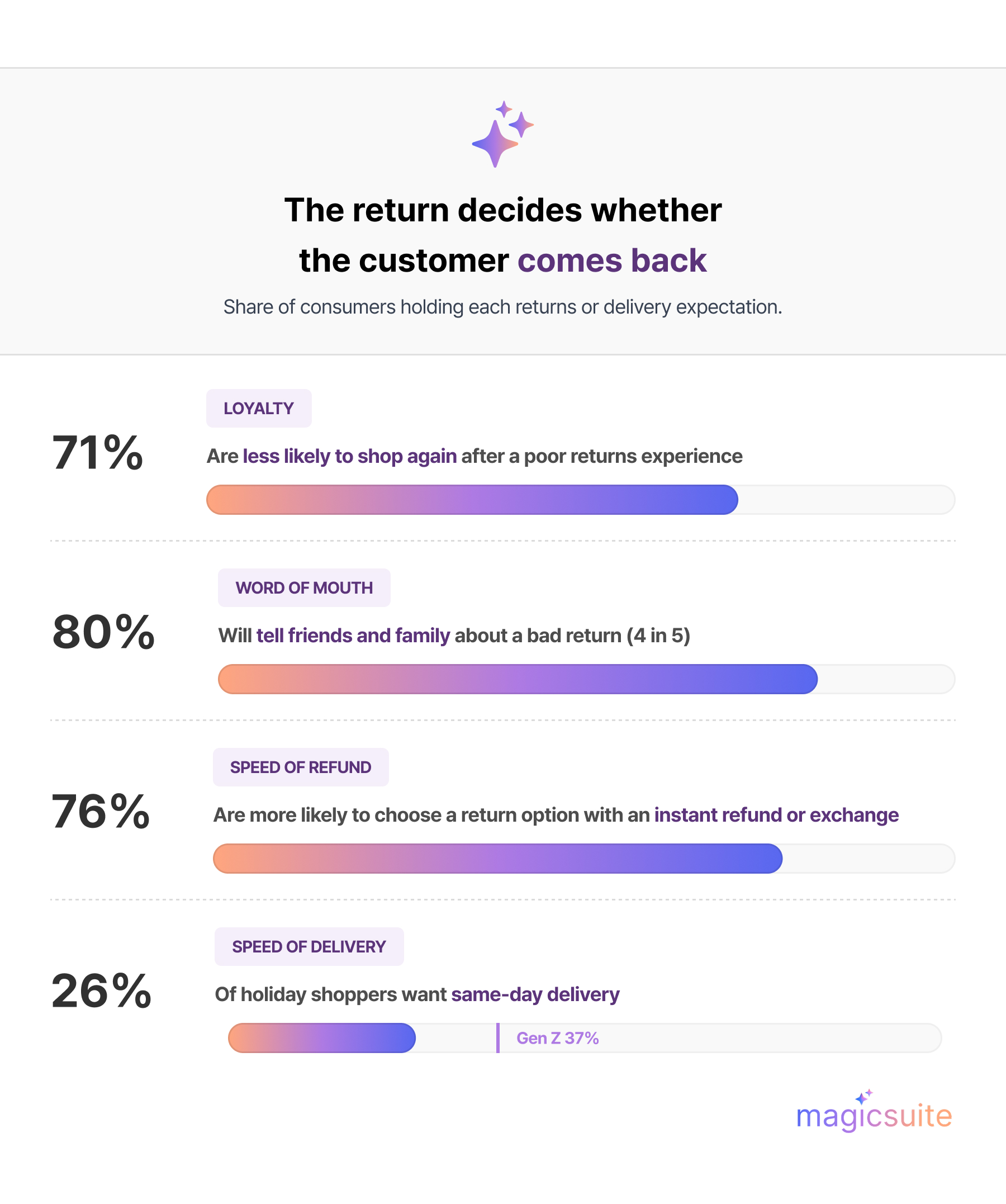
- 71% of consumers say a poor returns experience makes them less likely to shop with that retailer again.
- Customers are roughly three times more likely to use outside GenAI tools for help than a company's own chatbot.
- Only 24% of service leaders have shown positive financial returns across their AI use cases.
- AI winners stand out less for their technology than for redesigning how the work gets done.
Introduction
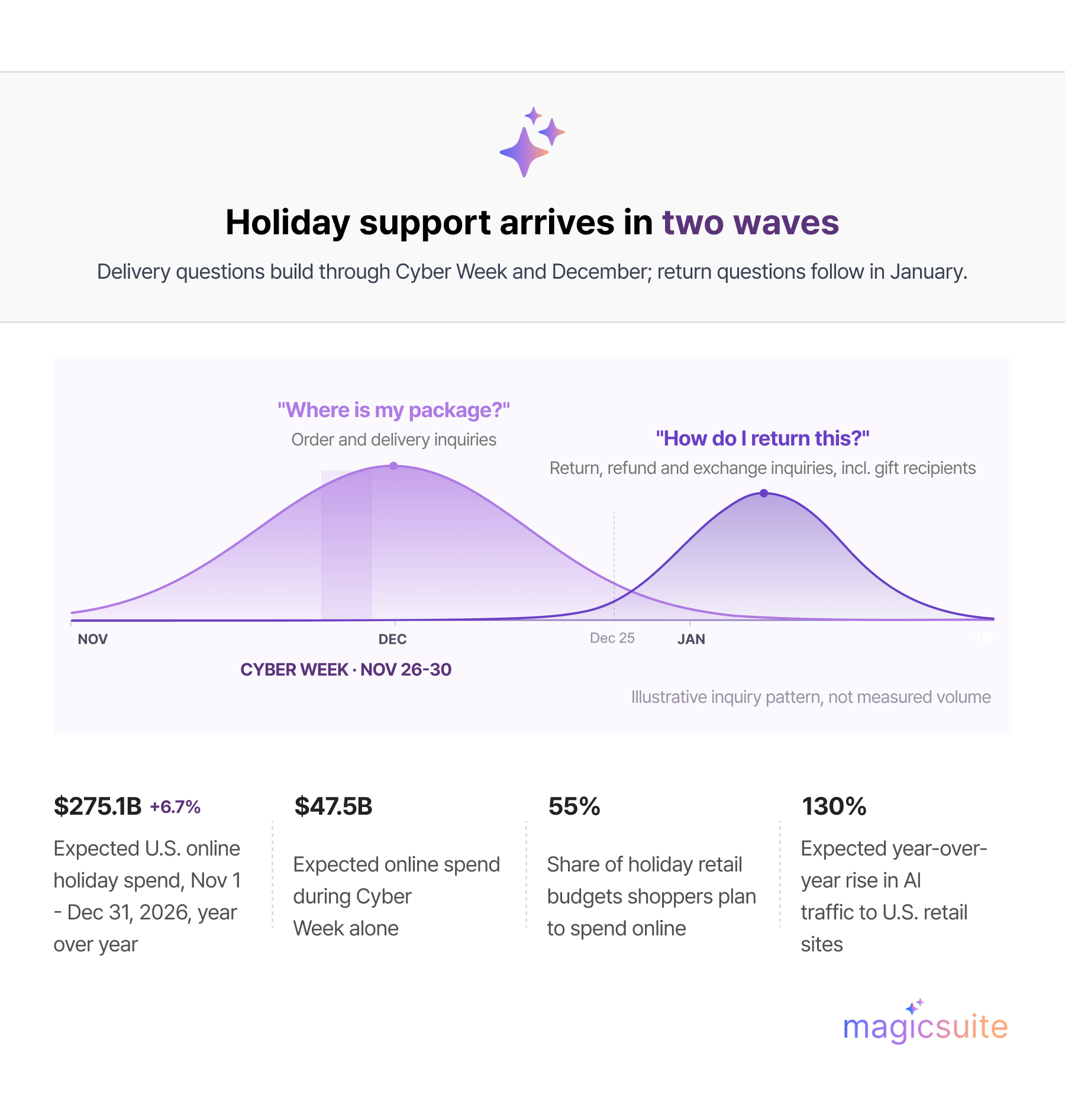
Holiday shopping brings two rushes of customer questions: "Where is my package?" in November and December, and "How do I return this?" in January. The second matters just as much, because 71% of consumers say they are less likely to shop with a retailer after a poor returns experience.
The stakes are higher this year. Online holiday spending is expected to hit a record, AI traffic to U.S. retail sites is expected to rise 130% year over year, and service leaders are increasingly moving money away from labor and toward technology. Generative AI in retail is going mainstream, but spending on AI does not guarantee results.
This article explains how to prepare an AI chatbot for e-commerce for peak volume without losing customers' trust.
Why Holiday Returns Turn Into a Customer Service Problem
Adobe expects U.S. shoppers to spend $275.1 billion online between November 1 and December 31, 2026, up 6.7% from last year, with $47.5 billion during Cyber Week alone. Deloitte's survey of 4,000 U.S. consumers found shoppers plan to spend 55% of their retail holiday budgets online.
Returns are also more common online: NRF estimated that 19.3% of online sales would be returned in 2025, compared with 15.8% of total retail sales.
Shoppers also expect a lot:
- They share bad experiences. Four in five consumers will tell friends and family about a bad return.
- They want returns to be fast. 76% of consumers are more likely to choose a return option with an instant refund or exchange.
- They want delivery to be fast. 26% of surveyed holiday shoppers want same-day delivery, rising to 37% among Gen Z.
Many retailers plan to add staffing capacity. Among large merchants NRF surveyed, 49% plan to rely more on third-party logistics partners and 43% plan to hire seasonal staff to manage holiday returns and fraud. That helps, but repetitive, data-driven order and return questions are a better fit for AI customer service automation.
Why Most Customer Service Chatbots Fall Short
Why are chatbots not already handling this? Gartner's 2026 survey of 3,566 B2B and B2C customers found that 49% would have been willing to use a company's chatbot, yet only 7% used a chatbot or digital assistant in their last service interaction. Company chatbot use has stayed statistically unchanged since 2022, while service use of third-party GenAI tools (AI assistants customers use on their own) nearly doubled in the past year.
Three findings stand out:
- People give chatbots one chance. Only 27% would try a chatbot again after a bad experience.
- People want action, not just answers. 58% of GenAI users have used it to complete a task for them.
- People want a way out. 87% say access to a human agent is essential when companies use GenAI for service.
A customer the chatbot fails on December 20 may skip it entirely in January. Gartner advises putting reliability over reach: a chatbot that reliably solves a focused set of problems earns more customer trust than one that tries everything and often fails. Otherwise, AI-powered customer support just pushes the workload to the phone line.
Why a Few Companies Get Results From AI and Most Do Not
In McKinsey's State of AI in 2026 survey of 1,719 respondents, 80% say AI has made them more productive, but only 37% say it has added anything to their company's EBIT (a common measure of profit). Just about 6% are "high performers" that credit AI with at least 5% of EBIT and call its impact significant.
AI customer service shows the same gap. Gartner found that service leaders' AI spending rose 38% while overall budgets grew just 2%, and service teams put a median 12% of their 2025 budget into AI, the highest of the 10 business functions it studied. Yet only 24% can show positive financial returns.
McKinsey's research on high performers points to four differences:
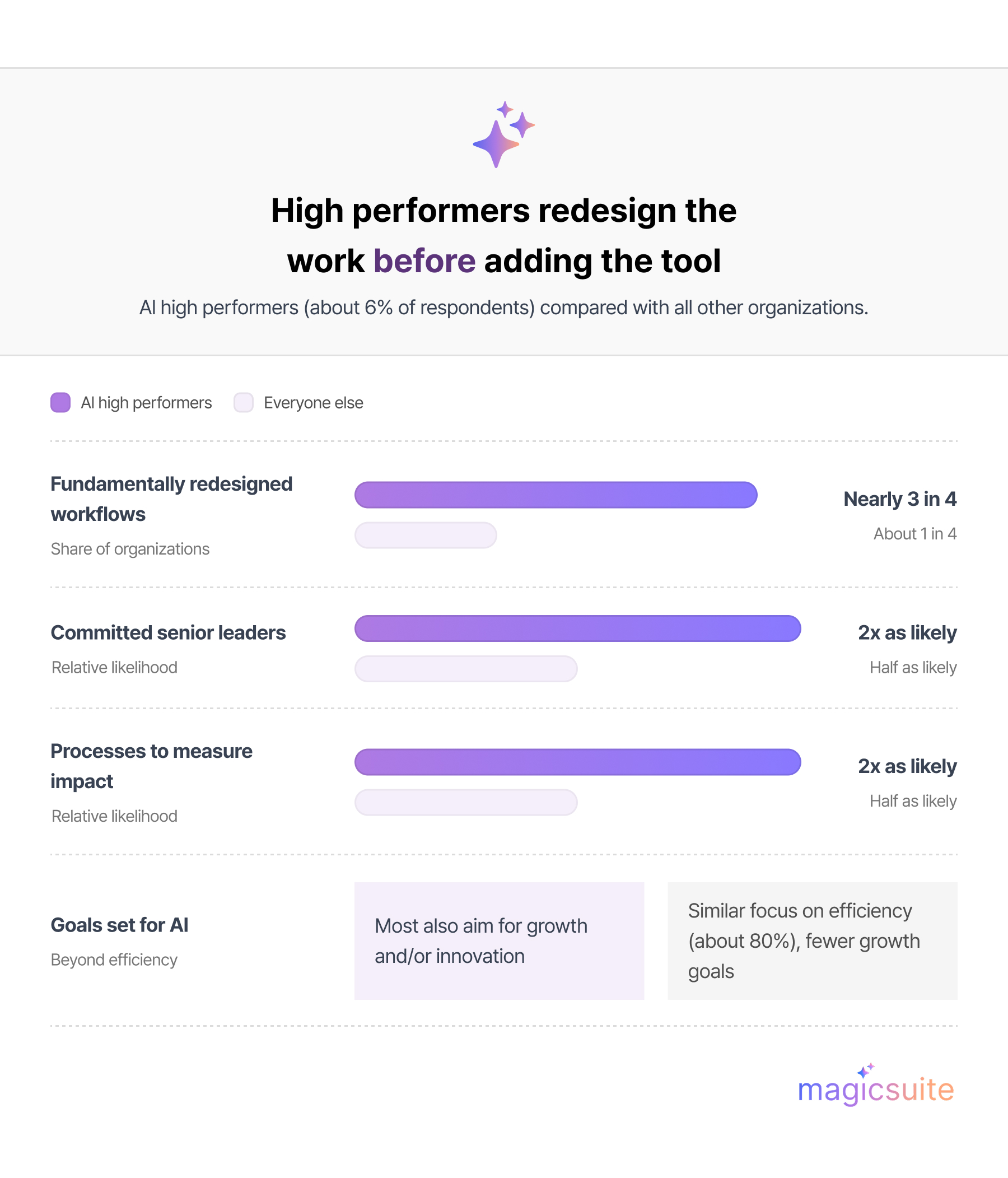
For e-commerce customer support, the lesson is to rebuild the workflow so AI can handle returns from start to finish, not just add a chatbot.
How to Get an AI Chatbot Ready for Holiday Orders, Deliveries and Returns
Cyber Week runs from Thanksgiving (November 26) to Cyber Monday (November 30). Five steps will get an AI chatbot for e-commerce ready:
1. Connect the Chatbot to Real Order and Shipping Data
A Large Language Model (LLM), the AI behind modern chatbots, understands what customers ask but cannot know where a package is on its own. Good AI order tracking links it to live order, warehouse and shipping data, so it looks up answers instead of guessing.
2. Let the Chatbot Complete Tasks, Not Just Explain Them
As Gartner notes, GenAI can understand intent while traditional automation completes the transaction: the AI works out the customer's intent, and rule-based systems do the work. For e-commerce returns automation, one conversation should check eligibility, create a label, offer an exchange and confirm refund timing. Since shoppers favor instant refunds and exchanges, a chatbot that only explains the policy misses much of the value.
3. Plan the Handoff to a Human Before Launch
Gartner warns against making GenAI a mandatory first step for every issue. A good human handoff includes:
- A clear trigger: hand off when the chatbot is unsure, before the customer gets frustrated.
- Full context: the agent sees the chat history, so customers never repeat themselves.
- Fast lanes: smart ticket routing sends high-value orders, damaged items and possible fraud straight to the right people.
4. Keep Holiday Policies Up to Date
Return windows, gift receipt rules and shipping cutoffs change every year. Gartner found that 58% of service leaders plan to upskill agents into knowledge management specialists who keep help content accurate, which makes knowledge management a key holiday task. Give each seasonal policy an owner to avoid outdated answers.
5. Start Small and Prove It Works
Gartner advises starting with issue types that have a proven high rate of successful resolution and expanding only once the chatbot performs reliably. Typically, that means order status, delivery changes and standard returns first, load-tested at Cyber Monday traffic.
Common Problems When Moving Beyond the Pilot
A pilot (a small test run) can stall once real crowds arrive. Watch for these technical and organizational obstacles:
- Pressure from the top: 91% of service leaders feel pressure from executives to implement AI, which can push teams to launch too early.
- Return fraud: 9% of all returns are fraudulent, so e-commerce returns automation needs built-in fraud checks. In NRF's survey, 85% said they are employing AI to detect or prevent return fraud.
- Scattered data: Order, inventory and shipping information can sit in separate systems. A well-integrated AI support stack lets the chatbot check them in real time.
- Running costs: About 20% of McKinsey respondents say running costs, including tokens (the billed units of text an AI processes), have limited their AI use.
The lesson matches McKinsey's research: companies that treat AI customer service as just a technology purchase tend to struggle, while those that change how they work are better placed to get value.
How to Measure Success After January
Do not judge a chatbot only by its deflection rate, the share of chats it keeps from human agents. A better scorecard for holiday returns management tracks:
- Resolution rate: how often order, delivery and return questions are actually solved.
- Exchange rate: how often a refund becomes an exchange, which keeps revenue.
- Repeat contacts: customers who come back within seven days, a sign the first answer failed.
- Purchases after a return: whether customers keep shopping.
AI may also prevent returns: in Adobe's July 2026 survey of 5,000 consumers, 69% of shoppers who used AI for online shopping said they are less likely to return an item. Though self-reported, this suggests generative AI in retail could reduce returns before they happen.
Conclusion
Holiday returns show whether customer service was built for real customer behavior. AI spending is rising, customers have little patience for weak chatbots, financial returns go mostly to companies that redesign workflows and measure results, and customers expect an easy path to a human.
For leaders in e-commerce customer support, a chatbot that uses live data, completes tasks and knows when to hand off becomes a lasting tool for every holiday season. Built now, it can turn one of retail's most expensive moments into a reason for customers to come back.
Makebot’s AI Strategic Whitepaper Vol.02, From Scattered AI to a Single Core: CX·EX Innovation with a Unified Intelligence Core, explains why this matters beyond the holiday season. It argues that the AI performance gap comes from the operating model rather than the model itself, and that Human-in-the-Loop should be the standard way AI work is executed. AI proposes, and people approve at clear control points. It also shows how one Unified Intelligence Core connects customer conversations and internal work in a single flow, instead of leaving them in separate systems. For service leaders preparing for peak season, download the whitepaper for the full framework.
Don’t Let Peak Season Expose Your AI Gaps
Holiday returns reveal whether your customer service was built for real customer behavior. Only 24% of service leaders can show positive financial returns from AI, and the gap almost always comes down to workflow design rather than the tools themselves. If your chatbot can’t complete a return from start to finish, connect to live order data, or hand off to a human at the right moment, January will be expensive. MagicSuite gives e-commerce and service teams the AI-powered infrastructure to handle peak-season volume without losing customer trust - so your busiest season becomes a reason for customers to come back, not a reason to leave.
























What Happens to Marketing When the C-Suite Starts Using AI Every Day?






Why AI Shopping Assistants Will Replace Traditional Ecommerce Search
































Why Generative AI Projects Fail and How to Achieve Scalable AI Success
































Interview Feature: Why Companies Are Betting Big on Generative AI