How Hospitals Can Use Outbound Callbots to Recover No-Shows and Follow Up After Discharge
23% of appointments end in no-shows. AI outbound callbots cut that rate with reminder calls.


Key Takeaways
- On average, about 23% of scheduled appointments end in a no-show, based on 105 studies. Reminders bring that number down.
- In one randomized trial, reminder calls from clinic staff worked better than automated messages. That gap is what conversational healthcare AI voice agents are trying to close.
- Short follow-up calls after discharge, usually a single phone call, have not lowered 30-day readmissions. The research points instead to fuller support aimed at higher-risk patients.
- Half of surveyed US healthcare organizations now use generative AI. Patient engagement is one of the most promising uses of generative AI in healthcare, yet fewer organizations have started there.
- Only 37% of survey respondents see any effect on company profit from AI. Among the top 6%, nearly three in four redesign their workflows, compared with one in four of everyone else.
Introduction
An empty appointment slot and an unanswered call after a hospital stay are the same problem: the hospital lost touch with a patient when it mattered most.
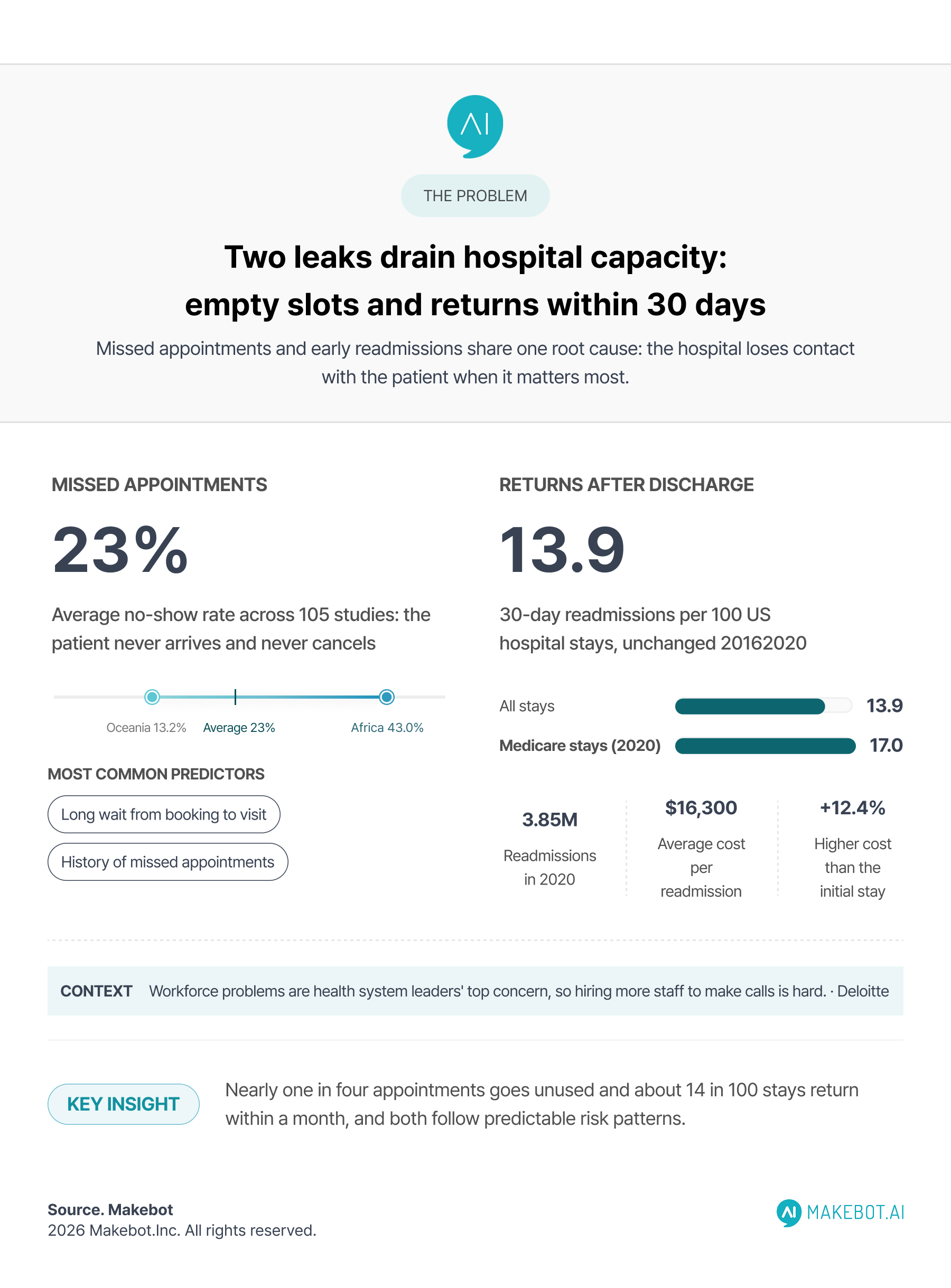
Across 105 studies, about 23% of scheduled appointments end in a no-show, meaning the patient never arrives and never cancels. From 2016 to 2020, about 14 of every 100 US hospital stays were followed by another admission within 30 days. Meanwhile, health system leaders name workforce problems as their top concern.
That is why hospitals are turning to the AI outbound callbot, a voice program that calls patients on its own. In a 2025 Mount Sinai pilot, healthcare AI voice agents built on large language models gave patients instructions, collected their information, answered questions, and passed them to a nurse when needed. Still, automation alone is not enough, and this article explains why.
Two Problems That Drain Hospital Capacity
Missed appointments. A review of 105 studies in Health Policy found an average no-show rate of about 23%, ranging from 13.2% in Oceania to 43.0% in Africa. The most common warning signs were a long wait between booking and the visit, and a history of missed appointments. So no-shows are not random, and every gain in hospital no-show reduction gives back care time that cannot be recovered later.
Patients returning after discharge. The US Agency for Healthcare Research and Quality reports that the 30-day readmission rate stayed at 13.9 per 100 hospital stays from 2016 to 2020, with Medicare stays at 17.0 in 2020. In 2020, that meant about 3.85 million readmissions, averaging $16,300 each, or 12.4% more than the first stay.
Both problems depend on reaching many patients by phone, which is the main job of hospital call automation.
What Research Says About Calling Patients
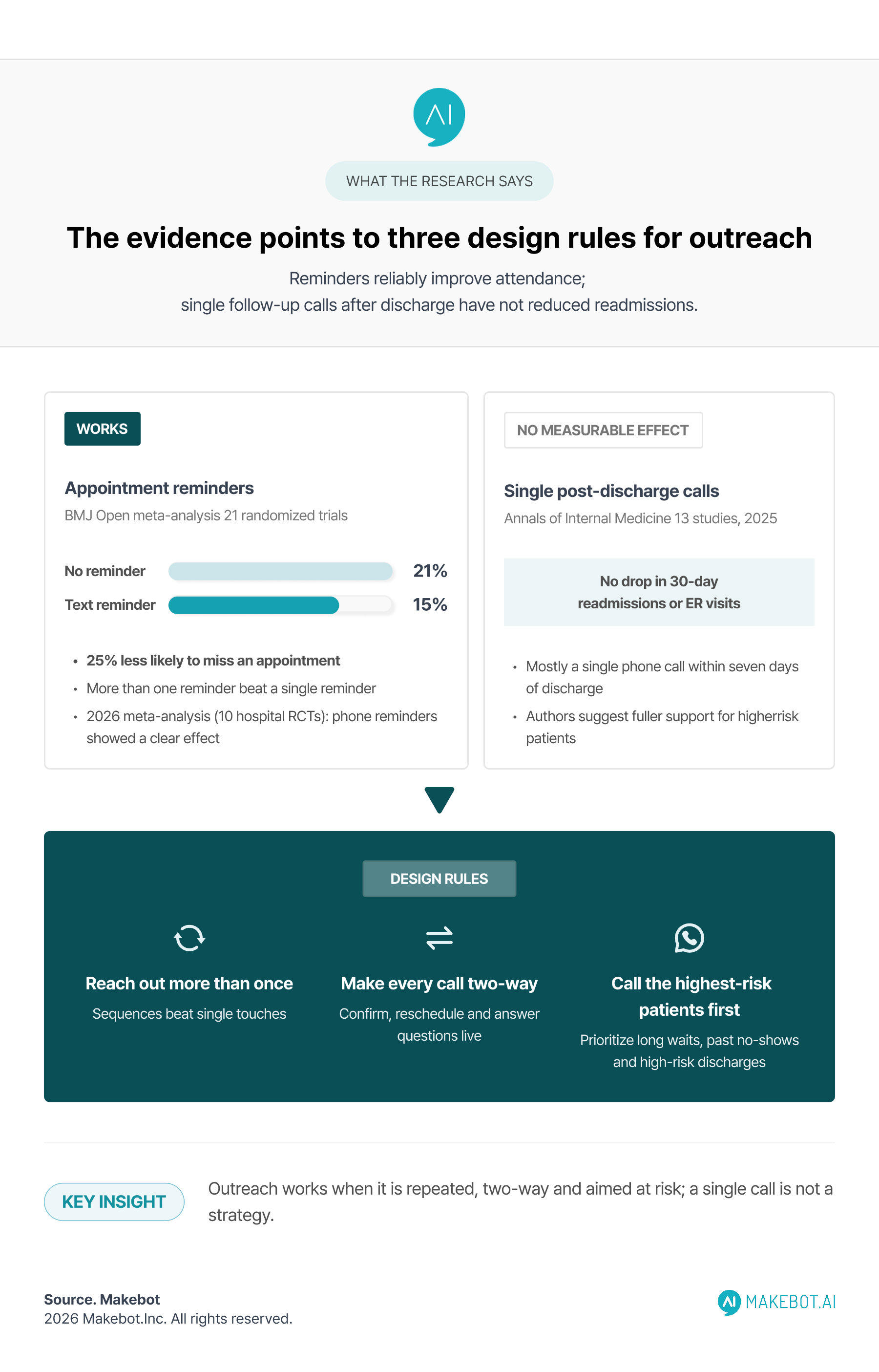
Reminders work. A BMJ Open meta-analysis, which combines results from many studies, covered 21 randomized trials. Patients who got text-message reminders were 25% less likely to miss their appointment (15% vs. 21%), and sending more than one reminder improved attendance more than a single one. A 2026 meta-analysis of 10 trials in hospital outpatient clinics also found that reminders improved attendance, with phone reminders showing a clear effect. Together, these studies make a strong case for hospital appointment reminders.
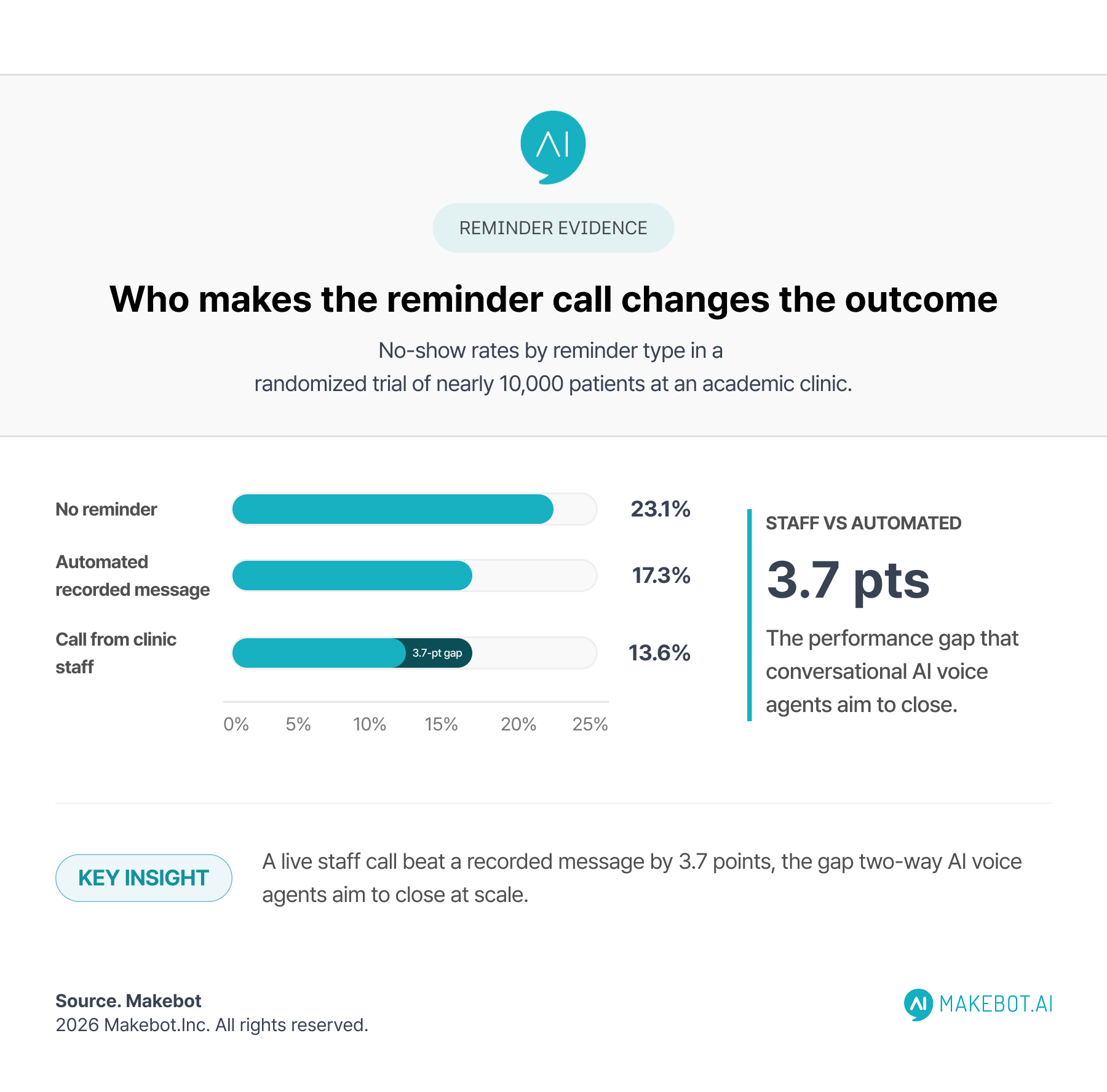
In a randomized trial of nearly 10,000 patients at an academic clinic, published in The American Journal of Medicine, no-show rates were 13.6% when clinic staff called, 17.3% with an automated recorded message, and 23.1% with no reminder. That 3.7-point gap is what healthcare AI voice agents hope to close.
Calls after discharge tell a different story. A 2025 review and meta-analysis of 13 studies in Annals of Internal Medicine, mostly single phone calls made within a few days of discharge, found no drop in 30-day readmissions or emergency room visits. The authors suggested that fuller support for higher-risk patients may be needed.
The lessons: reach out more than once, make every call two-way, and call the highest-risk patients first.
How an AI Outbound Callbot Works
An AI outbound callbot connects five parts:
- Triggers: the electronic health record (EHR) and scheduling system flag who needs a call.
- A risk model: it ranks patients so the likeliest no-shows and highest-risk discharges are called first.
- A language model: a healthcare LLM (large language model, the type of AI behind modern chatbots) runs the conversation, but only within clinician-approved scripts.
- Speech and phone tools: these turn speech into text and back again, and place the calls.
- A handoff path: urgent cases go to a person, and call details are saved in the patient's record.
Generative AI in healthcare creates new responses instead of following a fixed menu, so the system can handle interruptions, questions, and rescheduling.
Recovering no-shows
Calls start a few days before the visit, beginning with high-risk patients. The agent confirms the visit or offers a new time, and when a patient cancels, the open slot goes to someone on the waitlist. If a patient still misses the visit, a same-day recovery call tries to rebook them.
Following up after discharge
Post-discharge follow-up automation works best as a series of check-ins, not one call. The agent asks clinician-approved questions about medicines, symptoms, and follow-up visits. Any warning sign leads to a warm transfer to a nurse, meaning the call is passed straight to a live nurse. Higher-risk patients get repeated check-ins during the 30 days after discharge, which fits the Annals review's point that they may need more support.
A real-world example
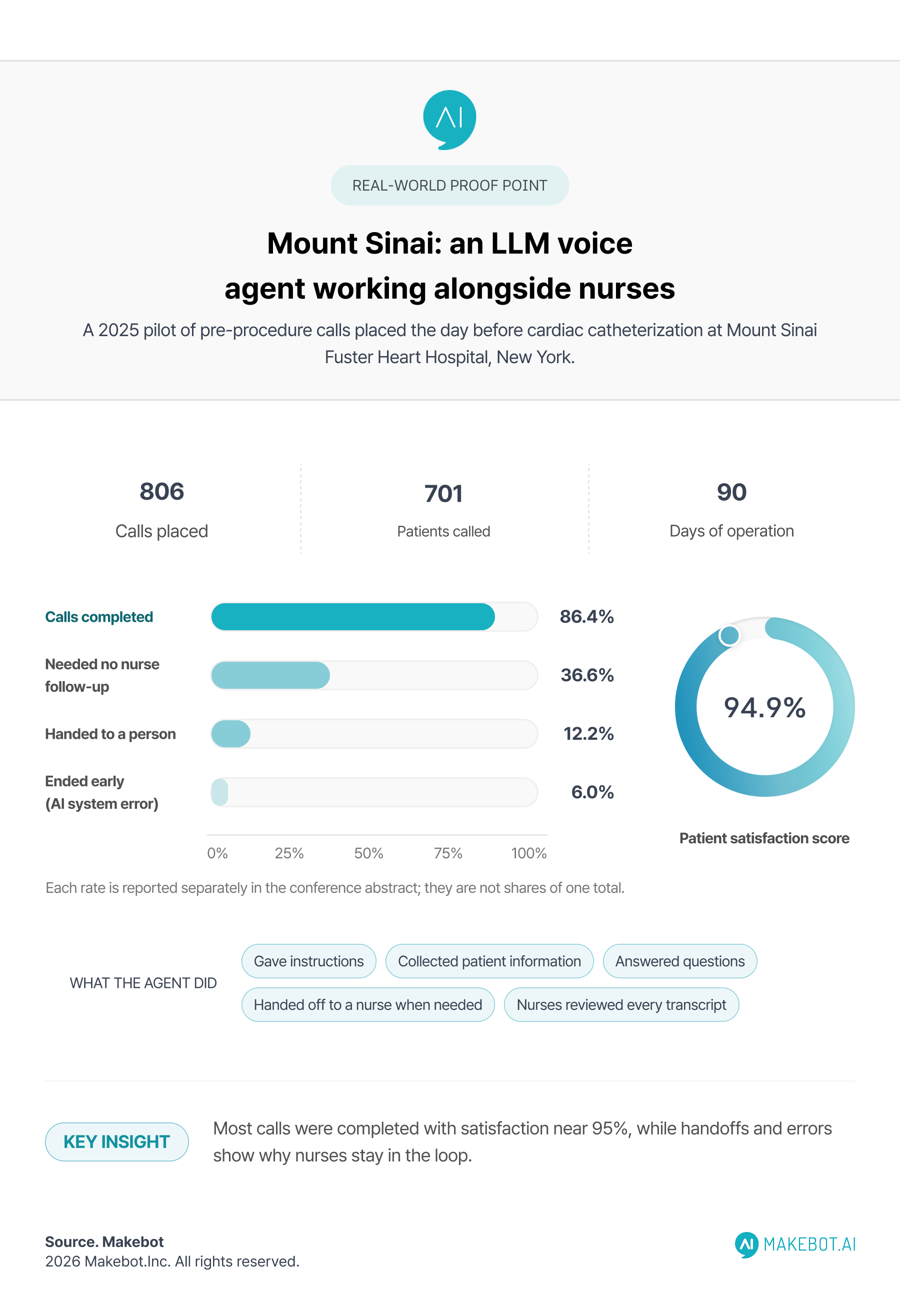
At Mount Sinai Fuster Heart Hospital in New York, an AI voice assistant powered by a large language model made 806 calls to 701 patients over 90 days, the day before their heart catheterization procedures. In results published as a conference abstract, 86.4% of calls were completed, and 36.6% needed no follow-up from a nurse. Another 12.2% were handed to a person, and 6.0% ended early because of AI system errors. The patient satisfaction score was 94.9%, and the system worked as a partnership between AI and nurses.
Generative AI in Healthcare Is Now Mainstream
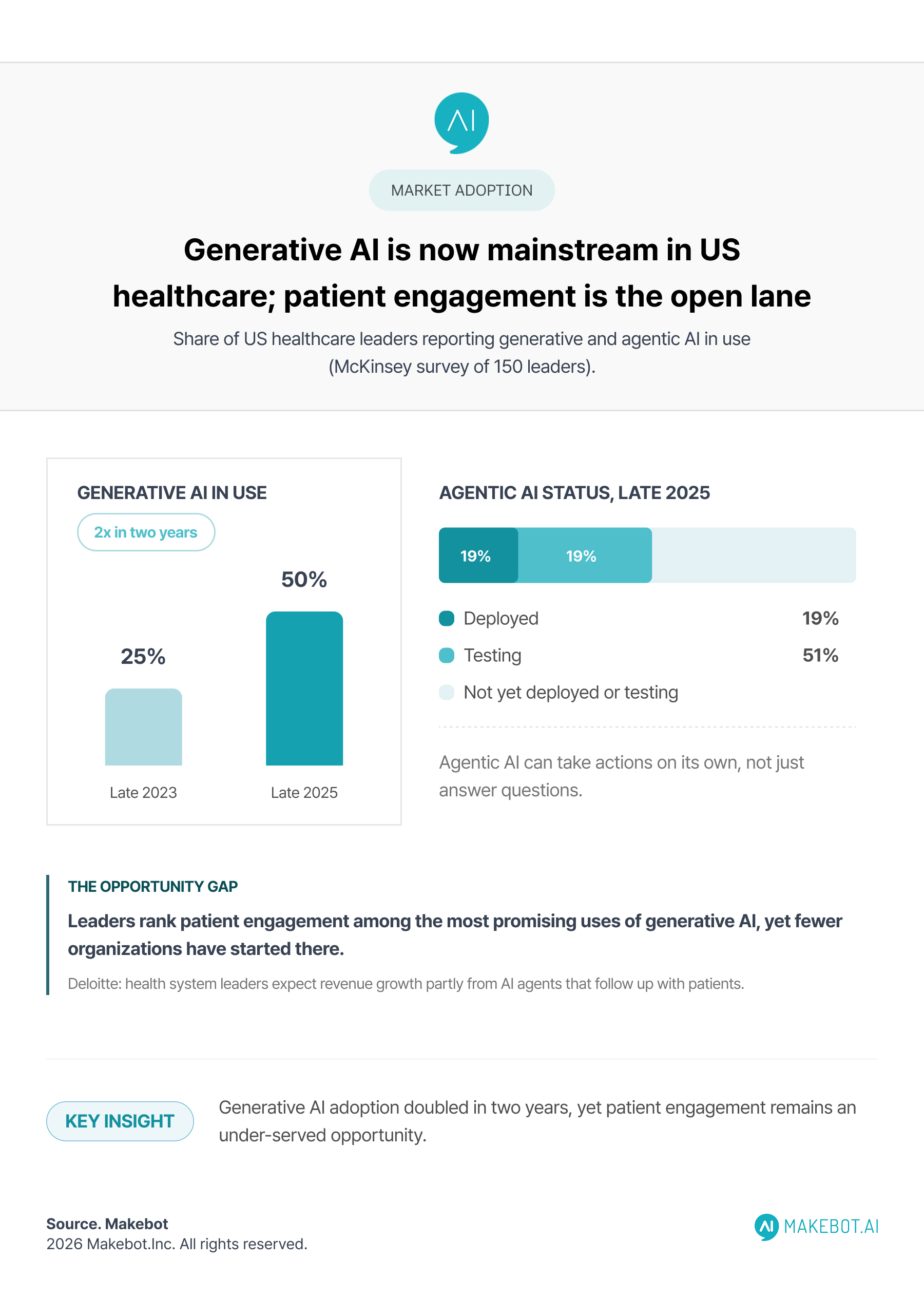
McKinsey surveyed 150 US healthcare leaders in late 2025. For the first time, 50% said their organizations had put generative AI into use, up from 25% in late 2023. In addition, 19% have put agentic AI to work (AI that can take actions on its own, not just answer), and another 51% are testing it.
Leaders named patient engagement as one of the most promising areas, yet fewer had started there, which makes AI patient engagement a gap worth closing next. Deloitte also found that health system leaders expect revenue growth partly from using AI agents to follow up with patients.
Why Some Organizations Get Results From AI and Most Do Not
McKinsey's 2026 survey of 1,719 people found that 44% say AI is being rolled out across their company. Yet only 37% see any effect on EBIT (profit before interest and taxes). McKinsey calls the strongest group "high performers": the roughly 6% who say AI drives at least 5% of their company's EBIT and brings significant value. Nearly three in four high performers redesign their workflows around AI, compared with one in four of everyone else, and they are twice as likely to have committed leaders and clear ways to measure impact.
Healthcare shows the same split. In McKinsey's healthcare survey, 82% of leaders expect a positive return on investment (ROI). Yet Deloitte found that 51% had not measured returns or said it was too soon, and only 3% saw significant returns. An AI outbound callbot has an edge here, because show rates, filled slots, and nurse handoffs are easy to count.
What Makes Hospital Call Automation Hard to Scale
McKinsey's healthcare survey found that connecting AI to existing systems was the top barrier, and 43% named risk and safety as a roadblock. Gartner predicts that more than 40% of agentic AI projects will be canceled by the end of 2027 because of rising costs, unclear value, or inadequate risk controls. For hospital call automation, plan for:
- Connection: reading from and writing to scheduling, waitlists, and care-team task lists.
- Safety: clear script limits, fast escalation of warning signs, and regular transcript reviews.
- Reaching patients: answer rates, consent rules for calling, and accuracy across languages.
- Ownership: one person accountable across the call center, nursing, and IT.
A Simple Roadmap for Hospital Leaders
Hospitals that succeed treat automated patient follow-up as a new way of running a service, not just a software purchase:
- Start small: run a focused pilot in one busy clinic, and record your starting numbers first.
- Focus on risk: call long-wait and past no-show patients first, and save intensive discharge follow-up for high-risk patients.
- Keep people involved: set handoff rules and transcript reviews before launch.
- Connect before you grow: make sure filled slots and call notes flow into the EHR automatically.
- Measure results, not activity: track reach, show rates, filled slots, staff hours saved, and readmissions in targeted groups.
Conclusion
No-shows and gaps after discharge come down to one thing: reaching patients. With workforce problems as health system leaders' top concern, hiring more people to make calls is hard. Automated patient follow-up extends two-way, repeated outreach beyond what staff alone can cover, making it a form of AI patient engagement with results that are easy to measure.
The evidence also sets clear limits. Reminders work. Automated messages do worse than staff calls. Short follow-up calls alone have not lowered readmissions. Hospitals that see results work like the roughly 6% of AI high performers: they redesign workflows, have committed leaders, and measure impact from the start.
Built to Reduce No-Shows and Keep Patients Engaged
The outbound callbot use cases in this article are core to what CareAI already does for 500+ clinics and hospitals across Korea. CareAI’s 24/7 AI call bot proactively reaches patients for appointment reminders and follow-ups, cutting no-shows by 30% and increasing web booking conversion by 2.5x. With real-time EMR integration, every outbound interaction is grounded in verified patient data. To explore Makebot’s full suite of healthcare and enterprise AI solutions, visit Makebot.





















What Happens to Marketing When the C-Suite Starts Using AI Every Day?







Why AI Shopping Assistants Will Replace Traditional Ecommerce Search































Why Generative AI Projects Fail and How to Achieve Scalable AI Success

























Interview Feature: Why Companies Are Betting Big on Generative AI