Where Enterprise AI Value Actually Sits and Why Core Functions Beat IT Projects
See where AI ROI comes from, which use cases to fund, and how to scale beyond pilots.


Key Takeaways
- Most AI value sits in core functions. BCG places 70% of AI's potential value in core functions such as sales, operations, and supply chain. IT is the main support-area exception, at 13%.
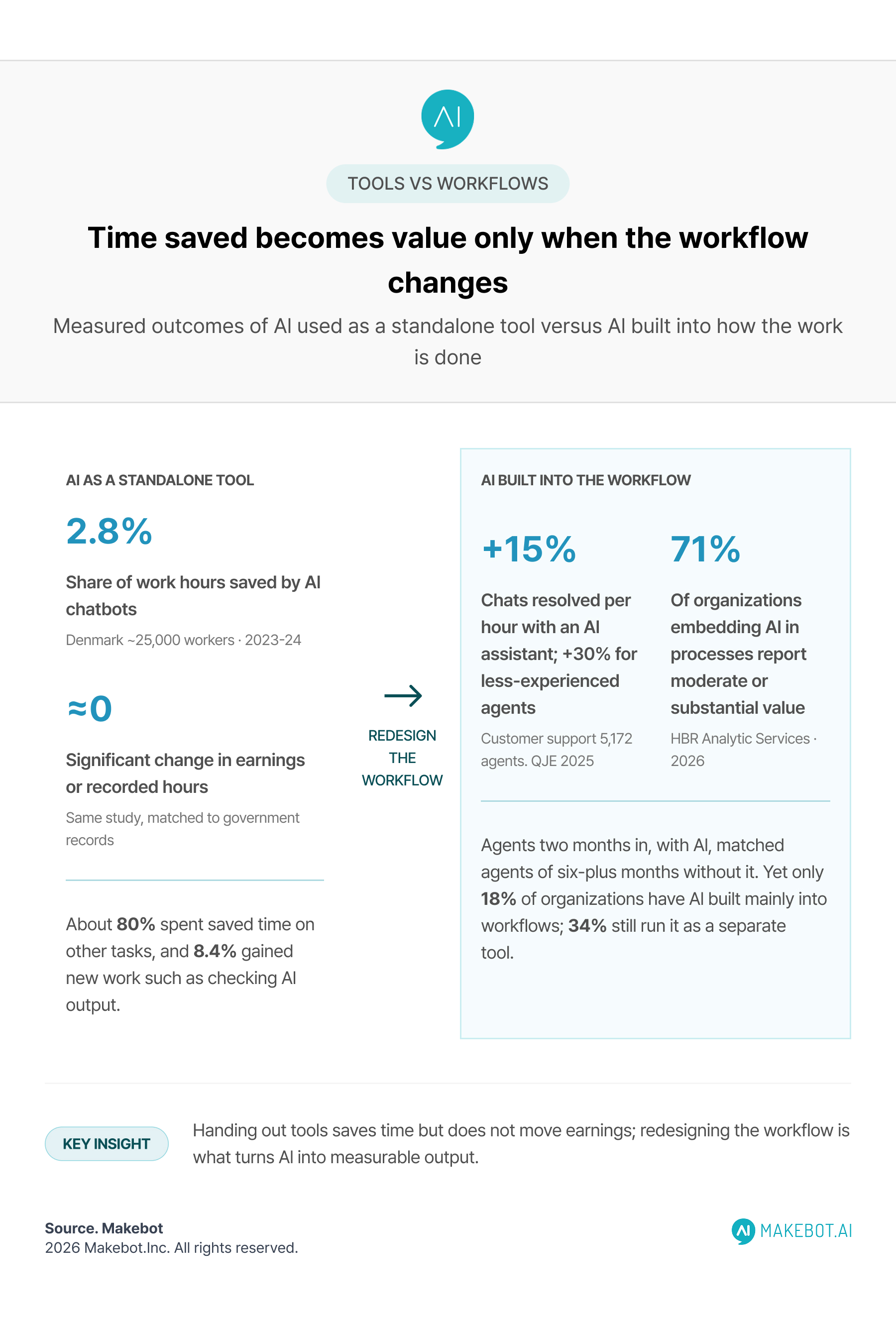
- Handing out tools is not enough. Danish survey and government records show AI chatbots saved users 2.8% of work hours, with no significant change in earnings or recorded hours.
- AI pays off when it is built into the workflow. Only 18% of firms have AI built mainly into their workflows, but 71% of those that embed it report moderate or substantial value.
- AI ROI is now judged in money, not time saved. Direct financial impact nearly doubled to 21.7% of answers on how AI ROI is measured in Futurum's 1H 2026 survey.
- Business leaders should own results, and IT should run the platform. More than 80% of company AI spending now sits outside the IT budget, according to BCG.
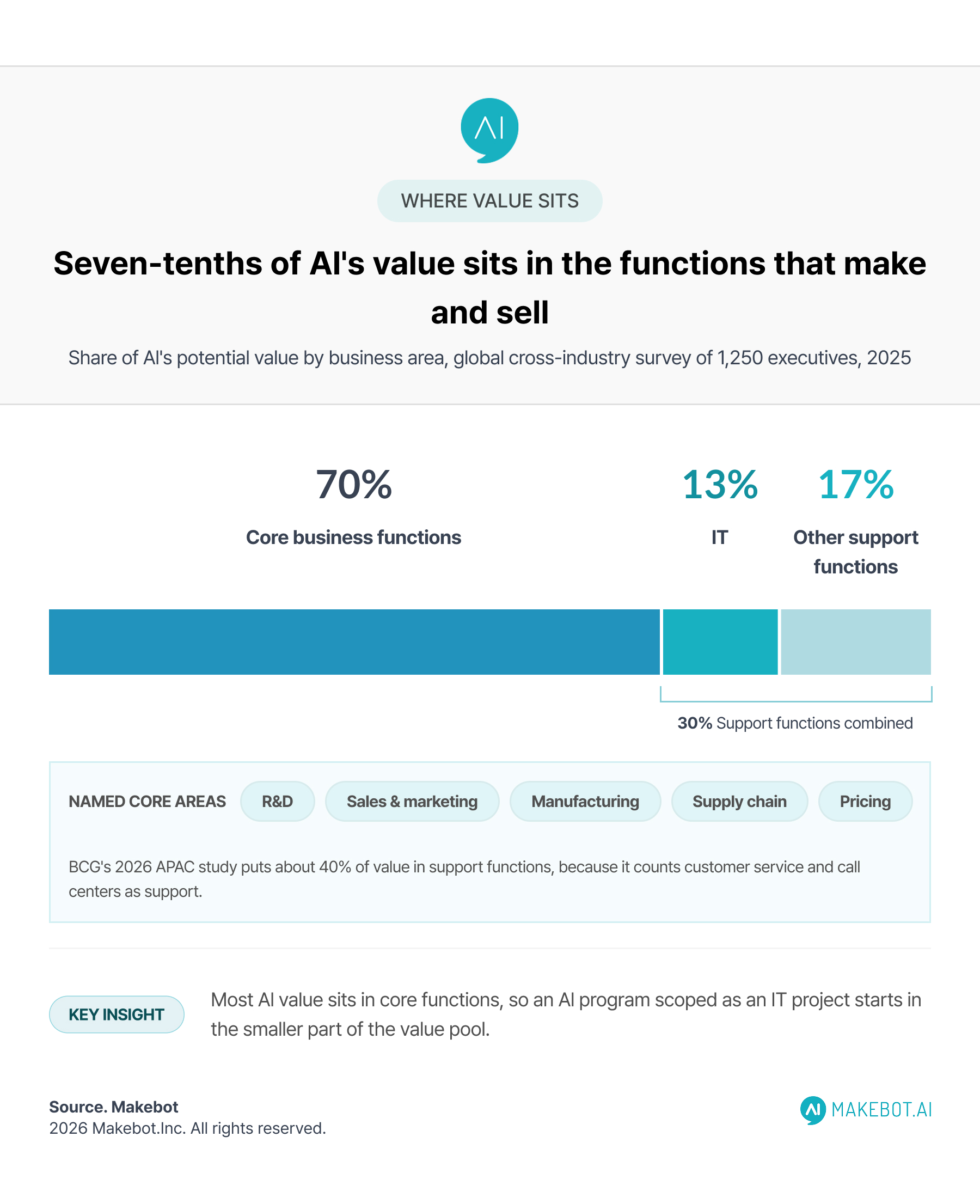
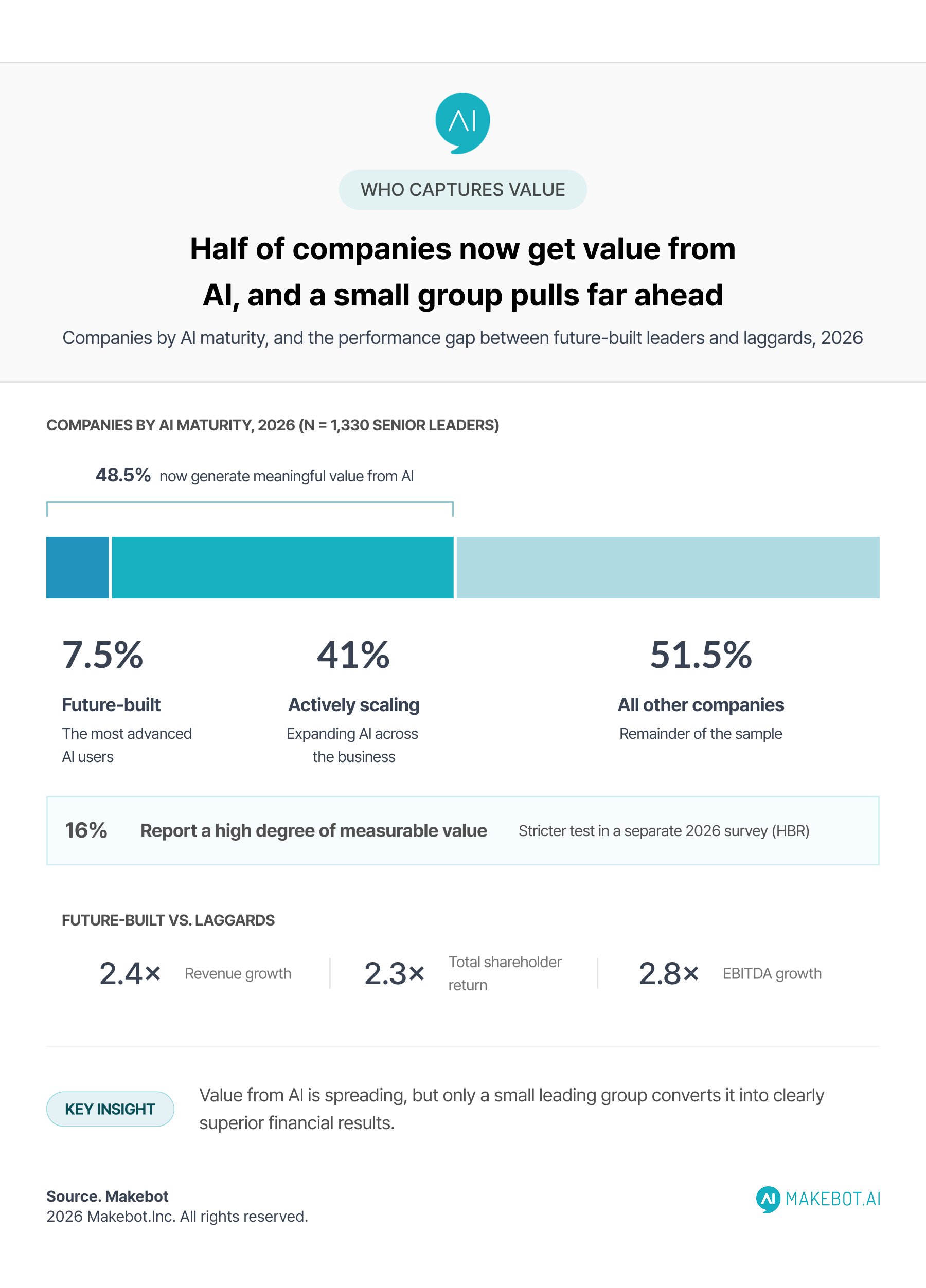
Most companies have moved past asking whether to use AI. The question now is where it pays off. In BCG's 2025 survey of 1,250 executives, 70% of AI's potential value sits in core business functions such as sales and marketing, manufacturing, supply chain, and pricing. Yet in a March 2026 Harvard Business Review Analytic Services survey, only 16% of organizations reported a high degree of measurable value from AI.
The gap is rarely about technology. It is about enterprise AI strategy. Many companies still treat AI as an IT project: roll out a tool, count users, and report time saved. The companies pulling ahead change how work gets done inside the teams that earn money and serve customers.
Where Does Enterprise AI Create the Most Value Today?
Enterprise AI creates the most value in core functions like sales, service and operations, not IT. BCG's 2025 survey places 70% of AI's potential value in core business functions, naming R&D, sales and marketing, manufacturing, supply chain, and pricing. The same tasks repeat all day there, so small gains add up.
More companies are now getting results. BCG's Applied AI Index 2026, based on 1,330 senior leaders, labels 7.5% of companies "future-built" (the most advanced AI users), while another 41% are actively scaling AI. Compared with laggards, the future-built group shows 2.4 times the revenue growth.
Two more points matter for any enterprise AI strategy:
- IT is the exception. IT holds a 13% share of AI value, making it a sensible place to build early skills.
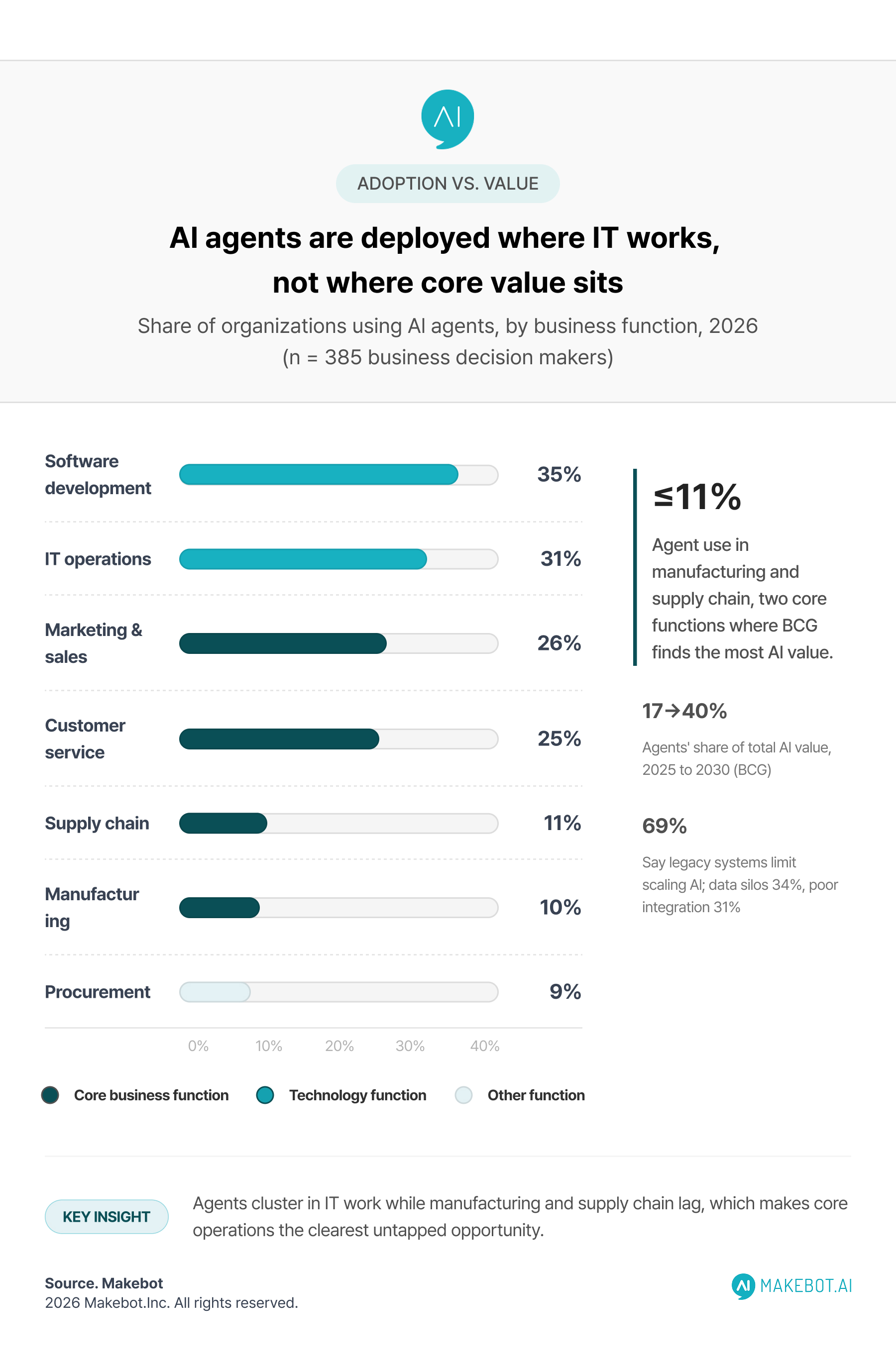
- AI agents raise the stakes. Agents plan and carry out tasks on their own instead of only answering questions. They made up 17% of AI value in 2025, and BCG expects about 40% by 2030. Because agents work inside processes, placement matters more.
Which core function has the strongest evidence of AI ROI?
Customer service has some of the strongest evidence so far. A study in the peer-reviewed Quarterly Journal of Economics followed 5,172 support agents at a Fortune 500 software company. An AI assistant helped agents resolve 15% more chats per hour on average, and 30% more for less-experienced agents. A staggered rollout let researchers isolate the effect. This makes contact centers a natural place to test generative AI use cases: the work is repetitive, rule-based, and easy to count.
Why Do Core Business Functions Beat IT Projects for AI ROI?
Core functions beat IT projects for AI ROI because they change how a company earns money. Time saved only becomes AI ROI when a workflow is redesigned so that time turns into more output or lower spending.
A Danish study of about 25,000 workers, matched to official pay and hours records, shows why. The working paper found that AI chatbots saved users 2.8% of work hours on average, with no significant effect on earnings or recorded hours. Most users spent saved time on other tasks, and 8.4% gained new work, such as checking AI output. Where employers actively encouraged AI use, workers reported benefits 10% to 40% larger.
Company surveys agree. The HBR Analytic Services study found that only 18% have AI built mainly into workflows, yet 71% of those that embed it report moderate or substantial value. An AI business transformation that stops at handing out tools creates activity. One that changes a core workflow creates results.
When AI is run as an IT project, success is measured in users and hours saved, ownership sits with the CIO or a central AI team, and the typical result is scattered time savings. When AI changes a core workflow, success is measured by one financial number, such as cost per case, a business leader is accountable for the result, and the outcome is a measurable change in a business number.
Does the Back-Office Evidence Contradict a Core-Function Strategy?
No, the back-office evidence supports a core-function strategy: value follows high-volume work. The strongest results come wherever AI handles work tied to a clear cost or revenue number. What fails is spreading generic AI tools thinly across the company.
MIT NANDA's 2025 report found that about 95% of companies in its dataset were getting little or no measurable P&L impact from generative AI. Fortune reported that the biggest returns came from back-office automation, such as cutting outsourcing. A BCG APAC report puts around 40% of AI value in support functions, but it counts customer service as support. The winners share a pattern, not a department: high volume, clear rules, and a cost finance already tracks. The 95% figure deserves caution, but one lesson holds: tools bought from specialized vendors succeeded about 67% of the time, while in-house builds succeeded only one-third as often.
How Should Enterprises Choose Which Generative AI Use Cases to Fund?
Enterprises should fund generative AI use cases that are high-volume, rule-based and tied to P&L.
Yet in the HBR data, AI agents are used most in software development (35%) and IT operations (31%) and least in procurement (9%), manufacturing (10%), and supply chain (11%), even though manufacturing and supply chain are core functions where BCG finds most AI value. That gap is an opportunity for well-chosen enterprise AI use cases, though 69% cite legacy systems as a barrier.
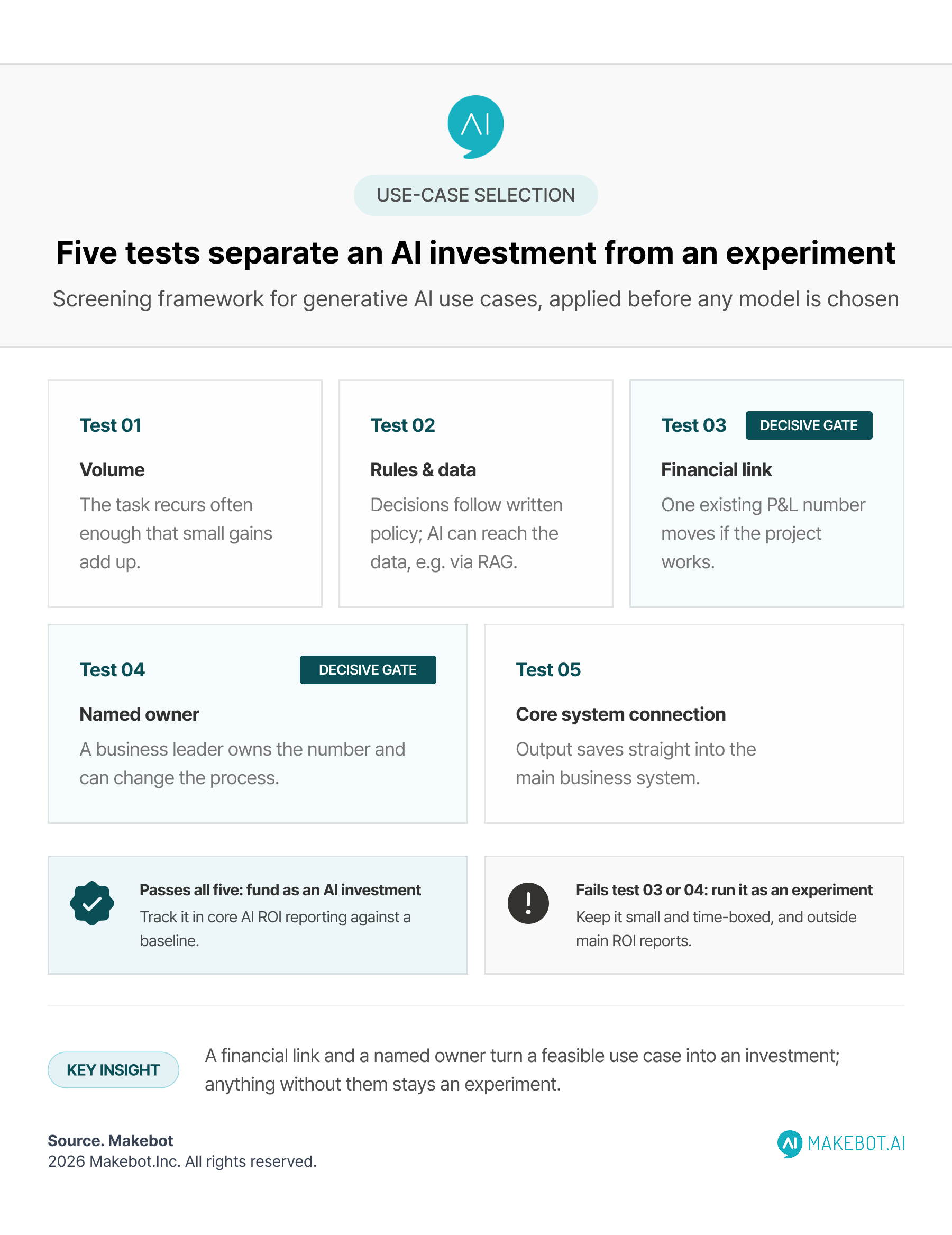
How do you tell a project worth funding from an experiment?
Run each idea through five tests before choosing any AI model:
- Volume: The task happens often enough that small gains add up.
- Rules and data: Decisions follow written policies, and data is reachable, for example through retrieval-augmented generation (RAG), which looks up company documents before answering.
- Financial link: One existing number, such as cost per case or conversion rate, will move if the project works.
- Named owner: A business leader owns that number and has authority to change the process.
- Core system connection: AI output is saved directly into the main business system, not copied by hand.
Ideas that fail test 3 or test 4 are experiments. Keep them small and out of your main AI ROI reports.
How Do You Measure AI ROI Inside a Business Function?
Measure AI ROI in a business function by tracking one metric against a baseline and a control group. Hours saved is an input, not a result.
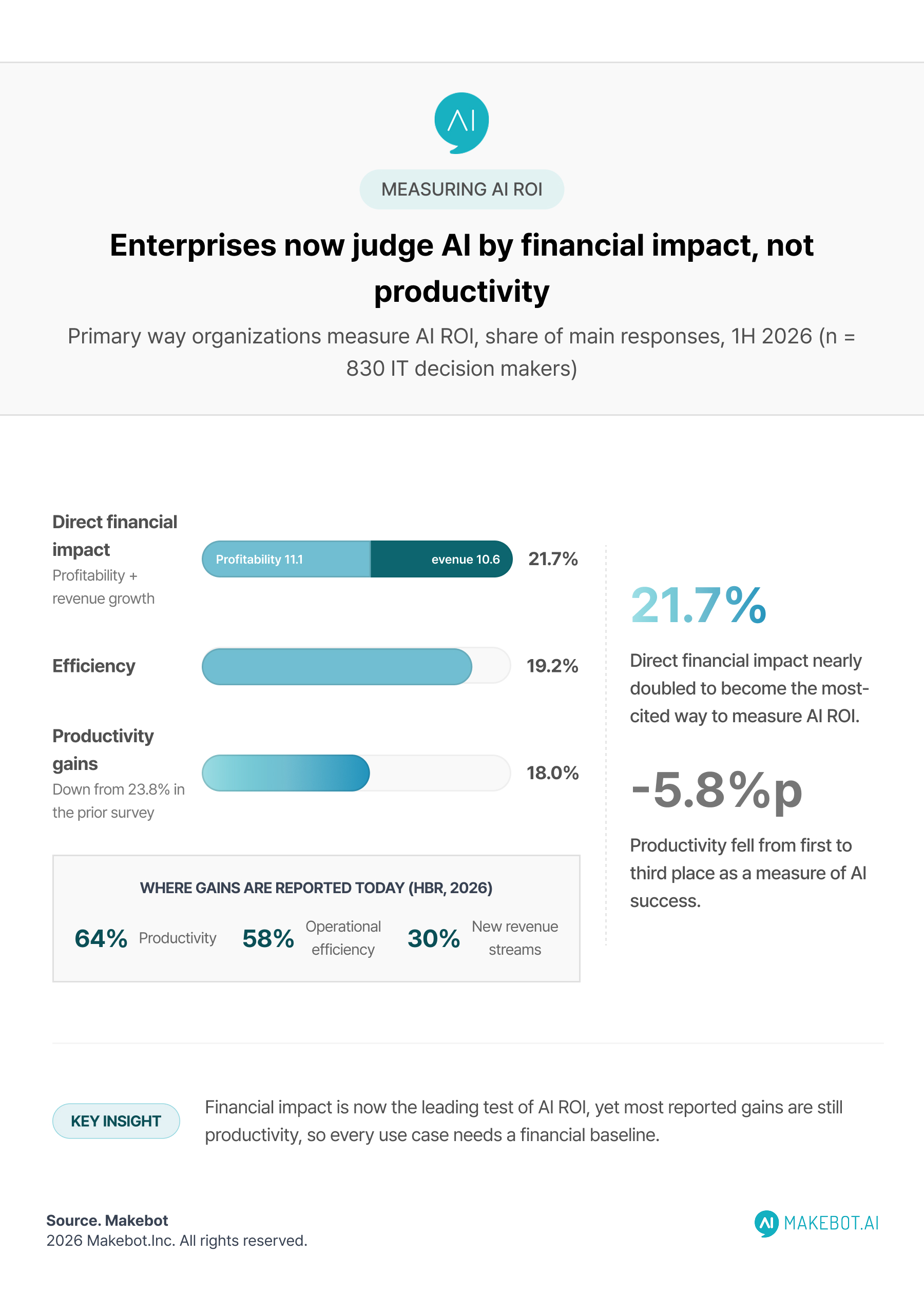
In Futurum's 1H 2026 survey of 830 IT decision makers, direct financial impact nearly doubled to 21.7% of answers on how AI ROI is measured, while productivity fell from 23.8% to 18.0%.
A practical approach has four parts:
- Baseline: Record the target number for at least one full business cycle before launch.
- Comparison group: Roll out to some teams first, as the QJE customer-support study did.
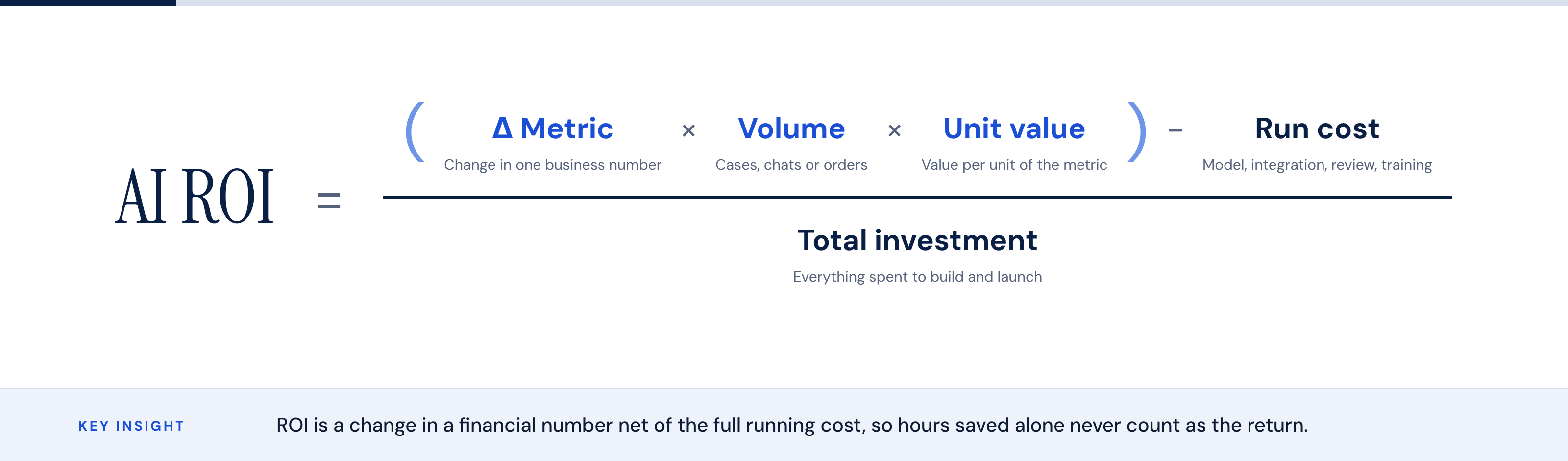
- Full cost: Include model, integration, human review, and training costs, not just licenses.
- Signals: Check operating numbers monthly and financial results quarterly.
Once the inputs are honest, the AI ROI math is simple:
Who Should Own Enterprise AI: The Business or IT?
Business leaders should own enterprise AI results, while IT runs the platform, data and security. This split is the heart of a working AI operating model. BCG's APAC research describes a hub-and-spoke setup: a central AI team sets standards and runs shared platforms, while business teams deliver projects and own the value. MIT NANDA also found that success came partly from empowering line managers.
Budgets already follow this model: more than 80% of company AI spending sits outside the IT budget.
Guardrails, the rules that keep AI within safe limits, need extra attention. 92% of HBR respondents agree AI agents need rules-based guardrails, yet only 48% have defined them. BCG finds that 42% of companies expect agents to make real decisions by 2030, but only 5% have all the needed controls.
How Can Enterprises Move From AI Pilots to Scaled Value?
Enterprises move AI pilots to scaled value by redesigning workflows and naming a business owner. Scaling AI fails when a pilot proves the AI works but nobody changes the process, roles, or budget around it. It succeeds when later projects reuse what the first built. BCG finds that leaders redesign a few high-value workflows end to end, then scale what works.
Five practical steps:
- Pick two or three workflows. Stop pilots that fail the financial or ownership tests.
- Redesign before you deploy. Remove unneeded steps and set human review points.
- Build once and reuse. Shared search, integrations, and oversight make each new project cheaper.
- Invest in adoption, not just access. In the Danish study, employer encouragement nearly doubled chatbot use, from 47% to 83% of workers, and training helped close gaps between groups of workers.
- Budget for running costs and oversight. Futurum found nearly half of companies overspending on AI, and only 17.2% of those pausing or cutting back.
Expect operating numbers to improve first and financial results to follow.
Conclusion: What Should an Enterprise AI Strategy Focus On Next?
An enterprise AI strategy should next focus on the high-volume core workflows that drive revenue. Surveys find most value in core functions, research shows clear gains in customer service, and national data show that handing out tools barely helps. Make business leaders accountable, let IT run the platform, and measure financial change, not hours saved. A good first step is to review your current enterprise AI use cases against the five tests above and stop any pilot that cannot name a number or an owner.






























What Happens to Marketing When the C-Suite Starts Using AI Every Day?






Why AI Shopping Assistants Will Replace Traditional Ecommerce Search
































Why Generative AI Projects Fail and How to Achieve Scalable AI Success