Why Data Readiness, Not Model Choice, Is Stalling Enterprise AI Agents
57% of firms run AI agents. Only 8% say their data is production-ready. The gap explained.


Key Takeaways
- Adoption is ahead of trust. More than half of surveyed organizations pilot or run agents in data and analytics workflows, yet fewer than one in ten say their AI data is ready for production.
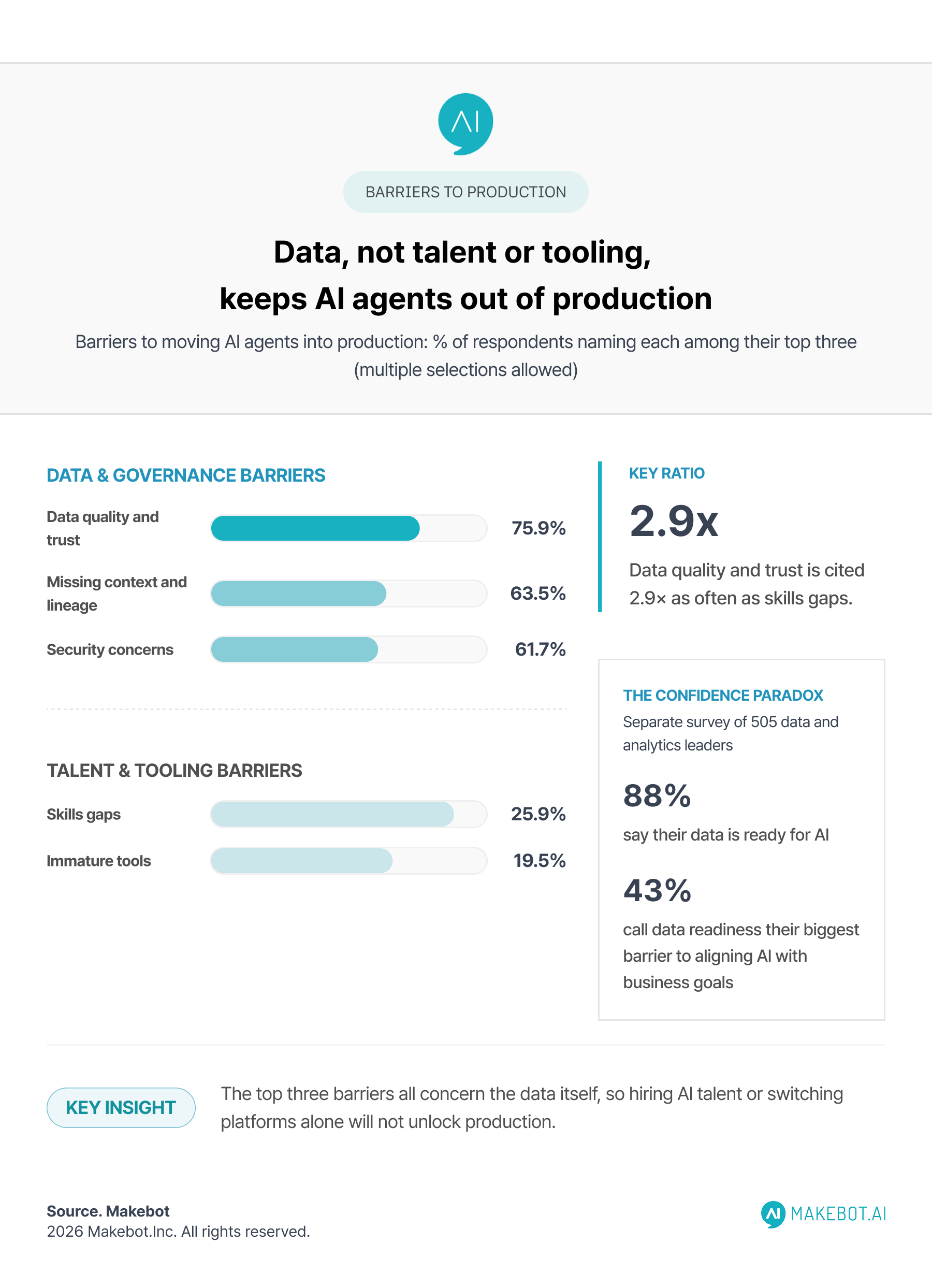
- Data is the biggest blocker. 75.9% of surveyed data leaders and practitioners put data quality and trust among their top three barriers, compared with 25.9% for skills gaps.
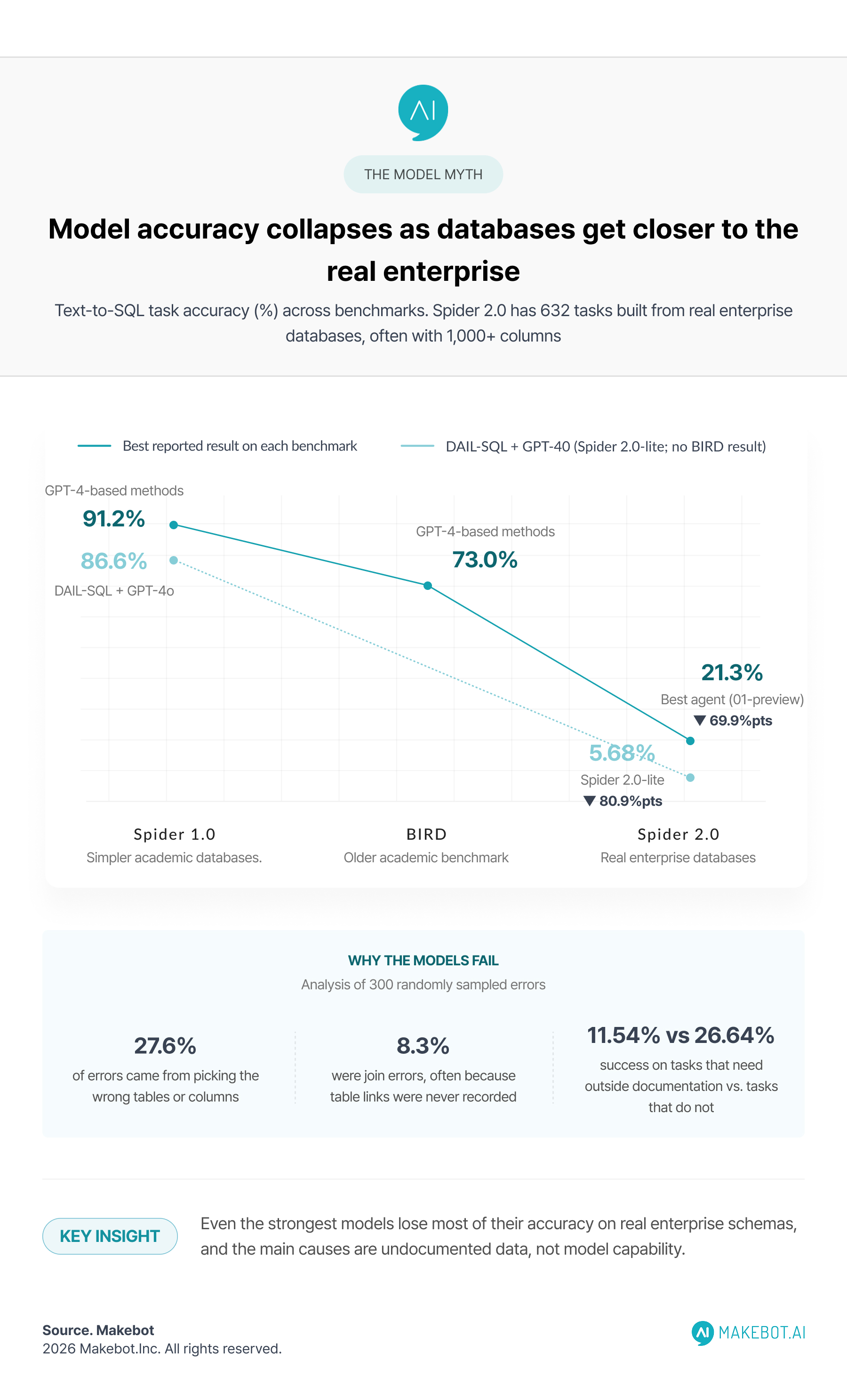
- Better models do not close the gap. On real company databases, the best agent tested solved only 21.3% of tasks, while GPT-4-based methods had scored 91.2% on the simpler Spider 1.0 benchmark.
- Governance builds trust. 71% of organizations with data governance programs report high trust in their data, compared with 50% of those without one.
- Start with one use case. Fixing the data for one workflow creates a pattern you can reuse for the next agent.
AI agents look up information and act on their own, such as answering customers or updating records. Companies are adopting them quickly, but the data they depend on is often not ready.
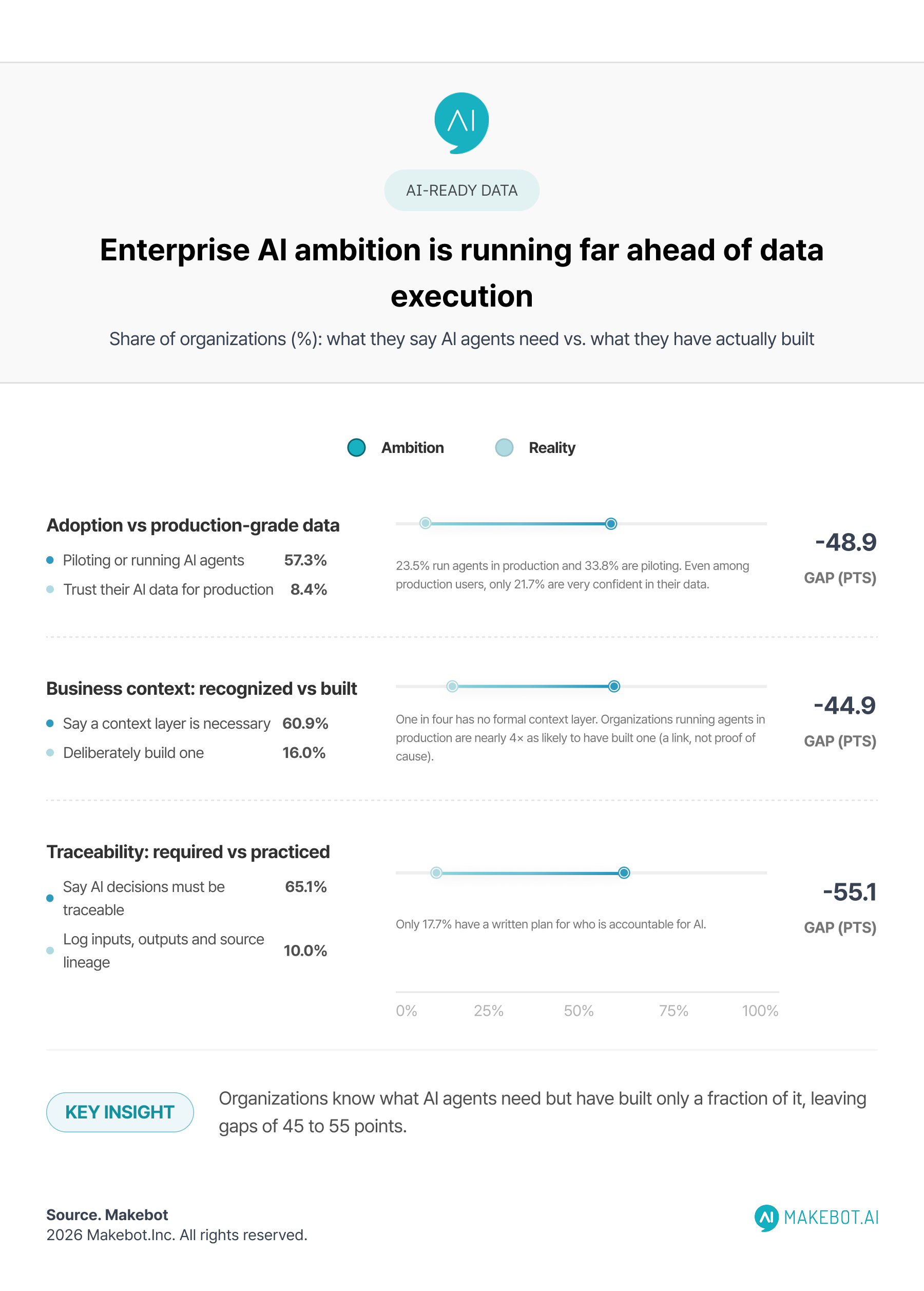
In the third annual Modern Data Survey, 57.3% of organizations said they were piloting or running AI agents in data and analytics workflows, but only 8.4% said the data feeding their AI was trustworthy enough for production. That gap explains why agents impress in demos, then stall in real work.
Many teams assume the fix is a smarter LLM (Large Language Model). The evidence points elsewhere: disconnected systems, missing descriptions, old records and unclear permissions. The real bottleneck for enterprise AI agents is AI-ready data, not the model.
What Is AI-Ready Data?
AI-ready data is accurate, governed, connected data with business context that agents can trust.
A person reading a dashboard knows that "Q3 revenue" in the finance report excludes refunds, while the sales team counts signed deals. An agent does not know this unless someone writes it down and links it to the data. People quietly fix confusion that an agent will treat as fact.
Business context is where most companies fall shortest. In the Modern Data Survey, 60.9% of respondents said a reliable context layer is necessary for AI agents, but only 16.0% deliberately build one, and one in four has none at all. Organizations running agents in production were nearly four times as likely to have built one as those not yet using agents, though the survey authors note this shows a link, not cause and effect.
Confidence can also hide the problem. In the 2026 State of Data Integrity and AI Readiness study of 505 data leaders by Drexel University's LeBow College of Business and Precisely, 88% said their data was AI-ready, yet 43% named data readiness as their biggest barrier to aligning AI with business goals.
Why Do Enterprise AI Agents Stall After the Pilot Stage?
Enterprise AI agents stall after pilots because production data is siloed, outdated and unlabeled.
A pilot hides these problems with hand-picked data, one connected system and an engineer checking every answer, which is why so many AI pilots stall after the proof of concept. Scaling from pilot to production removes those protections at once: live data from many systems, conflicting definitions, role-based permissions and thousands of unsupervised actions a day.
The Modern Data Survey of more than 540 data leaders in 66 countries found 23.5% of organizations running agents in production and 33.8% piloting them. Asked what keeps agents out of production, respondents pointed at the data itself: 75.9% named data quality and trust as a top-three barrier, 63.5% missing context and lineage, and 61.7% security. Only 25.9% cited skills gaps and 19.5% immature tools.
Even among production users, just 21.7% are very confident their data is trustworthy. (The survey is run by a data platform company and still in progress.) None of these gaps is a model problem, so a newer LLM rarely restarts a stalled agent.
Can a Better AI Model Fix Poor Data Readiness?
No. A better model can't fix poor data readiness, because it reasons over the same data gaps.
Weak data still produces confident wrong answers. The clearest evidence is Spider 2.0, presented at ICLR 2025 by a team led by the University of Hong Kong. Its 632 tasks use real company databases, often with more than 1,000 columns. The best agent, built on o1-preview, solved only 21.3% of the tasks. GPT-4-based methods had scored 91.2% on the simpler Spider 1.0 benchmark, and DAIL-SQL with GPT-4o fell from 86.6% on Spider 1.0 to 5.68% on Spider 2.0-lite.
The authors' analysis of 300 randomly sampled errors shows why:
- Wrong tables or columns caused 27.6% of errors.
- Join errors caused 8.3%, often because no links between tables were recorded.
- Tasks needing outside documentation succeeded only 11.54% of the time, versus 26.64% for other tasks.
Each is a data readiness problem: no model can invent a table link or definition the company never wrote down. Prepare the data first, then test models on your own data. A business glossary and documented table links fix the cause, without the ongoing cost of running a bigger model.
Where Does RAG Break When Source Data Is Stale or Contradictory?
RAG breaks at retrieval, pulling stale or contradictory sources into confident but wrong answers.
RAG is often promoted as a cure for made-up answers, but it only works when the documents themselves are trustworthy.
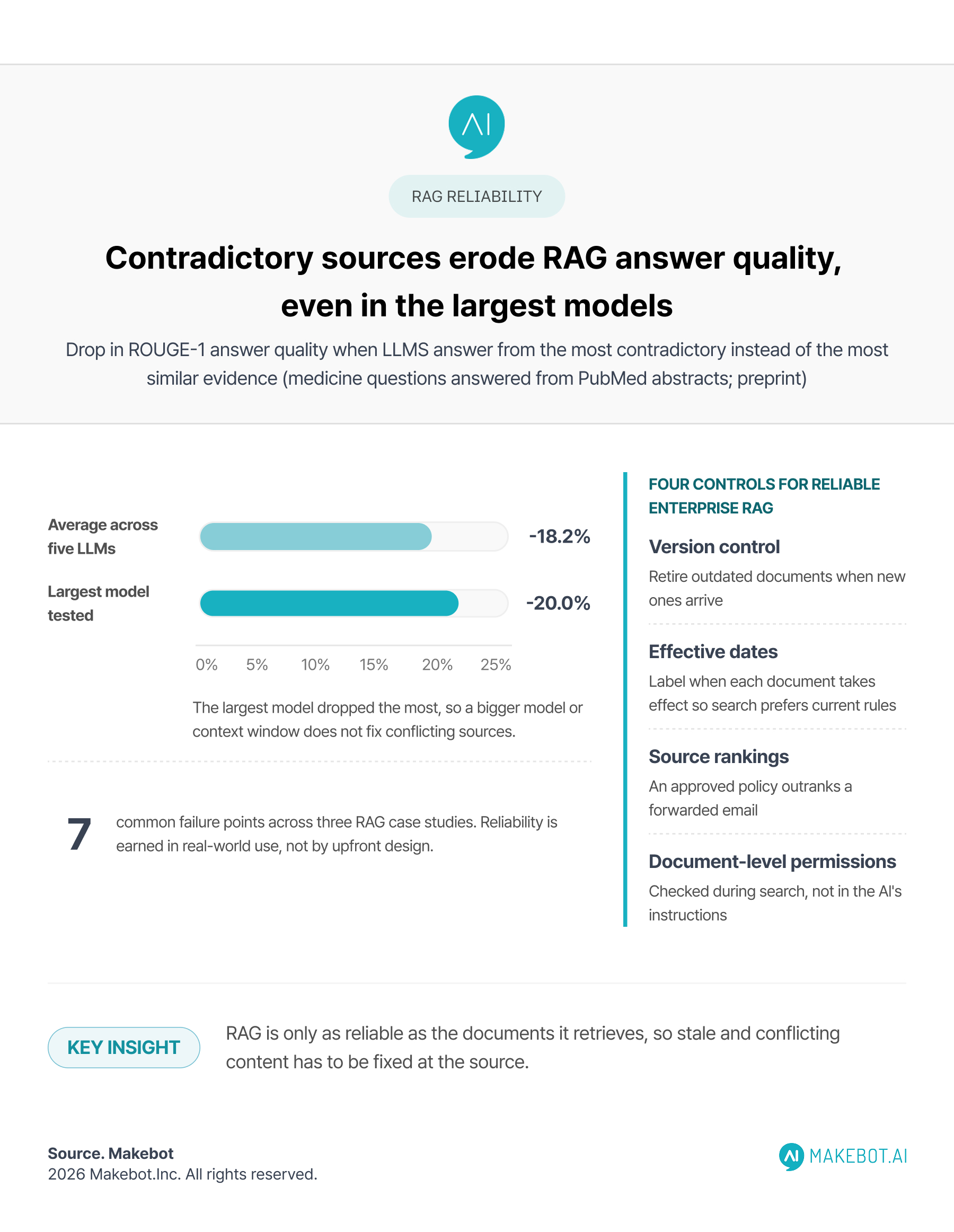
A Deakin University study presented at CAIN 2024 found seven failure points across three RAG systems, which became reliable through real-world use rather than upfront design. A newer RMIT and Deakin preprint, not yet peer reviewed, compared answers built on the most similar evidence with answers built on the most contradictory evidence. ROUGE-1 scores fell 18.2% on average with contradictory evidence, and 20% for the largest model tested. A bigger context window does not solve this, because more text also means more outdated and conflicting text.
Inside companies, an old refund policy or conflicting manuals cause the same problem. Teams that make RAG over enterprise data reliable add version control, effective-date labels, source rankings and document-level permissions checked during search.
How Do You Run a Data Readiness Assessment for AI?
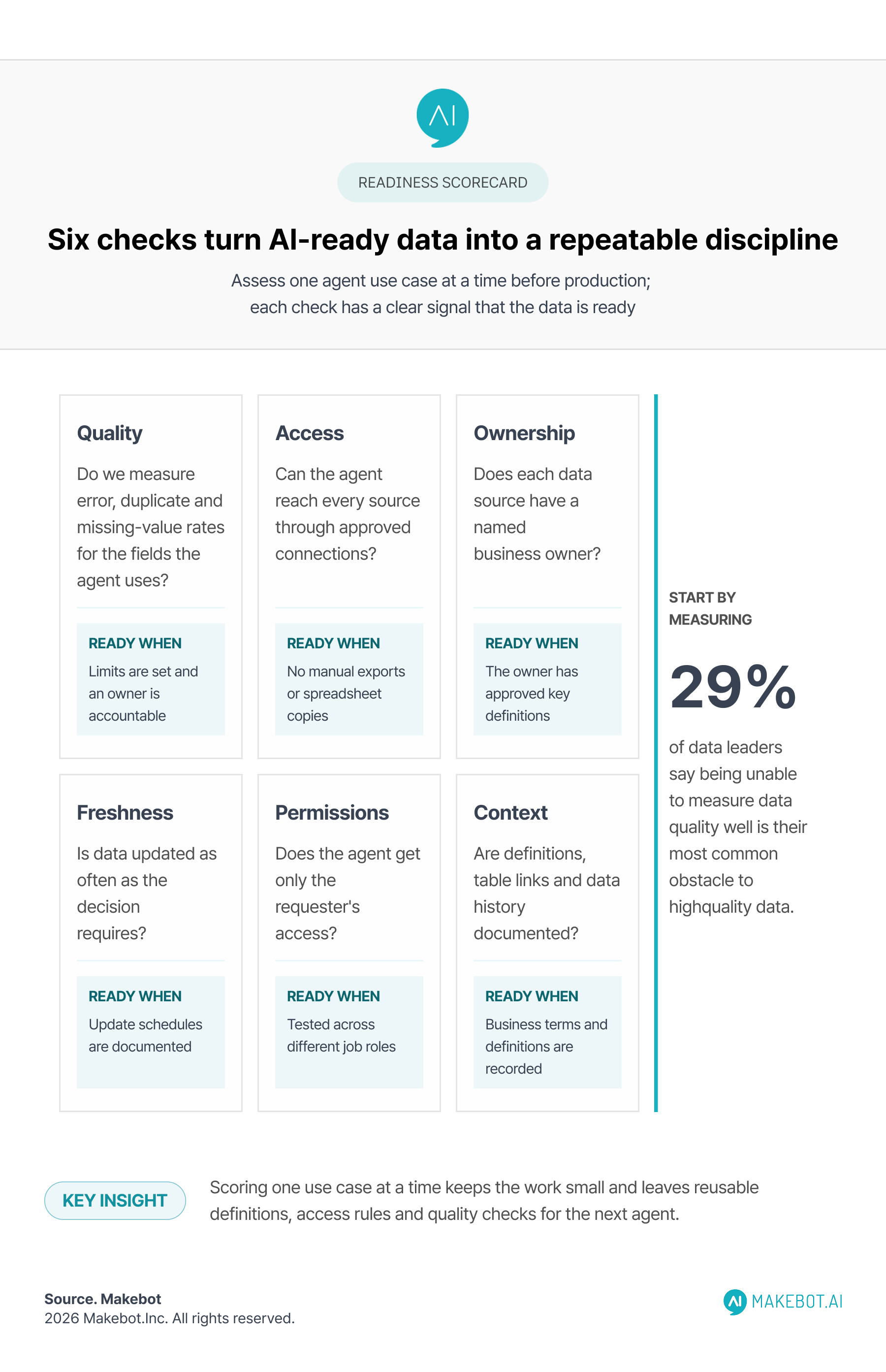
Assess data readiness for AI one use case at a time, scoring six areas from quality to context.
The six areas are quality, access, ownership, freshness, permissions and business context. Working on one clearly defined use case keeps the scope small and shows results sooner than a company-wide project. Measure first: 29% of leaders say being unable to measure data quality is their top obstacle.
What Role Does Data Governance Play for AI Agents?
Data governance for AI agents sets who owns data, what agents can access and how actions are logged.
Data governance for AI also builds trust: 71% of organizations with data governance programs report high trust in their data, compared with 50% without one. Yet 48% have not set up programs to govern the data used for AI.
Traceability is the weakest link. 65.1% of respondents say AI-driven decisions must be explainable and traceable, but only 10% keep both a record of AI inputs and outputs and a link back to source data.
The OWASP GenAI Security Project calls the related risk "Excessive Agency": an AI with more power than its job requires. Its 2026 Top 10 for LLM Applications ranks it third, and its guidance translates into five controls:
- Least privilege: access only to the data a use case needs.
- Act as the user, never a shared admin account.
- Human approval before payouts, deletions and other high-impact actions.
- Checks in the target system, not the AI's judgment.
- Logging of every action.
Regulation raises the stakes. Article 10 of the EU AI Act requires documented data governance for high-risk uses listed in Annex III, such as hiring or credit scoring, and those rules apply from 2 December 2027.
How Can Enterprises Make Their Data AI-Ready?
Enterprises make data AI-ready by fixing one use case at the source, adding controls, then scaling.
- Choose a focused use case with a measurable goal.
- Map its data: sources, owners, update schedules and permissions.
- Fix problems at the source, not in prompts.
- Add metadata and controls: definitions, table links, sensitivity labels and versions.
- Test on realistic data, keeping human approval for high-impact actions.
- Reuse the same checks for the next use case.
Measure business results, not just model accuracy. Only 31% of organizations tie AI metrics to business goals, which makes AI and data spending hard to justify. Track tasks completed without rework, human overrides, data incidents per thousand actions and time to launch the next use case.
What Should Enterprise Leaders Do Next?
Enterprise leaders should next put data readiness first and treat model choice as a later decision.
Surveys show adoption outpacing trust, benchmarks show strong models failing on poorly documented databases, and RAG research shows conflicting sources hurting every model size tested.
The organizations getting enterprise AI agents into production share a habit, not a vendor: they define business context, control what agents can do and build readiness one workflow at a time. Pick the use case closest to production, score its data against the six checks and fix the gaps at the source. The next LLM will arrive either way; its value depends on AI-ready data.
From Data-Ready to Production-Ready
Closing the gap between a promising AI pilot and a production agent that actually works requires both clean data infrastructure and an AI platform built to operate on it. Makebot builds enterprise AI solutions designed to work with real organizational data, not ideal conditions, so teams can move from demos to deployable results without rebuilding from scratch.
Makebot’s AI Strategic Whitepaper Vol.04, From the PoC Graveyard to Production: Enterprise AI Execution with a Unified Intelligence Core, takes this argument further. It shows how scattered databases and isolated Intelligence Islands make a unified, real-time business context structurally impossible. Its answer is a Unified Intelligence Core (UIC), a model-agnostic layer that manages state, memory and routing in one place and keeps every agent working from a single source of truth, with Human-in-the-Loop gates built in as a platform standard. For leaders trying to move agents from pilot to production, download the whitepaper for the full blueprint.

























What Happens to Marketing When the C-Suite Starts Using AI Every Day?







Why AI Shopping Assistants Will Replace Traditional Ecommerce Search
































Why Generative AI Projects Fail and How to Achieve Scalable AI Success































Interview Feature: Why Companies Are Betting Big on Generative AI