Why AI Coding Agents Are Forcing Enterprises to Rethink Build Versus Buy
Learn when enterprises should build, buy, or combine both in the agentic coding era.


Key Takeaways
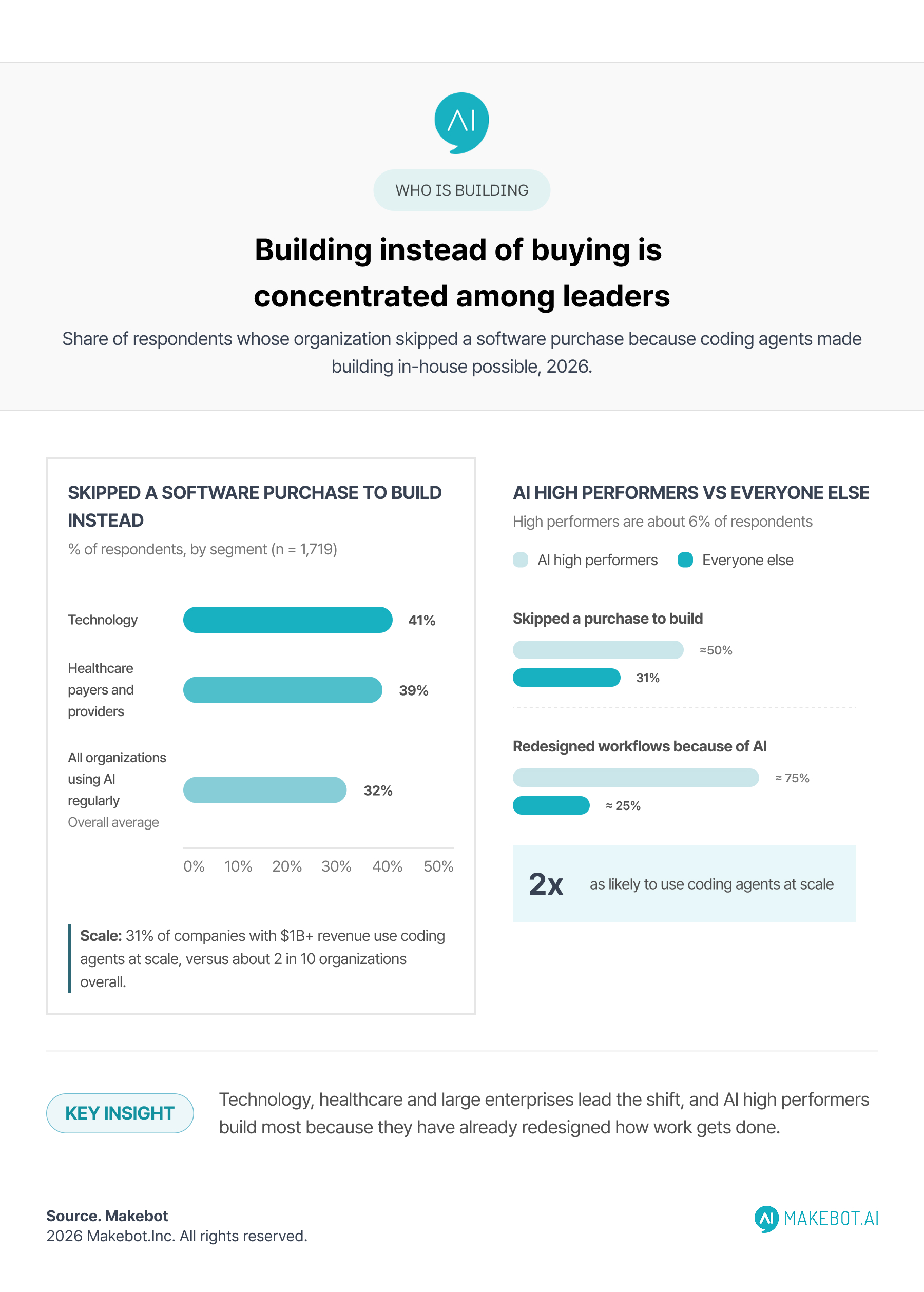
- Building is back on the table. 32% of McKinsey respondents skipped a software purchase because coding agents could build it. Among top AI performers, the figure is close to half.
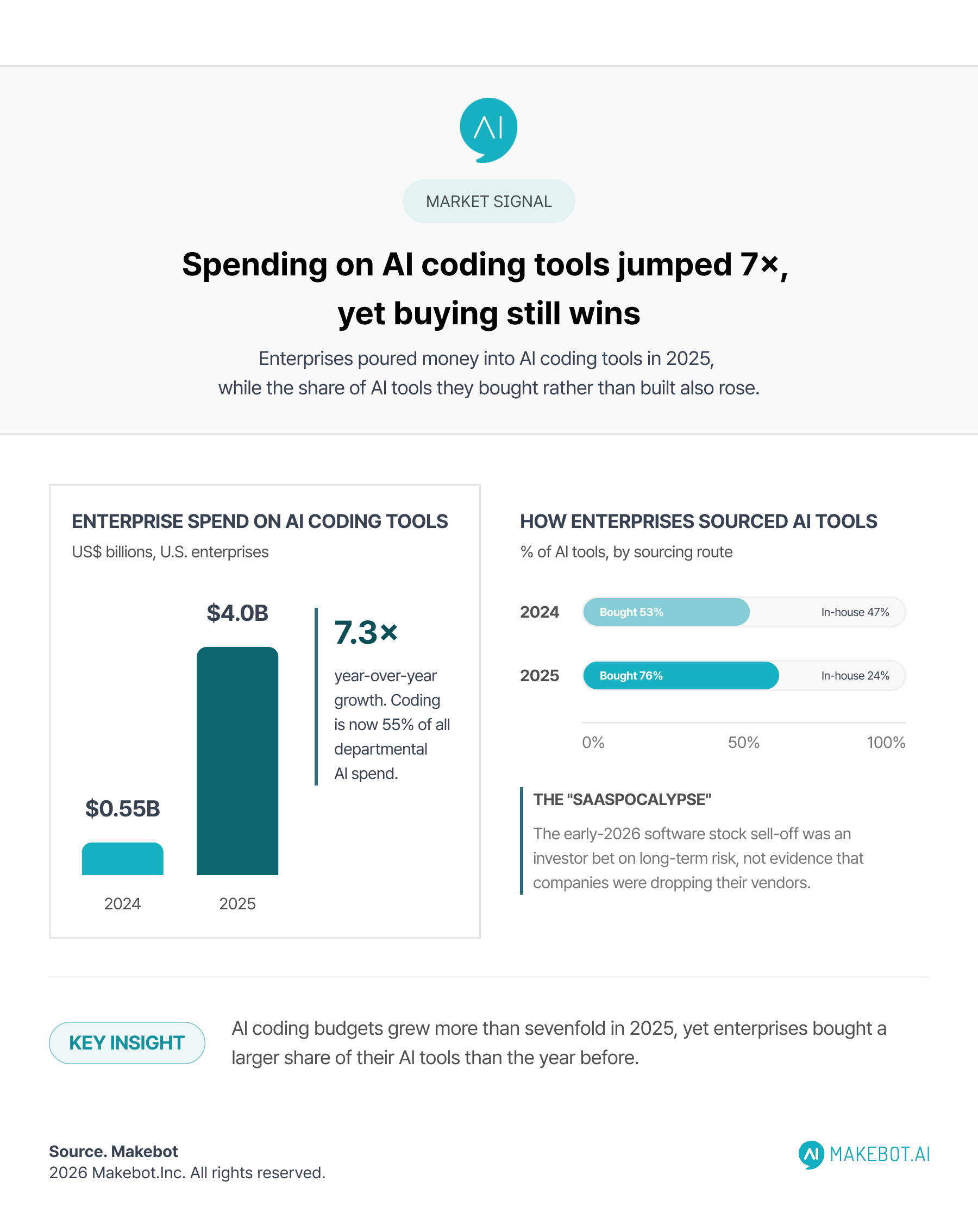
- The shift is narrow. Companies still bought 76% of their AI tools in 2025. They are building single features and workflows, not replacing whole platforms.
- Code is cheaper to write, not to own. Developers spend 31% of their day on AI-related work no productivity metric tracks, and review, maintenance, and token costs recur every year.
- Security still needs independent checks. AI-written code passed only 62% of Veracode's October 2026 security tests, and coding-focused large language models (LLMs) still scored lower than general-purpose ones.
- Decide workflow by workflow: buy, boost, or build. Buy what is regulated or commodity, extend a purchased enterprise AI platform with agent-built layers, and build from scratch only where a unique workflow has a team to own it.
Every company that needs new software faces the same question: build it in-house or buy it from a vendor? For most of the SaaS era (software rented online by subscription), the answer to the build vs buy software question was "buy." Engineers were scarce and expensive, so companies saved them for work that set the business apart.
AI coding agents are changing that. These are AI tools that can plan a programming task, write the code, test it, and fix their own mistakes. In McKinsey's State of AI 2026 survey of 1,719 people, 32% of those at organizations that regularly use AI had skipped at least one software purchase because agentic coding tools let them build it in-house.
That is only half the story. Menlo Ventures found U.S. enterprises still bought 76% of their AI tools in 2025, up from 53% a year earlier. And Veracode's October 2026 testing found AI-written code still had security flaws in about 38% of tasks when given no security instructions. Agents make code cheaper to write. They do not make software cheaper to own.
Why Are AI Coding Agents Reopening the Build vs Buy Debate Now?
AI coding agents are reopening the build vs buy debate because they remove the engineering shortage.
Agents now handle multi-step programming tasks, so a small internal team can produce working tools far faster than before.
Menlo Ventures estimates enterprise spending on AI coding tools jumped from $550 million in 2024 to $4.0 billion in 2025, 55% of all departmental AI spending. Models that understand a whole codebase turned coding tools from narrow helpers into end-to-end automation.
McKinsey's survey shows where buying is changing fastest: 41% of technology respondents and 39% of healthcare payer and provider respondents skipped a purchase to build, and companies with over $1 billion in revenue lead in using coding agents at scale.
The early-2026 "SaaSpocalypse" software stock sell-off was a bet on long-term risk, according to JLL, not proof that companies were dropping vendors. The real change is concentrated in firms with strong engineering teams.
How Are AI Coding Agents Changing the Build vs Buy Decision?
AI coding agents change the build vs buy decision by making single features and tools cheap to build.
The first version used to be the most expensive part of software. Agentic coding, where an AI agent does much of the programming, shrinks it: an agent can search a codebase, edit files, run commands, and keep fixing problems. What it does not shrink is the work that comes after launch.
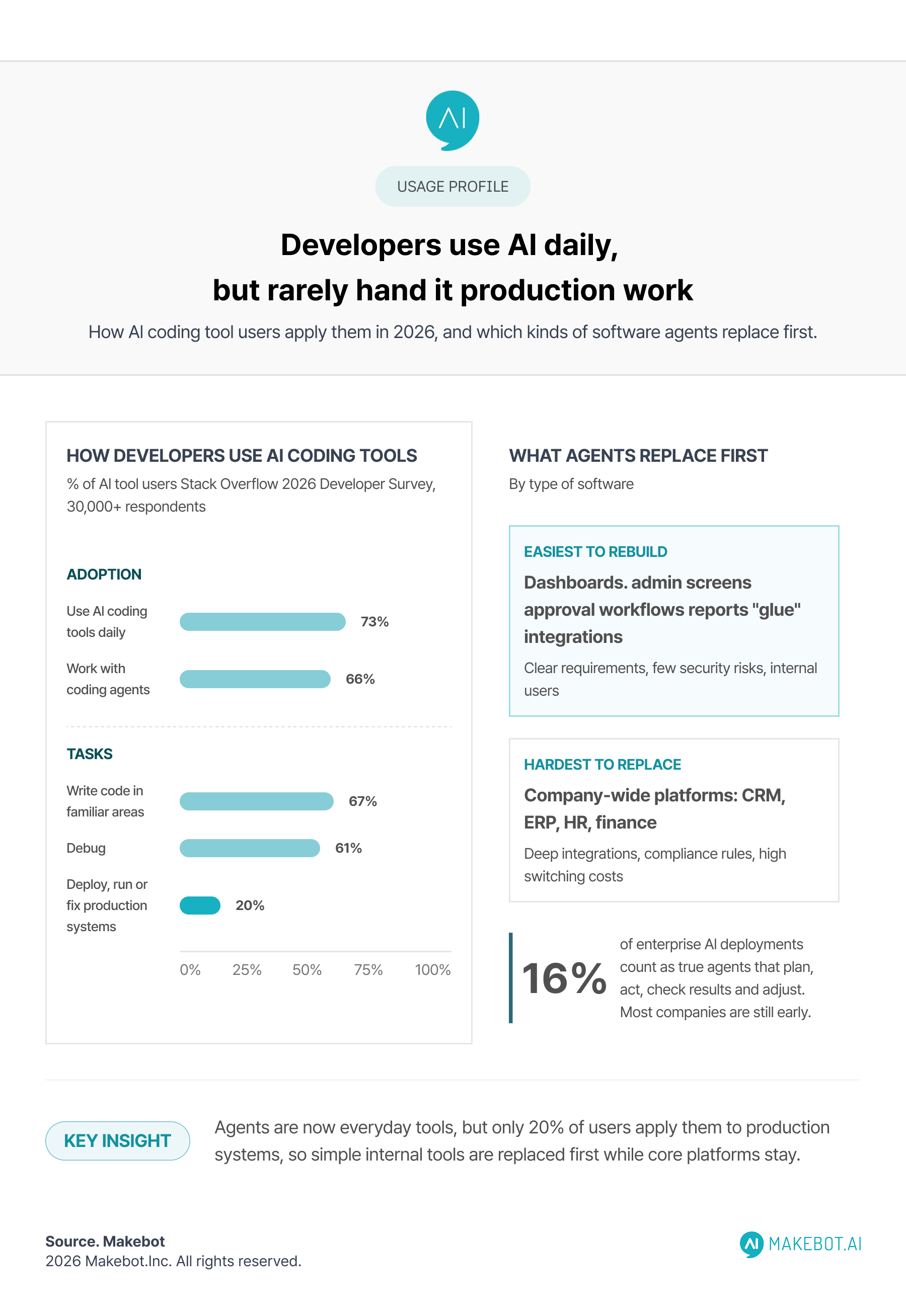
That gap shows which software is easiest to replace: dashboards, admin screens, approval workflows, reports, and small "glue" programs with clear requirements and internal users. JLL's review agrees that AI-built tools replace simple utilities far more easily than critical platforms. Developers also keep agents away from the riskiest work: in the Stack Overflow 2026 Developer Survey, 73% of AI coding tool users use them daily, but only 20% use AI to deploy, run, or fix live production systems.
"Build vs buy" now has three options: build from scratch, buy as is, or buy and extend. Agents make the third much cheaper, so start there.
Do AI Coding Agents Make Building Software Cheaper Than Buying It?
AI coding agents make building software cheaper to start, but not always cheaper than buying over time.
Testing, security, upkeep, AI fees, and support remain, so the total cost of ownership falls far less than the cost of the first build.
In a randomized METR trial using early-2025 tools, experienced developers expected AI to make them 24% faster. Instead, tasks took 19% longer, yet they still believed they had been 20% faster. METR's February 2026 update says gains are probably larger now but could not measure them. Perceived speed is not a business case.
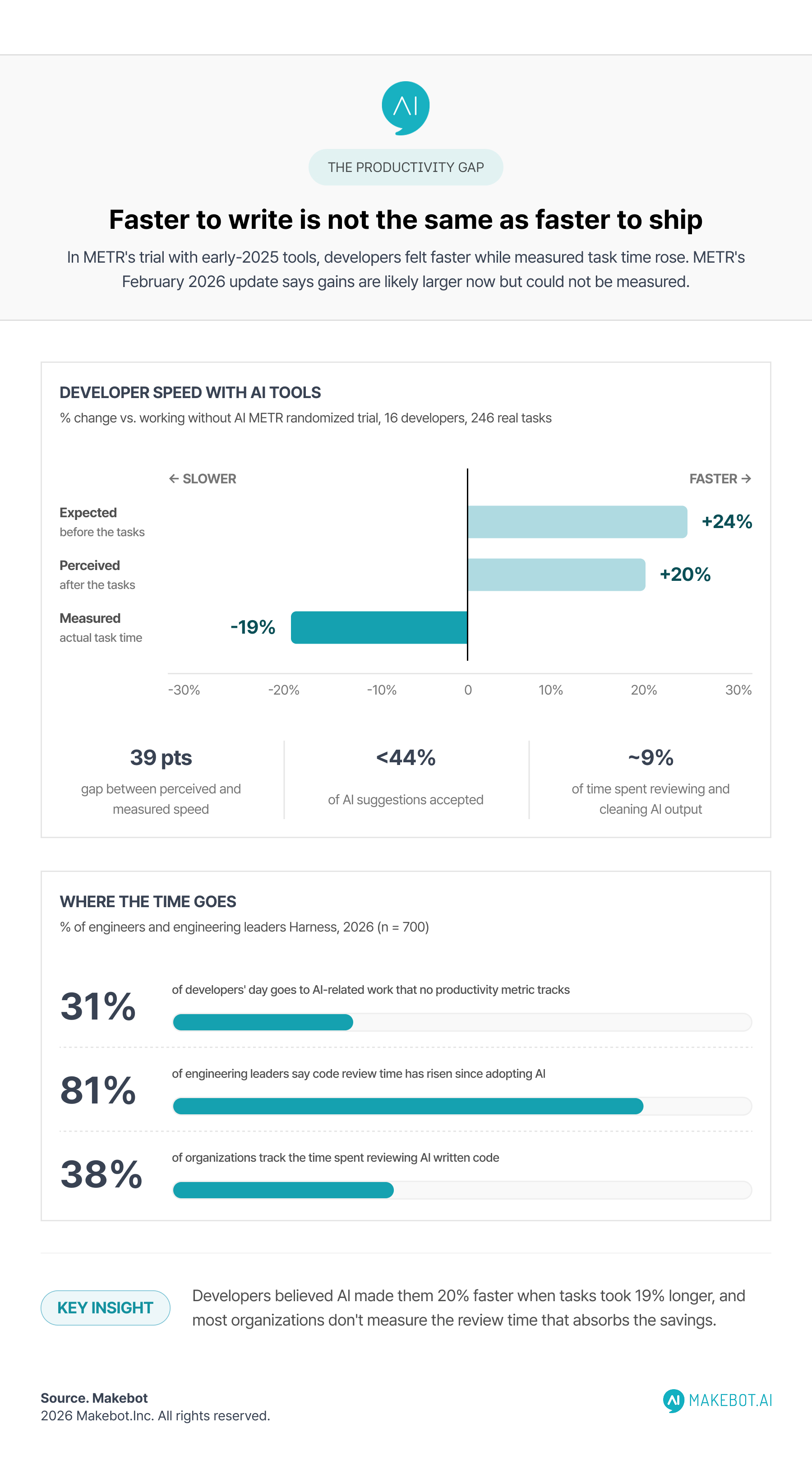
The Harness State of Engineering Excellence 2026 survey agrees:
- Developers spend 31% of their day on untracked AI-related work.
- 81% of engineering leaders say code review time has gone up since adopting AI.
- Only 38% of organizations track time spent reviewing AI-written code.
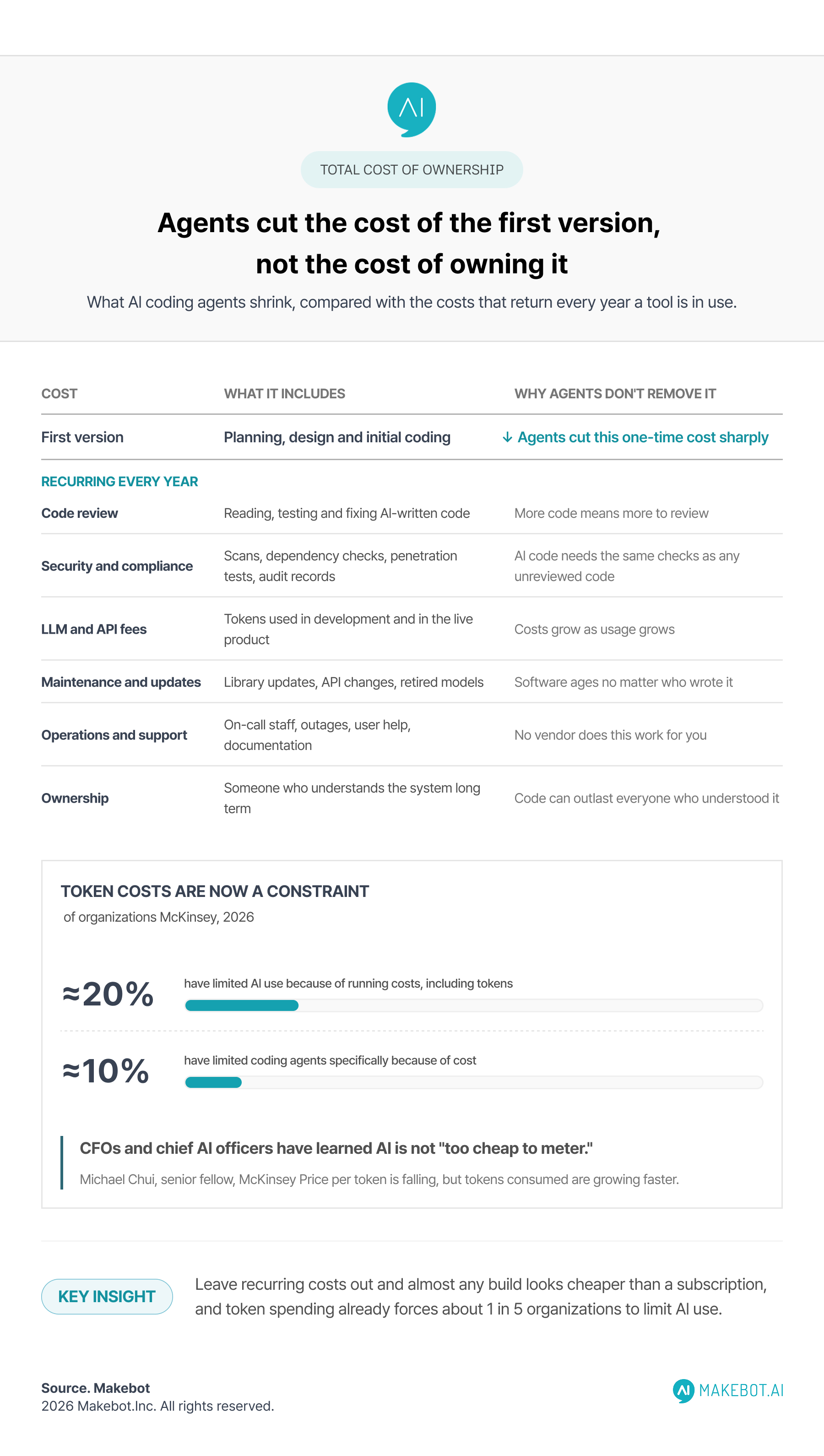
Tokens, the text units AI providers bill by, add a newer cost. McKinsey reports about 20% of organizations have limited AI use because of running costs. Prices per token are falling, but usage is growing faster.
What Hidden Costs Belong in a Build vs Buy Analysis?
Agents cut the one-time cost of the first version, but these costs recur every year. Leave them out, and almost any build looks cheaper.
When Should an Enterprise Still Buy Software Instead of Building It?
Enterprises should still buy software that is a commodity, heavily regulated, or reliant on vendor AI.
Core systems such as CRM, ERP, HR, and finance remain strong buy choices because the vendor handles security, uptime, and compliance.
For regulated data, security is decisive. Veracode's July 2026 report found code from more than 100 AI models passed only 56% of security tests without security instructions. Its October update showed the first real gain, to 62%, with the best models reaching 73%, but Java code passed only 31%. AI-written code needs independent security checks before going live.
Signs that buying is the better choice:
- It is a commodity that competitors use too.
- It handles sensitive data, such as health, financial, or personal data where audits matter.
- The vendor's AI is the product.
- No team can own it for the next three to five years.
When Does Building With AI Coding Agents Make More Sense?
Building with AI coding agents makes sense for unique workflows on core data with a team to own them.
Agents make these custom AI solutions faster to deliver, but ownership, not coding speed, should decide.
McKinsey's data shows "AI high performers" (about 6% of respondents) are twice as likely to use coding agents at scale, and nearly three-quarters have redesigned how work gets done, versus one-quarter of others.
Strong build cases involve a differentiating process (underwriting, routing, pricing), heavy integration that another product would only silo, data that should stay in-house, and a team to own it. A claims team needing one screen that combines policy data, adjuster notes, and fraud signals, with no product that fits, has a good case. A basic ticketing tool built to avoid a license fee usually does not.
Your AI model strategy matters too. Building on an LLM means owning prompts, search over company data, testing, and upgrades. Menlo found only 16% of enterprise AI deployments are true agents, so most companies are still early.
Is a Hybrid Build and Buy Approach Better for Enterprise AI?
A hybrid build and buy approach is best for most enterprises: buy the AI platform, then build on top.
A hybrid model means buying the core enterprise AI platform (secure LLM access, security controls, enterprise search, monitoring), then using agents to build workflows, integrations, and screens on top.
JLL calls this a "buy, boost, build" portfolio, decided workflow by workflow.
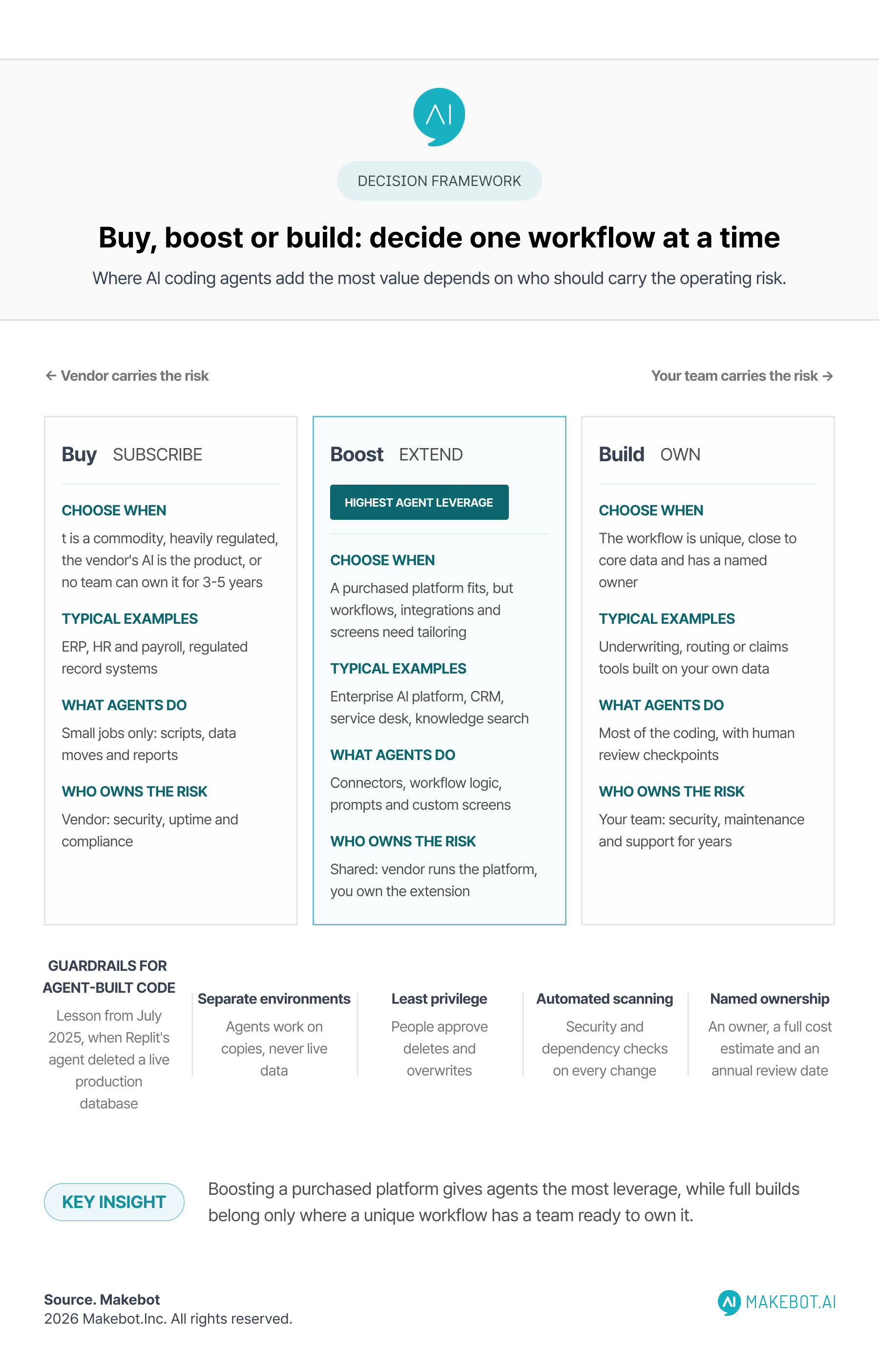
"Boost," building on an existing platform, is where agents help most: the vendor keeps uptime, hosting, and compliance, while your agents write the connecting code.
What Guardrails Should Govern Agentic Coding in Production?
Agentic coding needs the same safety controls as any automated system with powerful access. In July 2025, Replit's AI coding agent deleted a live production database despite instructions not to change code without permission. JLL blames missing environment separation, no approval steps, and overly broad permissions. Every build should include:
- Separate environments: agents never touch live data.
- Limited permissions: a person approves deletes and overwrites.
- Automatic scanning: security and dependency checks on every change.
- Clear ownership: a named owner, full cost estimate, and review date.
What Should Enterprise Leaders Do Next About Build vs Buy?
Enterprise leaders should buy core systems, boost their AI platform, and build only where they have an edge.
AI coding agents have not ended the case for buying; they have moved the line. Full builds belong only where your workflows and data give you an edge and a named team can own the result.
Start by checking every software renewal due in the next 12 months against the hidden-cost table, then decide: buy, boost, or build.
Build, Buy, or Partner Smarter
For enterprises navigating the build vs. buy decision in the agentic AI era, the right answer often depends on where differentiation actually lives. Makebot offers enterprise AI solutions that let organizations move fast without taking on the full cost of building and maintaining custom systems, so teams can focus development effort where it matters most.
Makebot’s AI Strategic Whitepaper Vol.05, Connection, Not the Model, Wins: Vertical Intelligence for AI in Six Industries, shows what the “buy, boost, build” approach looks like at enterprise scale. It argues that AI’s competitive edge comes from how well models connect to the business around them, not from the model itself, and that scattered single-purpose tools leave companies stuck in Intelligence Islands and the Infra Trap of vendor lock-in. Its answer is a three-layer Unified Intelligence Core (UIC) that keeps business logic separate from any one model, so teams can build on top without rebuilding when models change.
For leaders deciding what to buy, boost, or build, download the whitepaper for the full framework and a 12-month roadmap.



























What Happens to Marketing When the C-Suite Starts Using AI Every Day?







Why AI Shopping Assistants Will Replace Traditional Ecommerce Search
































Why Generative AI Projects Fail and How to Achieve Scalable AI Success