How to Measure Hospital Callbot and Chatbot ROI
Measure hospital callbot ROI with three levers: call deflection, staff hours saved, no-show rate.


Key Takeaways
- Hospital AI chatbot ROI comes down to one comparison: the staff time and recovered visits the bot creates each month versus everything the bot costs, measured against a pre-launch baseline.
- Only count calls the bot fully solved. In a Mount Sinai voice AI pilot, 86.4% of calls were completed, but only 36.6% needed no nurse follow-up.
- Saved hours only become saved money when they are reused. In MGMA's August 2026 poll, leaders more often said AI moved work to other tasks (37% of mentions) than reduced it (29%).
- Targeted outreach beats reminders alone. Reminders raise attendance about 11%, while a Penn Medicine trial cut no-shows among high-risk patients from 11.3% to 9.6% by adding automated calls.
- Measure for at least one full quarter after launch, because voice AI healthcare tools can improve over the first few months.
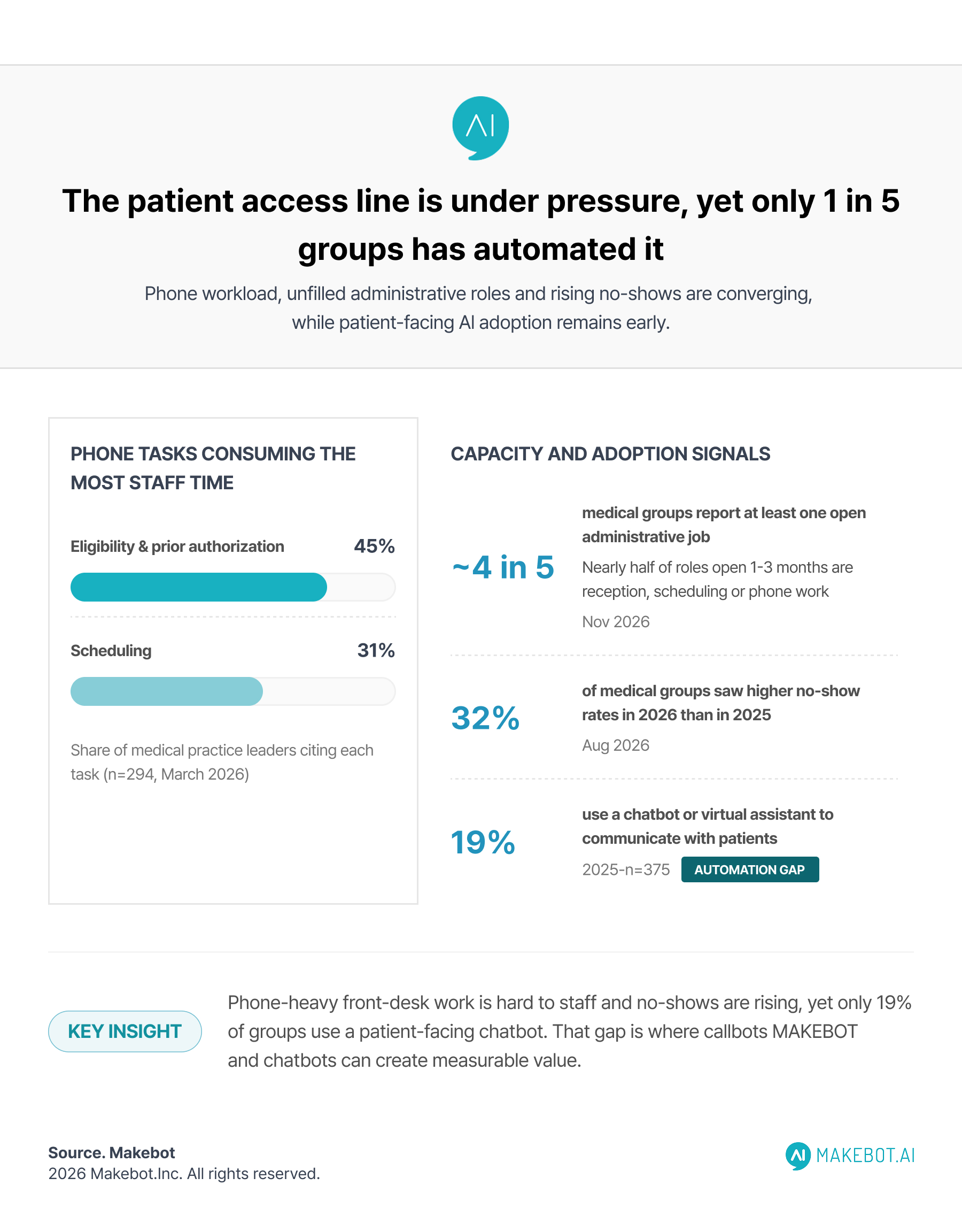
For most patients, booking or changing a hospital appointment still starts with a phone call, and that phone line is getting harder to staff. In a March 2026 MGMA Stat poll of 294 practice leaders, 31% named scheduling as the phone task that takes the most staff time, behind only eligibility and prior authorization (45%). By November 2026, about four in five medical groups had at least one open administrative job. Missed visits are rising too: 32% of medical groups reported higher no-show rates in 2026 than in 2025.
Conversational AI healthcare tools, meaning callbots that answer phone calls and chatbots that reply by text, can book, confirm, remind and reschedule patients without a staff member. They take routine work off the healthcare call center. This guide shows how to prove the bot paid for itself, using three measures: call deflection, staff hours saved and no-show rate.
How Do You Measure AI Chatbot ROI in a Hospital?
Hospital AI chatbot ROI is measured by comparing monthly staff-time and visit gains with total bot cost.
Value staff time at a fully loaded hourly rate. Value recovered visits at contribution margin (what a visit brings in minus its direct costs), not the billed price. Compare every number with the same pre-launch baseline.
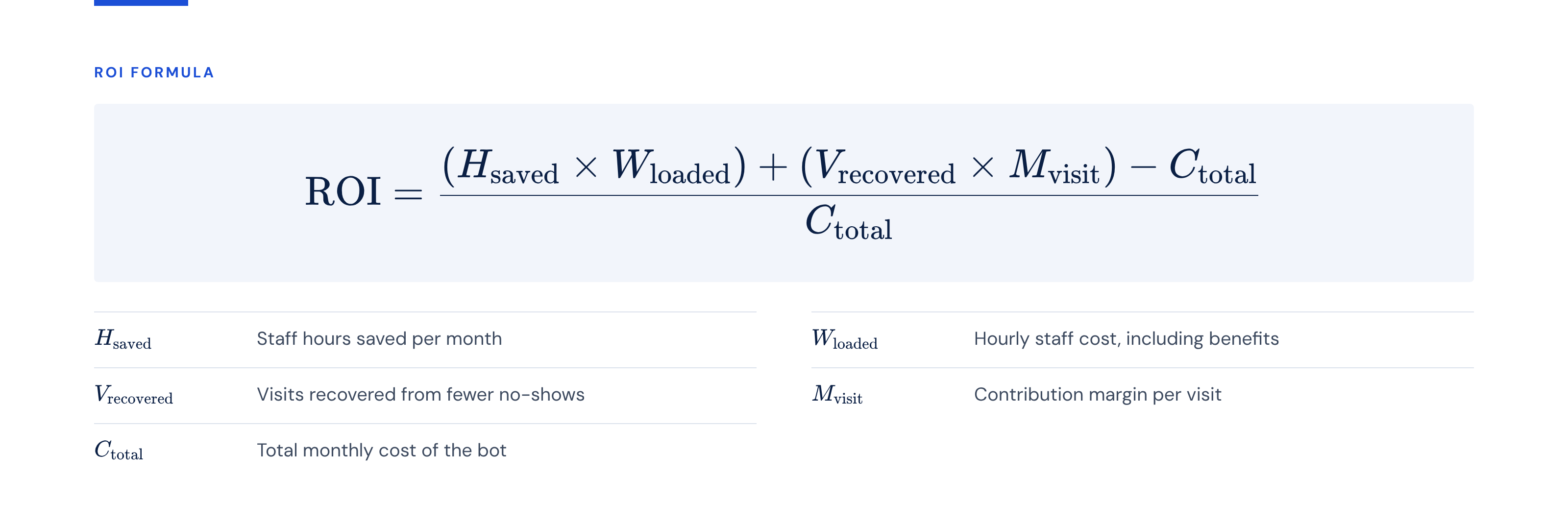
H is staff hours saved each month and W is the hourly staff cost, including benefits. V is visits recovered from fewer no-shows, M is the contribution margin per visit, and C is the bot's total monthly cost. Use your own rates; the BLS 2025 national median of $22.08 an hour for medical secretaries is a reference point.
What costs should hospitals include?
Business cases often look better than they should because some costs are left out. A fair total includes:
- Software and usage: license fees plus per-minute or per-message charges.
- Integration: connecting the bot to the EMR scheduling system, the phone system and identity checks.
- Oversight: staff time to review transcripts, fix weak spots and handle hand-offs.
- Governance: privacy review, consent rules and clinical safety sign-off.
What Is Call Deflection Rate in a Hospital Call Center?
Call deflection rate is the share of hospital calls a callbot fully resolves with no staff follow-up.
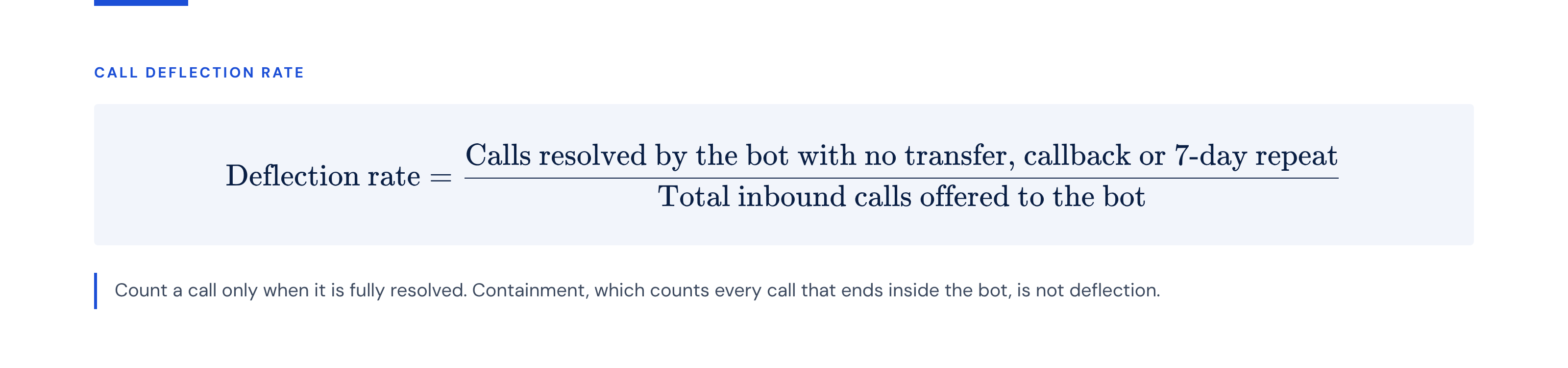
Fully resolved means no transfer, no callback and no repeat call about the same issue within a set window, such as seven days. Containment is looser: it only counts calls that ended inside the bot.
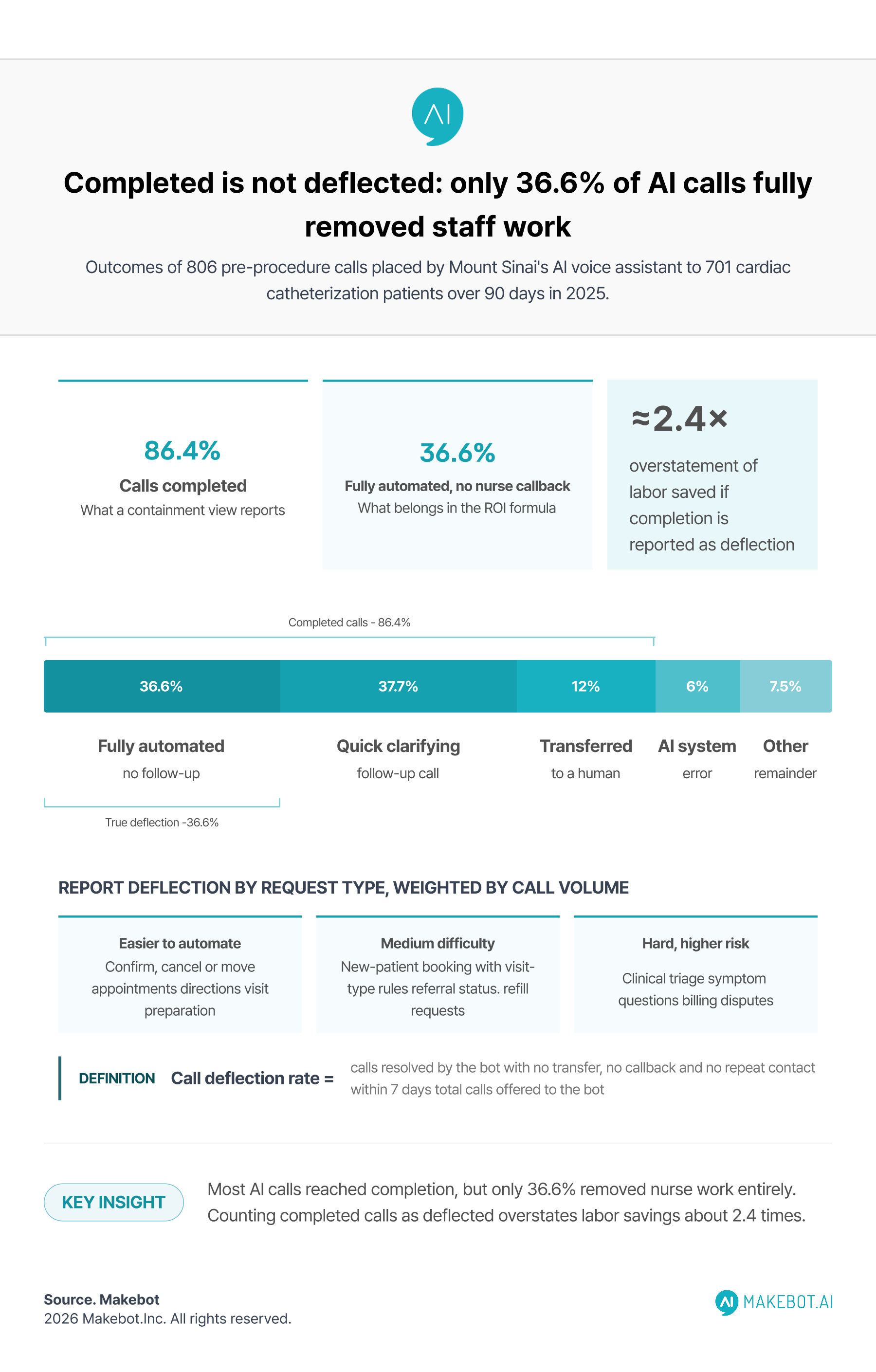
Over 90 days in 2025, Mount Sinai's AI voice assistant made 806 pre-procedure calls to 701 cardiac catheterization patients. Of those calls, 86.4% were completed, but only 36.6% were fully automated with no nurse callback. Another 37.7% needed a quick clarifying call, and 6.0% failed because of AI system errors. Only the strict 36.6% belongs in the ROI formula; reporting 86.4% would more than double the labor saved.
Which call types should a healthcare call center automate first?
Measure deflection for each request type, then weight it by call volume.
- Easier: confirming, cancelling or moving an appointment, directions and visit preparation.
- Medium: new-patient booking with visit-type rules, referral status and refill requests.
- Hard and higher risk: clinical triage, symptom questions and billing disputes.
How Do You Calculate Staff Hours Saved by a Callbot?
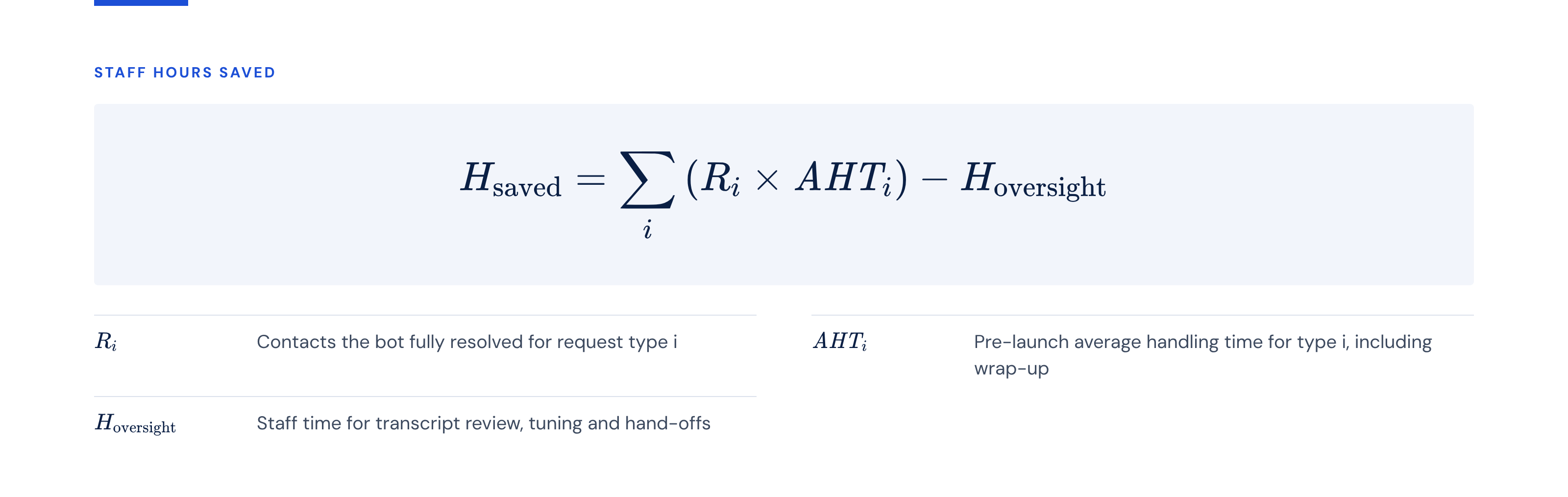
Staff hours saved by a callbot equal resolved contacts times pre-launch handling time, minus oversight.
Count only the calls or chats the bot fully resolves, and measure average handling time (AHT) by request type before launch, including wrap-up work.
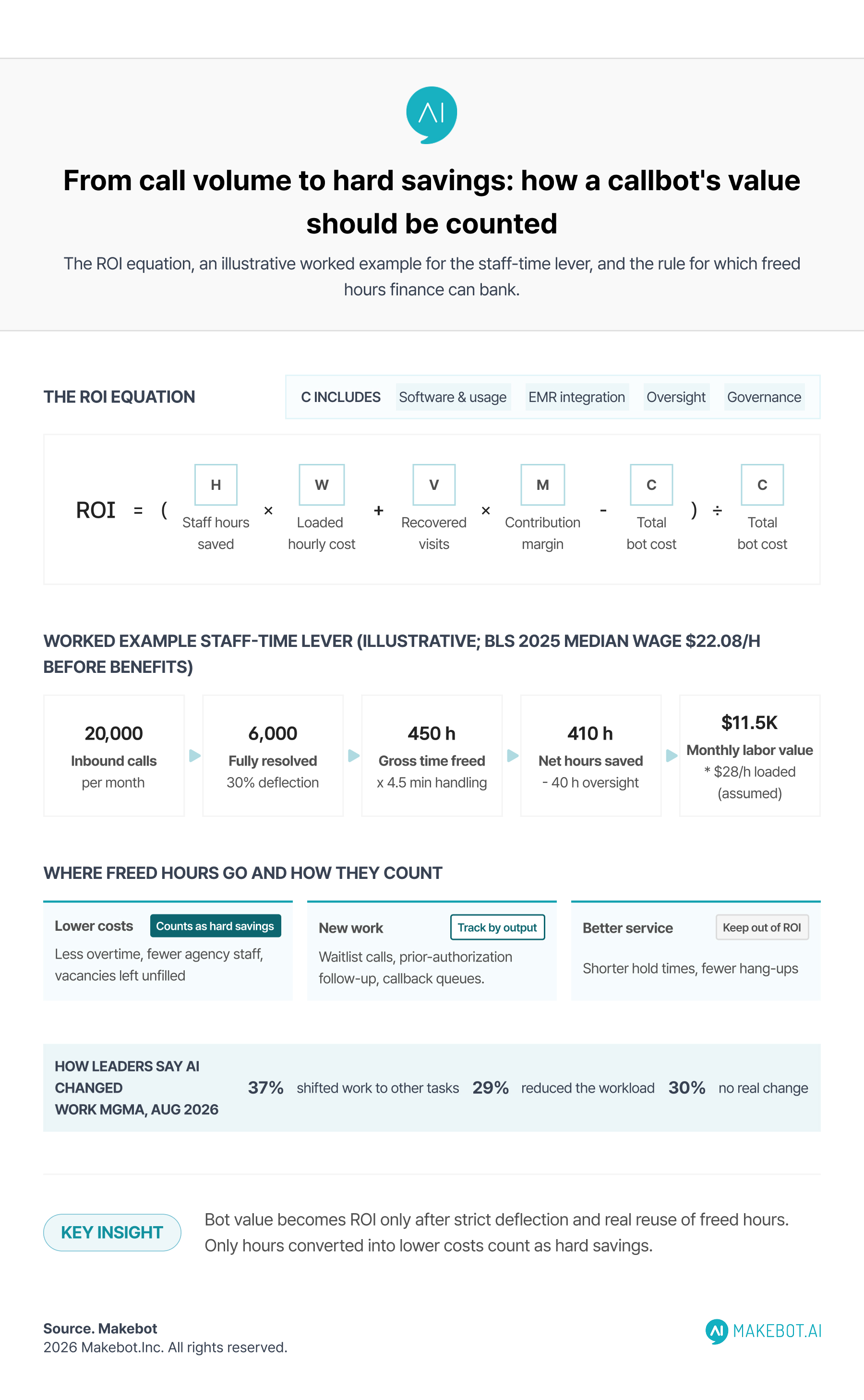
Hypothetically, say a hospital receives 20,000 calls a month, and the callbot fully resolves 30%, or 6,000. At 4.5 minutes each, that frees 450 hours. Subtract 40 oversight hours and the net saving is 410 hours, worth about $11,500 a month at an assumed $28 an hour including benefits.
Do saved staff hours actually reduce hospital costs?
Only if the hours go somewhere measurable. In an August 2026 MGMA Stat poll, leaders more often said AI moved work to other tasks (37% of mentions) than reduced it (29%). Freed hours can go to three places:
- New work: waitlist calls, following up on prior authorizations or clearing callback queues.
- Lower costs: less overtime, fewer agency staff or vacancies left unfilled.
- Better service: shorter hold times and fewer hang-ups.
Only lower costs count as hard savings. Keep service gains out of the ROI number.
How Do Callbots and Chatbots Reduce Patient No-Shows?
Callbots and chatbots reduce patient no-shows with targeted reminders and one-conversation rebooking.
Early confirmation or rebooking gives the hospital time to refill the slot. Results are strongest from focusing calls on the patients most likely to miss.
Published outpatient no show rate figures range from 12% to 42%. A March 2026 meta-analysis found they made patients about 11% more likely to attend hospital outpatient appointments (RR 1.11, 10 trials).
What does the best recent evidence on voice AI healthcare outreach show?
Penn Medicine's randomized trial, published in NEJM Catalyst in May 2026, added automated interactive voice response (IVR) calls to text reminders for 59,994 high-risk patients. IVR is a standard phone menu, not conversational AI, but it performs the core job of a voice AI healthcare callbot.
- No-shows fell to 9.6%, compared with 11.3% for text reminders alone.
- Completed appointments rose to 77.8% from 75.9%.
- Gains held across 244,000+ high-risk patients for six months after rollout.
Two choices drove the result: the most common reason for missed visits was not knowing about the appointment (22%), and calls went only to patients the EHR's prediction model flagged as high risk.
How should recovered visits be valued in the ROI model?
Recovered visits equal the drop in no-show rate multiplied by scheduled visits, minus slots you would have filled anyway. Value each one at contribution margin. Track cancellations too: MGMA data show only 27.40% of canceled visits were rescheduled within 30 days. Automated appointment reminders that turn a cancellation into an immediate rebooking create value a no-show figure alone misses.
Which KPIs Matter Most for Hospital Callbot ROI?
The KPIs that matter most for callbot ROI are deflection, hours saved, no-shows, bookings and escalations.
Track them monthly by request type against your pre-launch baseline. The first three feed the ROI formula. Booking completion and escalations (hand-offs to staff) show task success and protect patient safety.
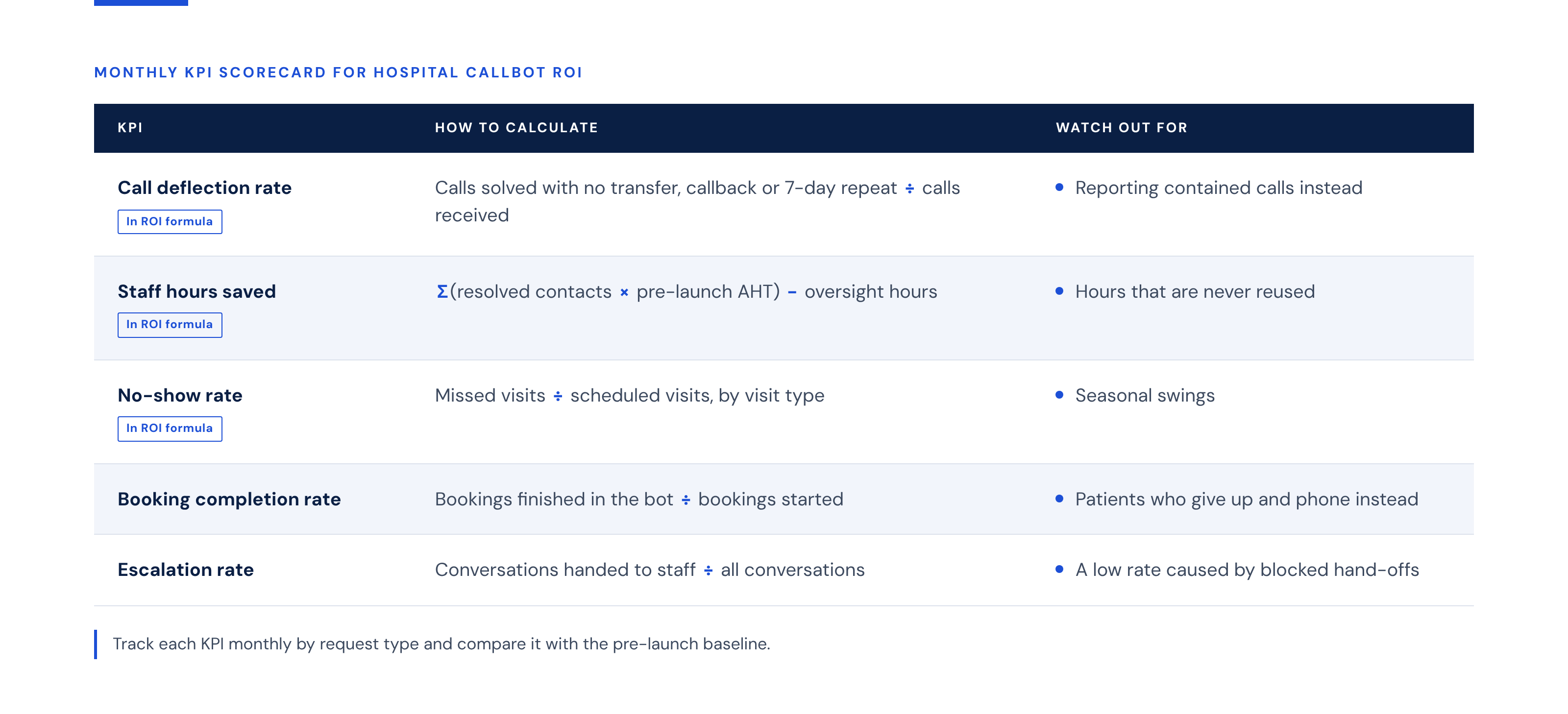
Fewer escalations are only good news if clinical questions still reach a nurse quickly. Treat any missed urgent symptom as a reason to stop and fix the bot.
How Long Does It Take to Prove Callbot ROI?
Proving callbot ROI takes at least one full quarter of monthly tracking against a pre-launch baseline.
In the Mount Sinai pilot, the weekly share of completed AI calls improved over the 90-day rollout and passed 90% in the final month, so month one alone would undersell the bot. A practical plan:
- Baseline (3 months before launch): record call volume, handling time, hang-ups and no-show rate by request type and visit type.
- Controlled launch (month 1): randomize patients, or start in some clinics first, to create a comparison group.
- Measurement quarter (months 1 to 3): report the KPI table monthly and log every change made to the bot.
- Decision (month 4): calculate ROI from month-three results, then decide whether to expand, narrow the scope or stop.
Why Do So Many AI Chatbot ROI Claims in Healthcare Fall Apart?
AI chatbot ROI claims in healthcare fall apart when loose definitions inflate savings and hide costs.
Teams count completed calls as deflected, leave out setup and oversight costs, value recovered visits at billed charges and treat safety as a soft measure.
Independent evidence is still limited. Mount Sinai's results come from a single-site abstract with no comparison group, and Penn tested IVR rather than a large language model. Adoption is early too: only 19% of medical groups used a patient-facing chatbot in 2025.
Good governance keeps these mistakes out. Set clear rules for passing clinical issues to staff, tell callers they are talking to AI, and name one owner for the monthly scorecard.
What Should Hospitals Do Next With Conversational AI Healthcare Investments?
Hospitals should next run conversational AI healthcare as a measured pilot with KPIs agreed with finance.
Run it as a business test with a clear goal, not a technology purchase. Pull three months of call and no-show data, agree on KPI definitions with finance, then decide where the bot starts.
Hospitals evaluating EMR-integrated options, such as CareAI, Makebot's healthcare AI chatbot and callbot, can apply this scorecard during a pilot, so the decision to expand rests on their own numbers.




























What Happens to Marketing When the C-Suite Starts Using AI Every Day?








Why AI Shopping Assistants Will Replace Traditional Ecommerce Search
































Why Generative AI Projects Fail and How to Achieve Scalable AI Success