Stanford AI Pioneer Fei-Fei Li Explains How AI Could Transform Healthcare and Medical Discovery
WHO projects 11M health worker shortage by 2030. Fei-Fei Li's ambient AI vision for hospitals.


Key Takeaways
- Li sees AI as a helper, not a replacement. It should watch for problems and alert people so busy clinicians have more time for patients.
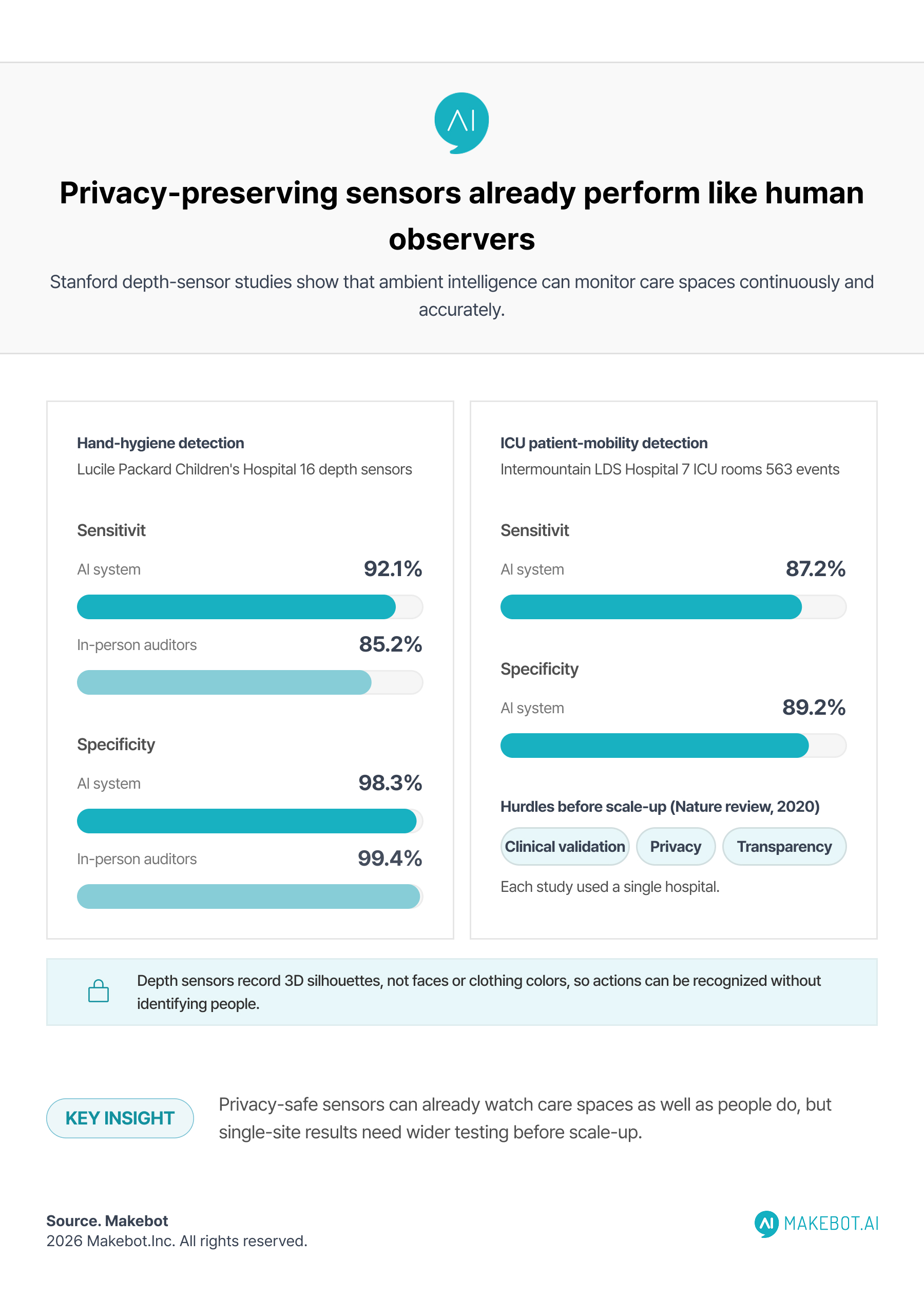
- Hospital sensors have worked in early studies. Stanford systems did as well as human observers at tracking handwashing and correctly caught 87.2% of patient movements in an ICU.
- Use is growing faster than proof. 81% of physicians surveyed by the AMA now use AI, but a careful trial of AI note-taking tools found only small time savings, and only with one of the two tools tested.
- AI drug discovery has reached a real milestone. A drug whose target and molecule were both found with AI finished a mid-stage trial and moved into a late-stage trial in 2026. It is not yet approved by any regulator.
- Safe adoption starts with low-risk tasks. Voluntary Joint Commission and CHAI guidance covers oversight, data protection, ongoing checks and bias testing.
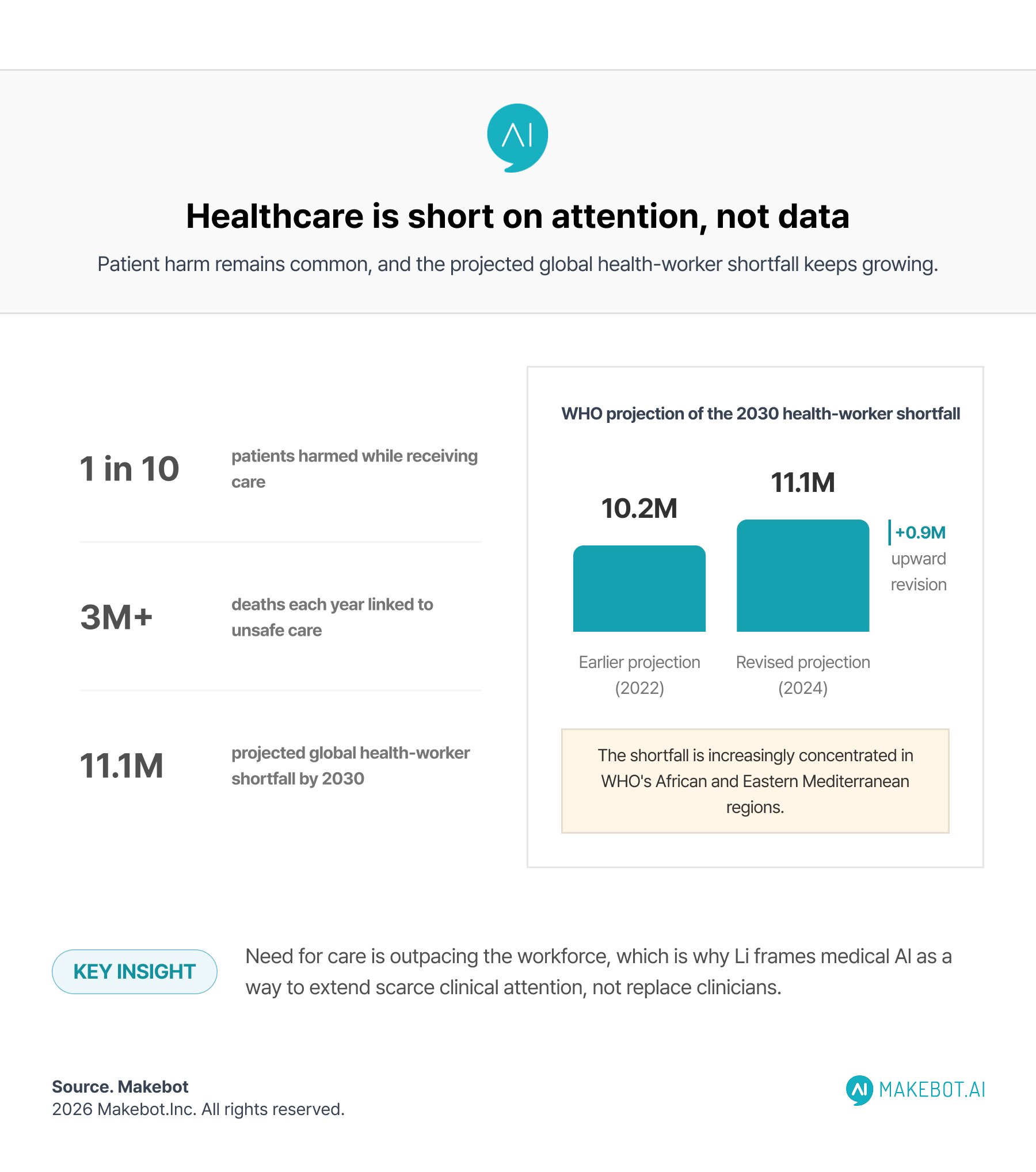
The World Health Organization (WHO) estimates that about 1 in 10 patients is harmed during care, with more than 3 million deaths a year from unsafe care. WHO also expects a shortage of 11.1 million health workers by 2030. That gap is why medical AI has become so urgent.
Fei-Fei Li, the Stanford computer scientist behind the ImageNet image database, has spent more than a decade studying how AI can support hospital care, work shaped by years of caring for her parents. Below, we cover her ideas, the evidence so far, how hospitals can use AI safely and what it means for the future of AI in healthcare.
How Does Fei-Fei Li Think Medical AI Could Transform Healthcare?
Fei-Fei Li believes medical AI can improve healthcare by supporting doctors and nurses, not by replacing them.
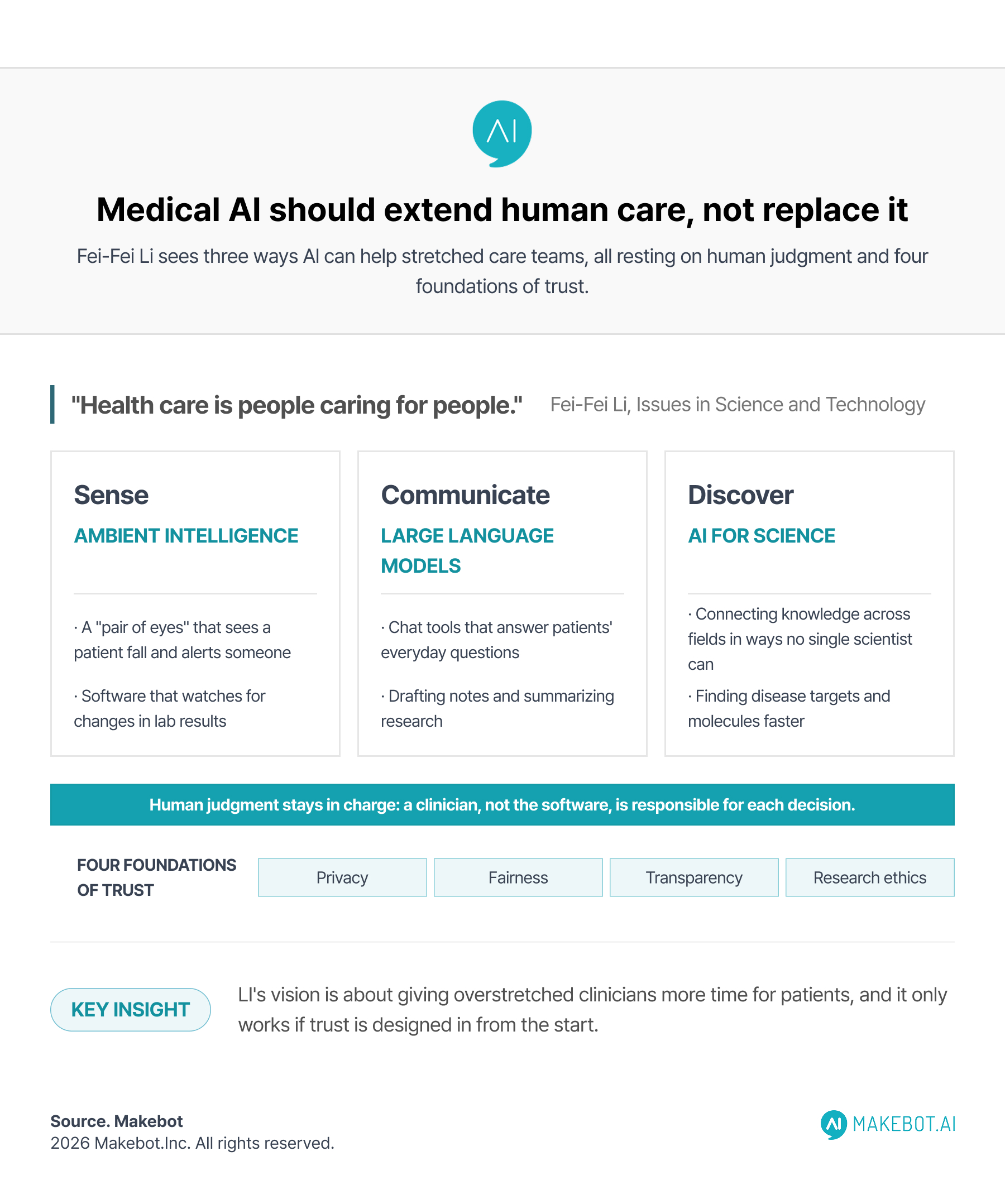
In an interview with Issues in Science and Technology, Li described three decades of caring for a sick parent. Her takeaway: "Health care is people caring for people," and there are not enough people. She gave three examples of where AI can help:
- A "pair of eyes" that sees a patient fall and alerts someone.
- Software that watches for changes in lab results.
- A chat tool that answers patients' everyday questions.
On the Huberman Lab podcast in August 2026, she also called scientific discovery one of the most exciting opportunities for AI and for health. Together, her ideas cover three areas of AI in the medical field: sensors that see, large language models (LLMs) that handle language, and tools that speed up discovery.
What Is Ambient Intelligence in Healthcare, and What Has the Research Shown?
Ambient intelligence uses sensors and AI to spot risks in hospital rooms, and early studies are promising.
Ambient intelligence uses small sensors and AI to watch care spaces around the clock. Li's Stanford teams use depth sensors, which record a rough 3D outline of a person instead of video. A 2020 Nature review by Li, Albert Haque and Arnold Milstein named three hurdles: careful clinical validation, privacy and transparency. Two Stanford studies tested it:
- Handwashing: At Lucile Packard Children's Hospital, 16 depth sensors tracked hand-sanitizer use. The AI did about as well as human observers, catching 92.1% of real uses versus 85.2%, with similarly few false alarms (JAMIA, 2020).
- ICU movement: In seven rooms of the Intermountain LDS Hospital ICU, the AI correctly spotted 87.2% of 563 patient movements and correctly ruled out non-events 89.2% of the time (npj Digital Medicine, 2019).
Why do depth sensors matter for patient privacy?
Depth sensors capture body shapes, not faces, so the system can tell what happened without showing who it was. Each study used one hospital, so wider testing is still needed.
Why Is Human-Centered AI the Organizing Principle for Medicine?
Human-centered AI matters in medicine because care depends on trust, privacy and respect.
Human-centered AI means building tools around what patients and health workers need, not just what the technology can do. For Li, that starts with listening to everyone involved and keeping human judgment in charge of care. In her 2025 essay From Words to Worlds, she wrote: "AI must augment human capability, not replace it." The Nature review names four parts of trust: privacy, fairness, transparency and research ethics. In practice:
- Design with frontline staff.
- Collect as little personal data as possible.
- Test for fairness across patient groups.
- Make a clinician, not the software, responsible for each decision.
Where Is Generative AI in Healthcare Delivering Measurable Value Today?
Generative AI in healthcare is most useful today for writing notes and summarizing research.
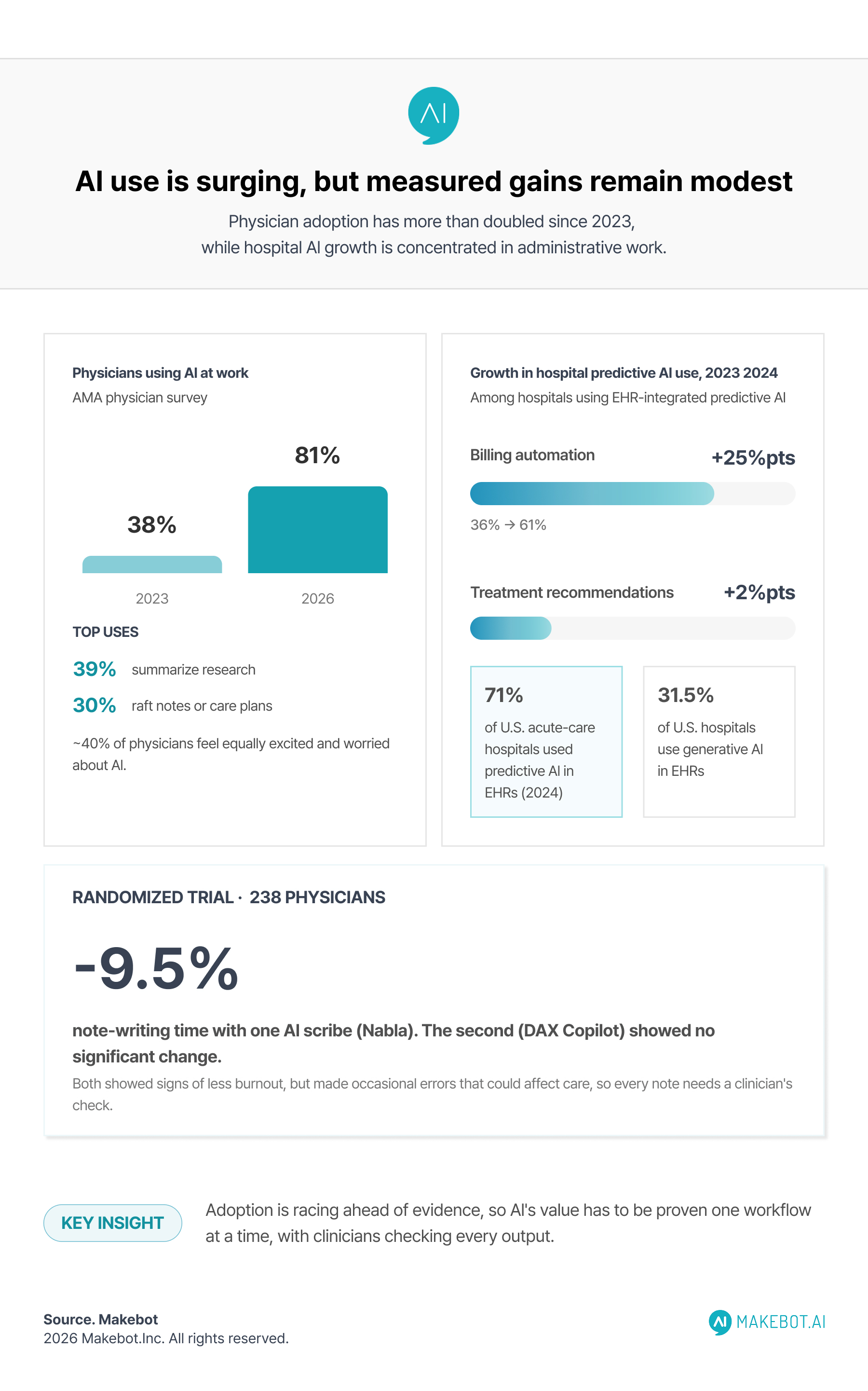
In hospitals, generative AI helps most with paperwork, not diagnosis. The American Medical Association (AMA) 2026 physician survey found that 81% of doctors now use AI at work, up from 38% in 2023 (full report). Top uses were summarizing research (39%) and drafting notes or care plans (30%).
The time savings are modest. In a randomized trial in NEJM AI with 238 UCLA doctors, one AI note-taking scribe (Nabla) cut note-writing time by 9.5%. The other (Microsoft DAX Copilot) made no clear difference. Both scribe groups showed signs of less burnout and workload, but they sometimes made errors that could matter for care, so doctors must check every note.
A federal ASTP/ONC report found that 71% of U.S. non-federal acute care hospitals used predictive AI in their electronic health records (EHRs) in 2024. Among them, AI use for billing jumped from 36% to 61%, while use for treatment recommendations grew only about 2 percentage points. A JAMA Network Open study found 31.5% of U.S. hospitals using generative AI in their EHRs.
What does this mean for LLM and AI chatbot deployments?
For patient chatbots, retrieval-augmented generation (RAG) makes the chatbot answer from the hospital's own approved documents, so each answer is easier to check.
How Can AI Speed Up Medical Discovery, and What Are the Current Limits?
AI finds new drug leads faster, but testing drugs in people still takes time.
AI helps find disease "targets" and molecules that act on them by searching huge amounts of biological, chemical and medical data much faster than people can. On the Huberman Lab podcast, Li said AI can connect knowledge across fields in ways no single scientist can. Trials run in phases: phase I checks safety, phase II whether a drug seems to work, and phase III tests many more patients.
- Rentosertib, a drug candidate for idiopathic pulmonary fibrosis (a disease that scars the lungs), has a target and molecule both found with generative AI. Nature Medicine reported its phase 2a trial of 71 patients in June 2025, and Insilico Medicine started a 320-patient phase III trial in July 2026. It is not yet approved.
- A 2024 study in Drug Discovery Today found AI-discovered drugs passed phase I 80 to 90% of the time, well above average, but about 40% passed phase II, close to average, in a small sample.
Why does data scarcity still constrain medical AI?
AI learns from examples, so it struggles when examples are rare. After her father's robot-assisted liver surgery, Li noted that even all the world's liver surgeries might not give enough data to train a robot to operate alone. For the same reason, AI's discovery gains will likely come early, in finding targets and molecules, while patient trials stay slow.
Will AI Replace Doctors and Nurses, or Redefine What Their Work Looks Like?
AI will change what doctors and nurses do by taking over routine tasks, not replace them.
The evidence points to AI sharing the work, not taking jobs. The real problem is too few health workers: WHO raised its 2030 shortage estimate from 10.2 million to 11.1 million. Li also notes that when a chatbot says it is sorry you are sick, it is repeating a learned pattern, not feeling empathy. In the AMA survey, about 40% of doctors felt equally excited and worried about AI.
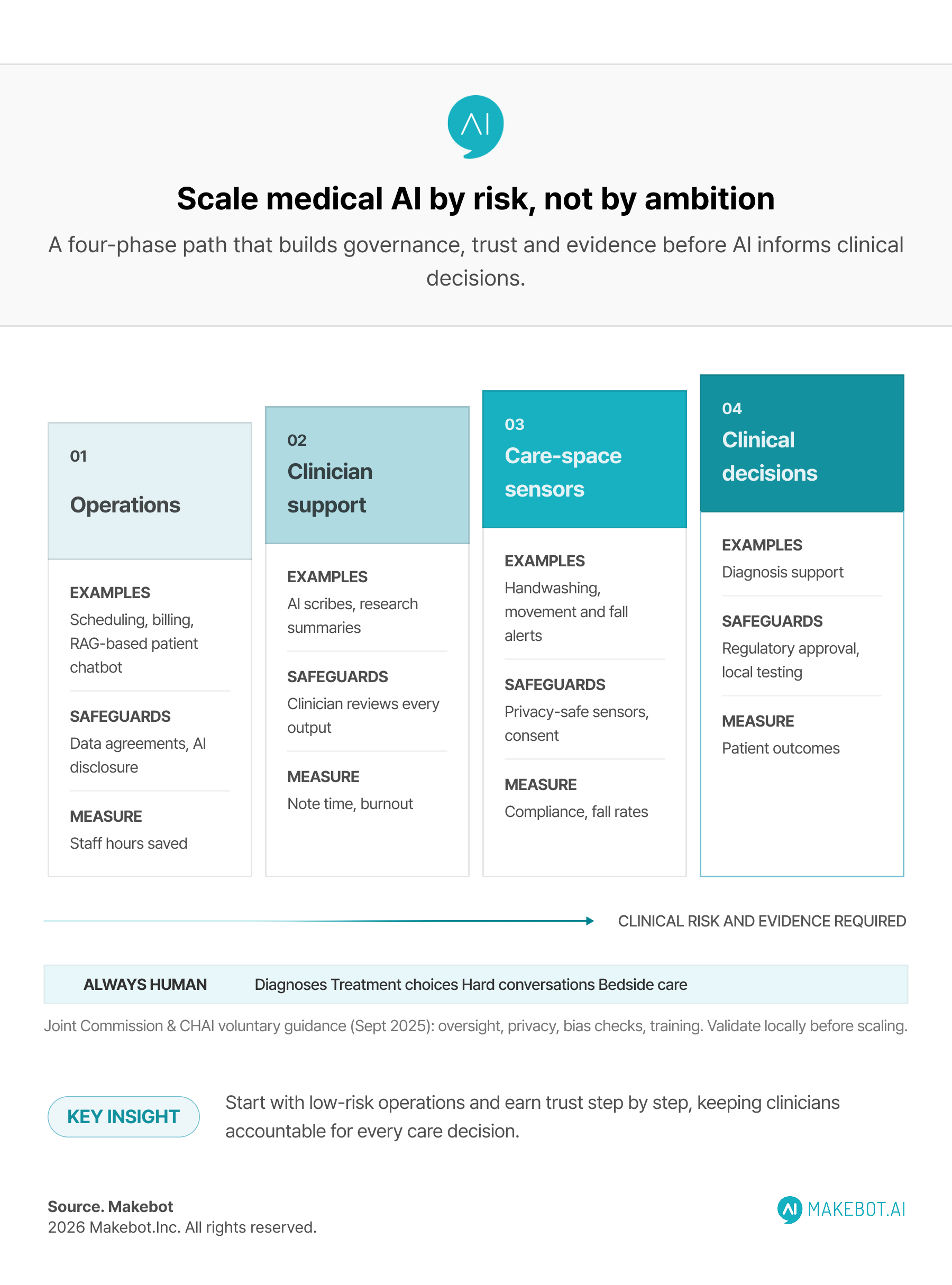
AI can take on notes, summaries, scheduling and monitoring. People keep diagnoses, treatment choices, hard conversations and bedside care.
How Can Hospitals Start Using Medical AI Responsibly?
Hospitals should start using medical AI on low-risk tasks and keep humans in charge.
Start where mistakes would not harm patients and benefits are easy to measure. Before scaling, do local validation, testing tools on your own patients and data. In September 2025, the Joint Commission and the Coalition for Health AI (CHAI) released voluntary guidance, Responsible Use of AI in Healthcare, covering areas such as oversight, privacy, bias checks and training. The roadmap below moves from the safest uses to the riskiest:
What Should Leaders Take From Li's Vision for the Future of AI in Healthcare?
The future of AI in healthcare, as Li sees it, keeps people at the center.
The future of AI in healthcare that Fei-Fei Li describes is not robots running hospitals but tools that pay attention, so people have more time for patients. Progress will be gradual: ambient intelligence shows promising early results, generative AI's proven benefits are still small, and AI-driven drug discovery has reached phase III without approvals yet. Leaders should pick one everyday problem, measure it, test a well-managed AI tool and let results build trust. Medical AI works best when it keeps people at the center.
AI That Supports, Not Replaces, Your Care Team
The vision Fei-Fei Li describes - AI that alerts, assists, and gives clinicians more time with patients - is the direction CareAI is built around. Trusted by 500+ clinics and hospitals across Korea, CareAI handles appointment booking, patient inquiries, and 24/7 call support through real-time EMR integration, reducing front-desk workload by up to 50% so medical staff can focus on care. To explore Makebot’s full suite of healthcare and enterprise AI solutions, visit Makebot.




























What Happens to Marketing When the C-Suite Starts Using AI Every Day?







Why AI Shopping Assistants Will Replace Traditional Ecommerce Search