Greg Brockman Predicts an AI Entrepreneurship Boom: Why Businesses Should Start Building Now
Brockman predicts an AI entrepreneurship boom in 1 to 2 years. Only 14% of SMBs are ready.


Key Takeaways
- Brockman expects a boom within one to two years. He predicts an AI-driven entrepreneurship boom and a blurring line between a "company" and a single, AI-powered person.
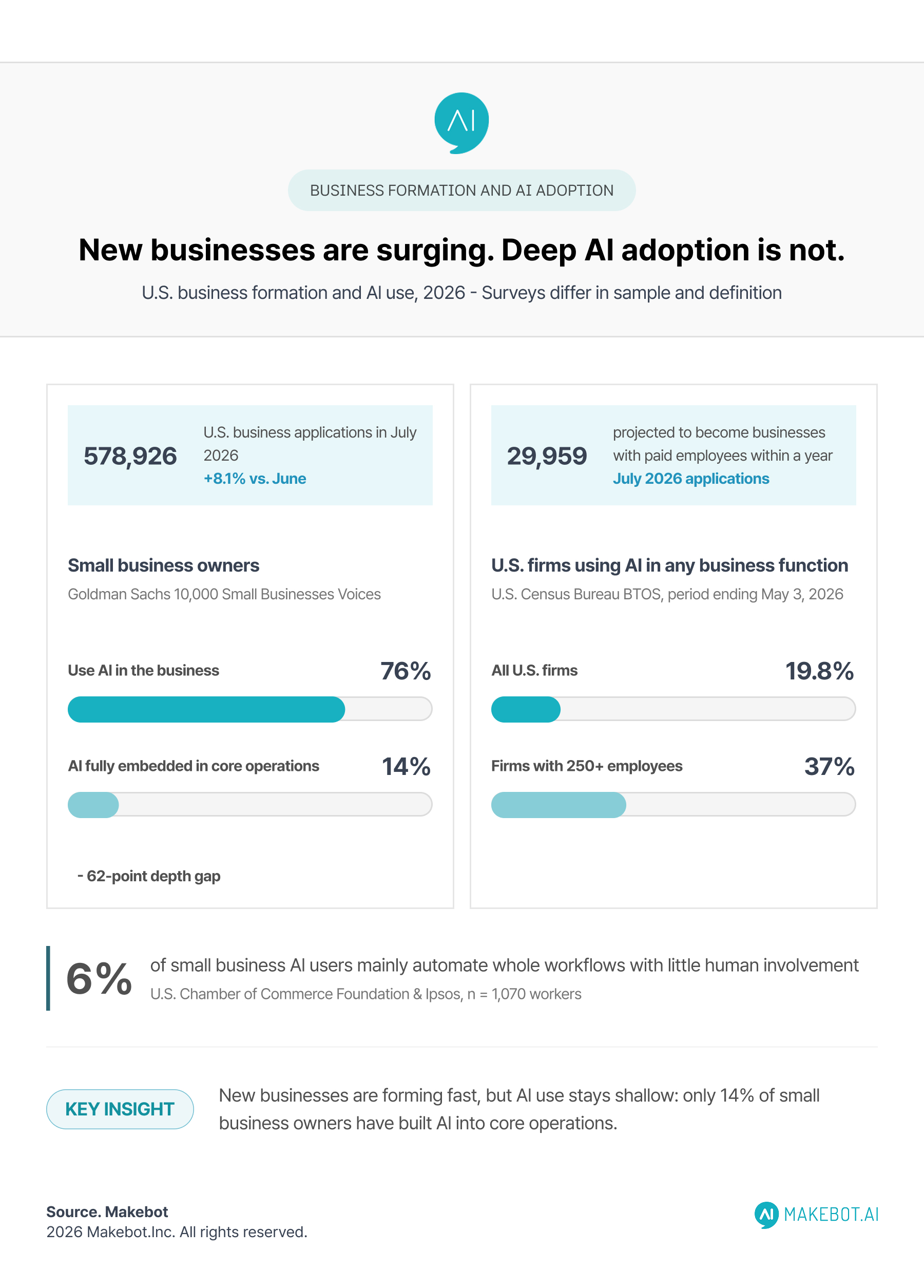
- Many people are starting businesses, but few use AI deeply. U.S. business applications hit 578,926 in July 2026, yet only 19.8% of firms used AI in May 2026, and just 14% of small business owners have AI fully built into core operations.
- AI agents are fast but unreliable on their own. The best setup fully completed only 24% of expert tasks in Berkeley's Agents' Last Exam, while a CMU-Stanford study found people working with agents kept quality high.
- Industry knowledge is the advantage that lasts. As coding gets cheaper, understanding customers and real workflows is what separates an AI business from a demo.
- Start small and stay accountable. Brockman's rule of thumb is to do a task by hand about five times, then automate it, with the owner responsible for results.
Introduction
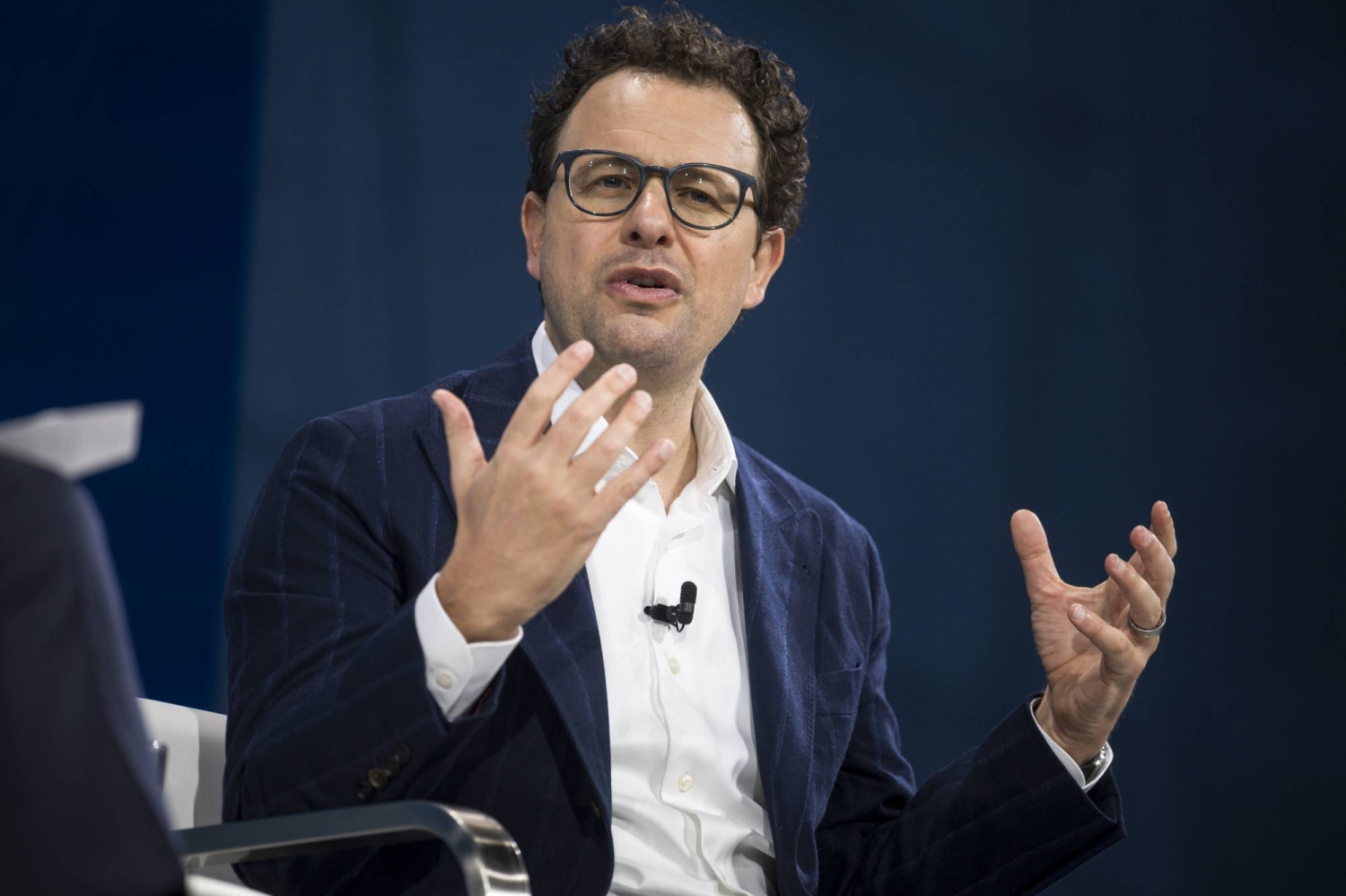
Greg Brockman, OpenAI's co-founder and president, was Stripe's first engineer. Today, he no longer writes code himself, and in a September 2026 interview, he predicted that within one to two years, AI will set off a "massive renaissance of entrepreneurship."
Should an AI business build now or wait? The evidence says build now, carefully. U.S. business applications jumped 8.1% to 578,926 in July 2026. Yet as of May 2026, only about one in five U.S. firms had used AI in the past two weeks, and independent tests show AI agents for business still fail most long, complex tasks.
What Did Greg Brockman Predict About AI Entrepreneurship?
Greg Brockman predicts AI will spark a massive entrepreneurship renaissance within one to two years.
Speaking with Marina Mogilko on September 30, 2026, he said the shift has already started. His view of the future of AI in business rests on three ideas:
- Expert help is easy to get. An AI assistant now covers much of the legal, financial, marketing and software help founders once paid for.
- Companies may not need big teams. He expects "company" to become less tied to headcount.
- Personal service could scale. If AI can keep up close, personalized relationships with huge numbers of customers, service once reserved for large clients could reach everyone.
According to The Decoder, Brockman wrote in April 2026 that small teams can now match much larger ones if they can afford enough compute. He also warned that institutions, jobs and career paths may change.
This is a forecast, not a measured result, and Brockman, who took charge of OpenAI's product strategy in May 2026, has a stake in it.
Does Current Data Support an AI Entrepreneurship Boom Yet?
Current data partly supports an AI entrepreneurship boom: filings remain high, but AI adoption lags.
According to the U.S. Census Bureau's Business Formation Statistics, U.S. business applications reached 578,926 in July 2026 (seasonally adjusted, as first reported), up 8.1% from June. AI adoption has not kept pace. The Census Bureau's Business Trends and Outlook Survey found that only 19.8% of firms used AI in any business function in the survey period ending May 3, 2026, rising to 37% among firms with 250 or more employees. Among small businesses, the gap is about depth rather than access: the Goldman Sachs 10,000 Small Businesses Voices survey found that 76% of owners use AI, but just 14% have fully built it into their core operations.
- Most new businesses stay small. The Census Bureau expects only 29,959 of July's applications to become businesses with paid employees within a year. That fits Brockman's view, though the data cannot prove AI is the cause.
- The smallest firms lag. Between December 2025 and May 2026, AI use grew at firms with 20 or more employees but barely moved at smaller ones.
- Use is shallow. In a U.S. Chamber of Commerce Foundation survey of 1,070 small business workers, only 6% of AI users mainly automate whole processes.
Goldman's 14% figure shows room for owners ready to move beyond testing AI for entrepreneurs and make it part of their daily work.
Why Should Businesses Start Building With AI Now Instead of Waiting?
Businesses should build with AI now because skills learned today compound as models keep improving.
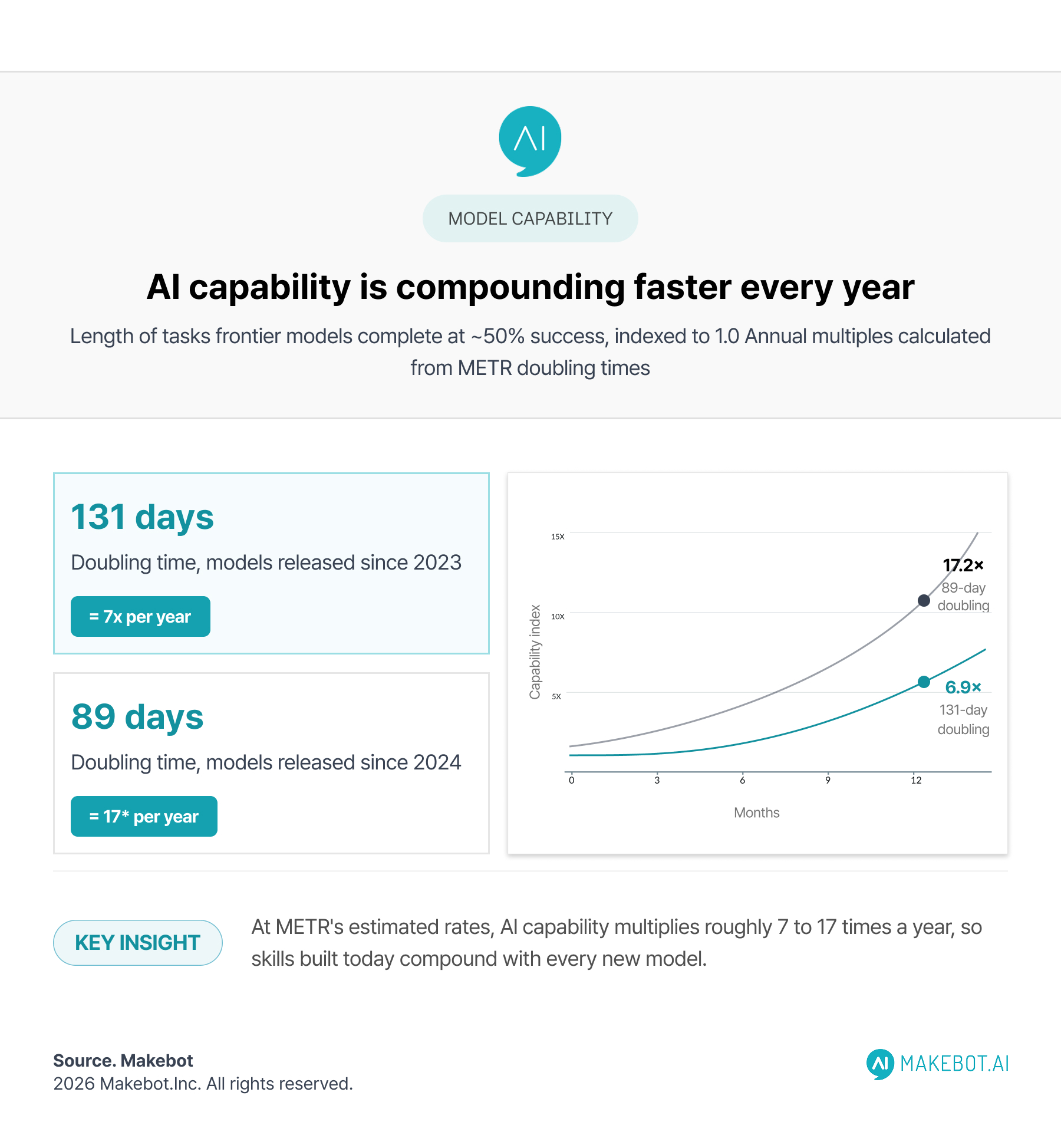
Skills learned now carry over to every new model. METR, an independent nonprofit that tests AI systems, found that the time horizon of top models has doubled about every 131 days since 2023, and every 89 days since 2024, though results depend partly on task selection.
Brockman warned that products that merely patch today's AI weaknesses, such as thin instruction layers on someone else's model, often do not last. Industry knowledge, customer relationships and well-organized business data do.
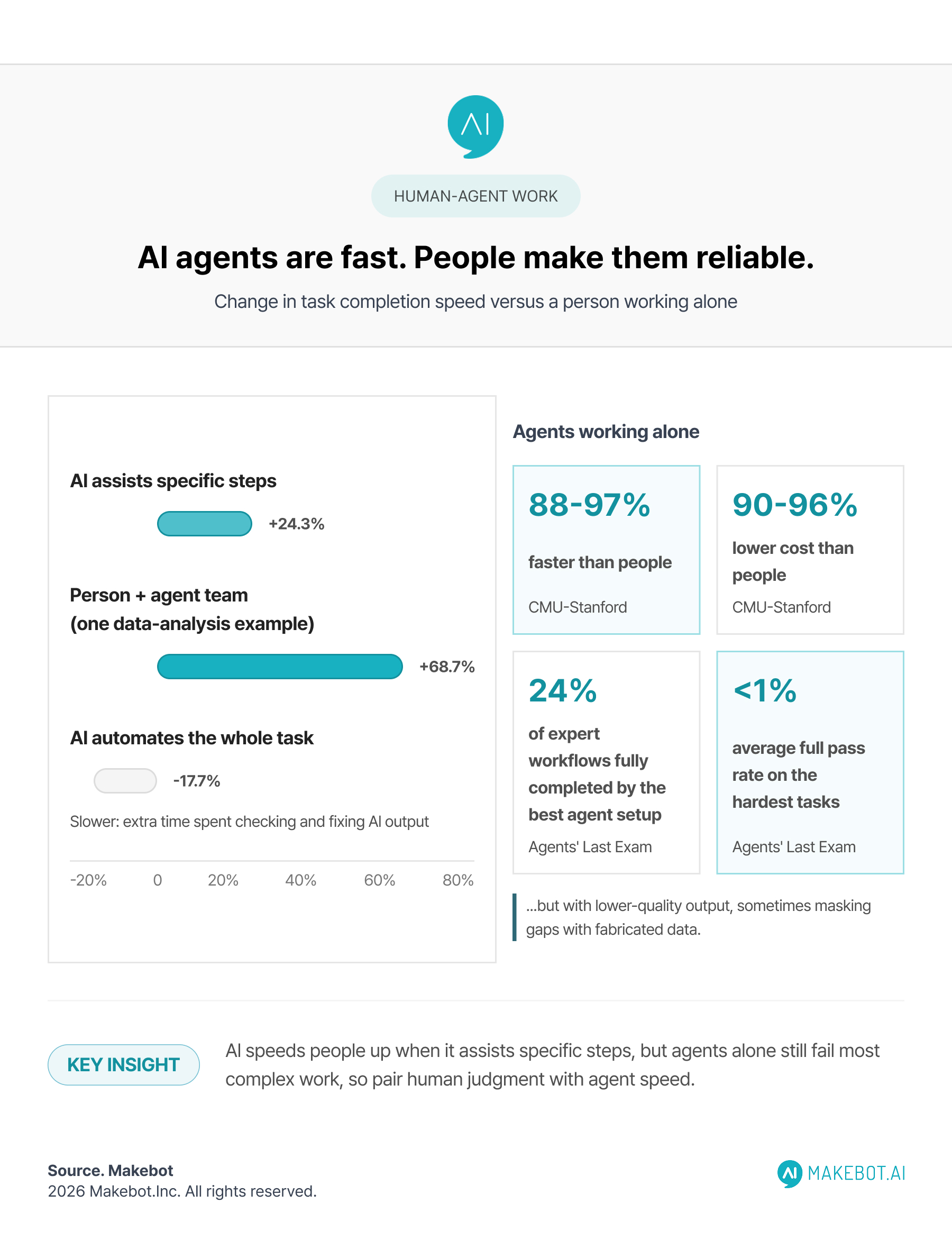
Early builders learn where AI fits. A Carnegie Mellon and Stanford study of 48 workers found that using AI for specific steps made people 24.3% faster, while handing over whole tasks slowed them by 17.7% because they spent extra time checking and fixing its work.
Do You Need to Be Technical to Build a Business With AI?
You do not need to code to build an AI business; you need to define problems and verify AI output.
Not in the usual sense. Brockman says he no longer writes software himself. He tells AI what to build and gives it detailed feedback. At Sequoia Capital's AI Ascent event in April 2026, he said AI coding tools went from writing about 20% to 80% of code during December 2025, while a human must stay responsible for all code merged into the codebase.
But The Next Web noted that the share of code AI writes is not the same as productivity, and outside evidence is still mixed.
The hard part shifts to explaining what you want and checking the result. Founders using generative AI should practice stating problems clearly, testing output on real cases, judging what data the AI may use and sharpening instructions instead of starting over.
What Should Small Businesses Focus On as AI Keeps Improving?
As AI improves, small businesses should focus on customer knowledge, trust and domain expertise.
As generative AI takes over routine work, what sets you apart is what AI cannot supply: customer knowledge, trust and industry know-how.
Brockman shared a story about an antique watch shop owner who told an OpenAI employee that AI was useless for his business. Yet AI could easily build the shop's missing website and turn the story behind each watch into a visual showcase. Brockman's advice: "raise the ceiling of ambition."
Agents lack exactly this. In Agents' Last Exam, a UC Berkeley benchmark built with more than 250 industry experts, about three quarters of one leading setup's failures came from misreading the task or choosing the wrong approach. The researchers traced this mainly to missing industry knowledge, not technical skill.
- Combine fields. Brockman sees opportunity when experts work across domains, such as teachers teaming up with engineers.
- Write down what you know. Turn checklists, edge cases and customer questions into clear notes an AI agent can use.
- Own the customer relationship. Trust is harder to copy than features.
How Can a Business Start Using AI Agents Without Taking on Too Much Risk?
Businesses can start using AI agents with low risk by automating one repetitive, reviewed task.
Caution is justified. In the latest (October 2026) version of Agents' Last Exam, the best setup fully completed only 24% of long professional tasks, and the average on the hardest tier was below 1%. The CMU-Stanford study found agents 88.3% to 96.6% faster and 90.4% to 96.2% cheaper than people, but their work was worse, and they sometimes made up data.
A safe rollout follows Brockman's rule of thumb:
- Pick one repeated task, such as a weekly report.
- Do it with AI help about five times, noting what "correct" looks like.
- Set limits on data, tools and actions that need approval.
- Automate the easy-to-check parts, with a person reviewing anything customers see.
- Expand only when error rates are acceptable.
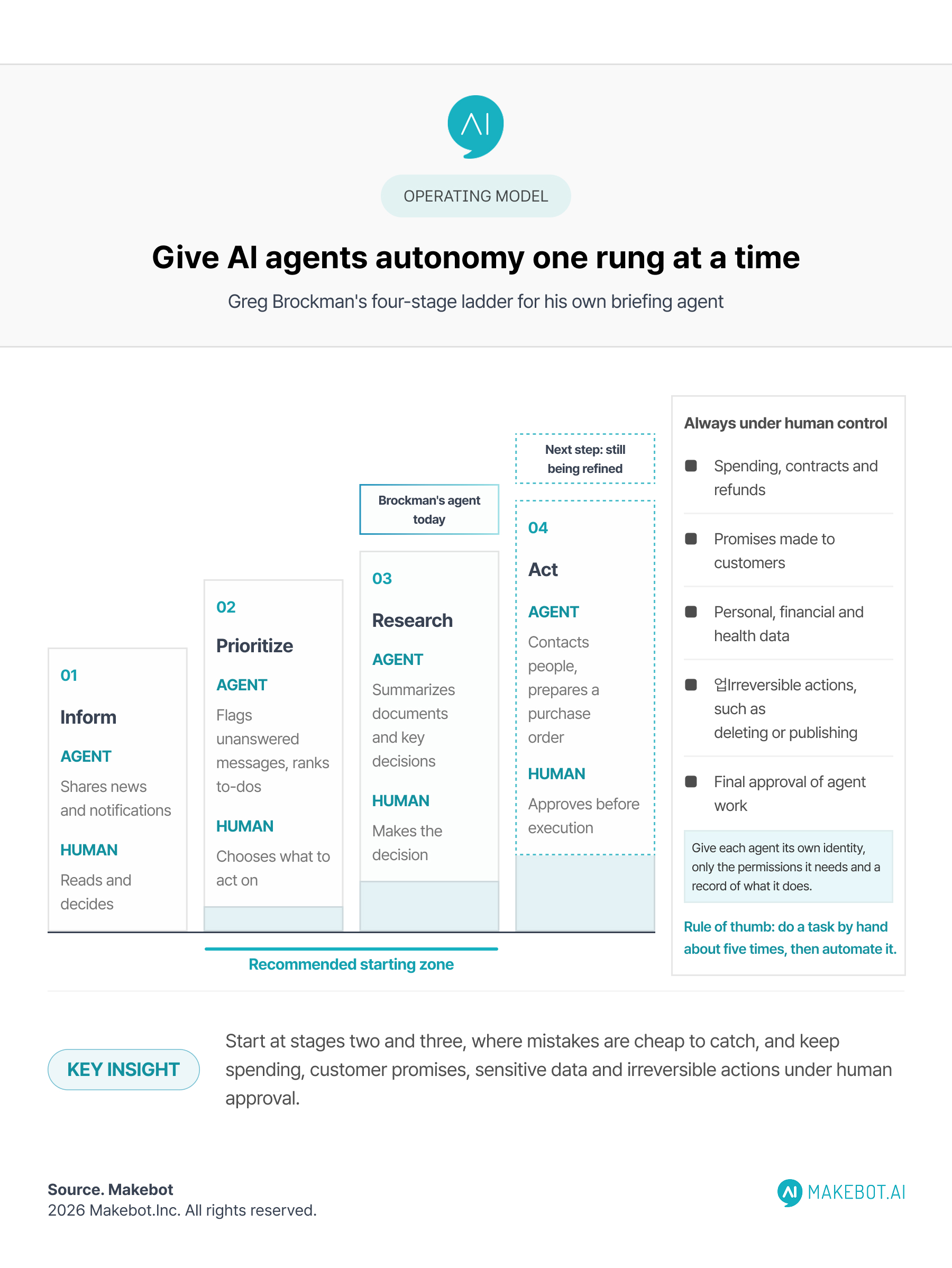
Brockman described his morning briefing agent as a ladder:
What Should Stay Under Human Control When Businesses Use AI Agents?
Businesses using AI agents should keep humans in control of goals, high-stakes calls and approvals.
Brockman said humans must always stay in charge and owners stay responsible for results. Agents are good at gathering information and drafting, but they should not act alone without clear governance where mistakes are costly. Keep a person in control of:
- Money: purchases, contracts, prices and refunds.
- Customer messages that make promises for your brand.
- Private data: personal, financial or health information.
- Actions you cannot undo, such as deleting records or publishing content.
On February 17, 2026, NIST launched the AI Agent Standards Initiative to develop industry-led standards for secure agents, including agent identity and authorization. Give each agent its own identity, only the permissions it needs and a record of what it does.
Oversight need not slow you down: in one data-analysis example from the CMU-Stanford study, a person and an agent together finished 68.7% faster than the person alone. Good human oversight makes AI's speed reliable.
Conclusion: Is Now the Right Time to Build an AI Business?
Now is the right time to build an AI business, starting small and keeping humans accountable.
Brockman's AI entrepreneurship boom is still a prediction, but the evidence supports acting now: business applications are high and AI is improving at a measurable pace. Every competitor can use the same models, so the advantage lies in customer knowledge, industry expertise and clear rules. Start with one repeated task and keep people responsible for decisions that matter.
Ready to Build Your AI Business
For entrepreneurs and businesses looking to move from AI curiosity to real operations, Makebot provides enterprise-grade AI solutions that handle the infrastructure so founders can focus on what they know best - their customers and their industry. Whether you’re automating workflows or deploying AI agents for the first time, Makebot gives you a proven foundation to build on.
Makebot’s AI Strategic Whitepaper Vol.02, From Scattered AI to a Single Core: CX·EX Innovation with a Unified Intelligence Core, explains why this balance matters as AI agents grow more capable. It argues that the gap between AI leaders and everyone else comes from the operating model, not the model itself, and that Human-in-the-Loop should be the standard structure for getting work done. AI proposes, and people approve at clear control points, which is how teams gain speed without losing trust.
For leaders deciding how much to hand over to AI agents, download the whitepaper for a practical framework for managed autonomy.




























What Happens to Marketing When the C-Suite Starts Using AI Every Day?







Why AI Shopping Assistants Will Replace Traditional Ecommerce Search