How B2B Companies Can Win by Making Service Easy for Customers Who Already Use AI Helpers
54% of B2B buyers say AI chatbots top their vendor shortlist. How to win when buyers use AI.


Key Takeaways
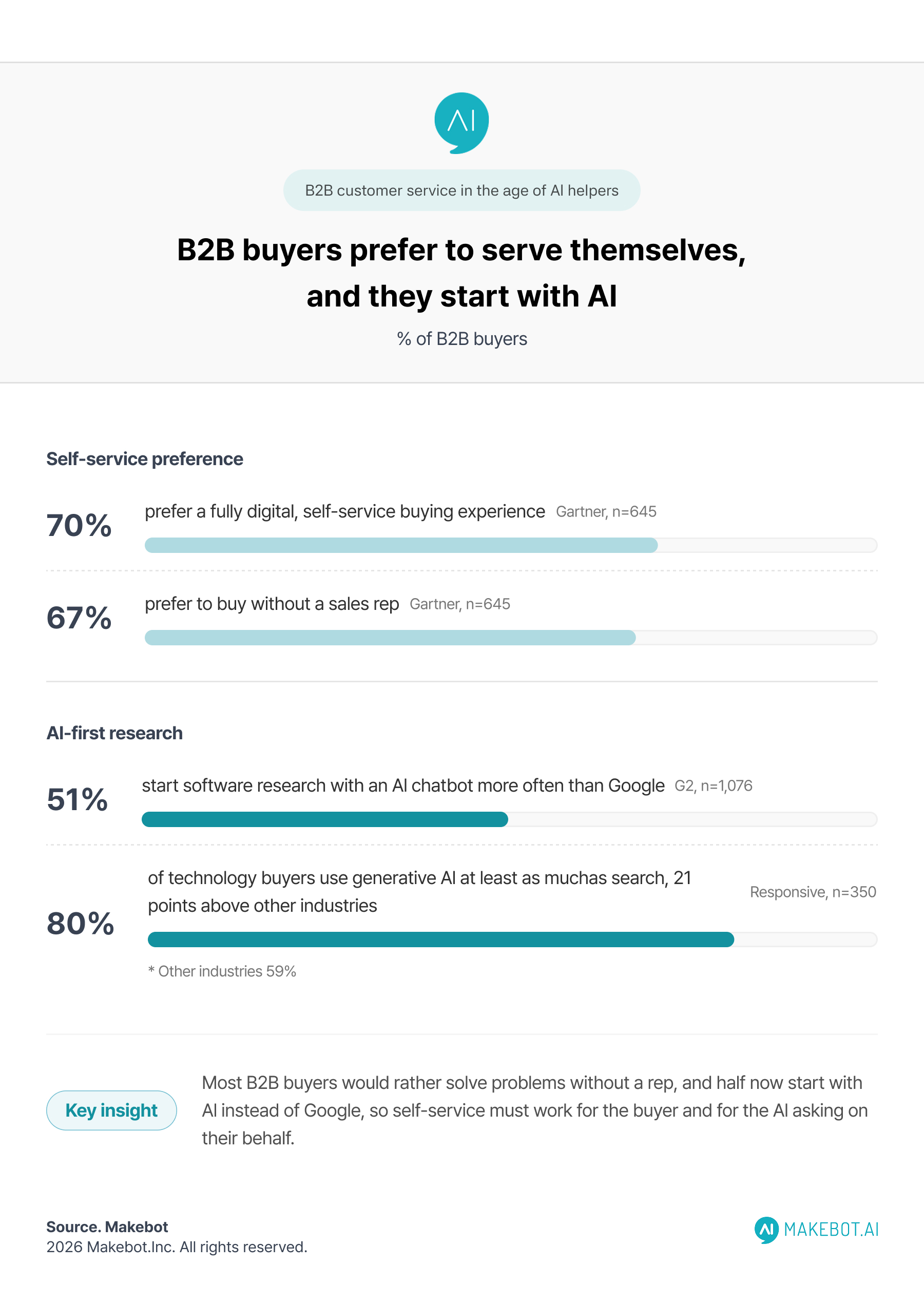
- Many buyers begin with AI, not Google. In G2's March 2026 survey, 51% of B2B software buyers said they start research with an AI chatbot more often than Google.
- AI helpers are already doing the work. According to Gartner, 74% of B2B customers who use generative AI have used it to complete a task for them.
- Clear information beats guesswork. Plain-text documents, public policies and secure connections give AI assistants the right facts.
- People remain part of good service. In the same Gartner survey, 87% of customers said companies using generative AI must offer a way to reach a human.
- Effort is the measure that connects everything. Track customer effort score together with self-service success, time to resolution and repeat contacts.
Many business customers now skip the vendor's support page and ask ChatGPT, Gemini, Copilot, or an in-house AI assistant. A Gartner survey of 3,566 B2B and B2C customers, run in February and March 2026, found that in their most recent service request, customers were about three times more likely to use an outside AI tool than the company's own chatbot.
That means good B2B customer service now has two audiences: the person, and the AI helper working for them. Companies whose prices, policies and order details are easy for AI to find give that helper the right answer. Companies whose information is unclear risk being guessed about or passed over for a competitor with clearer information.
Why Should B2B Companies Build Service for AI Helpers, Not Just People?
B2B companies should build for AI helpers because buyers already use AI to research vendors and get help.
G2's 2026 AI search report, a March 2026 survey of 1,076 B2B decision makers, shows how much AI shapes B2B buying. AI chatbots were the top influence on which vendors made buyers' shortlists, named by 54% of respondents, ahead of software review sites (43%) and vendor salespeople (19%). And 69% of buyers said an AI chatbot led them to choose a different vendor than they had planned.
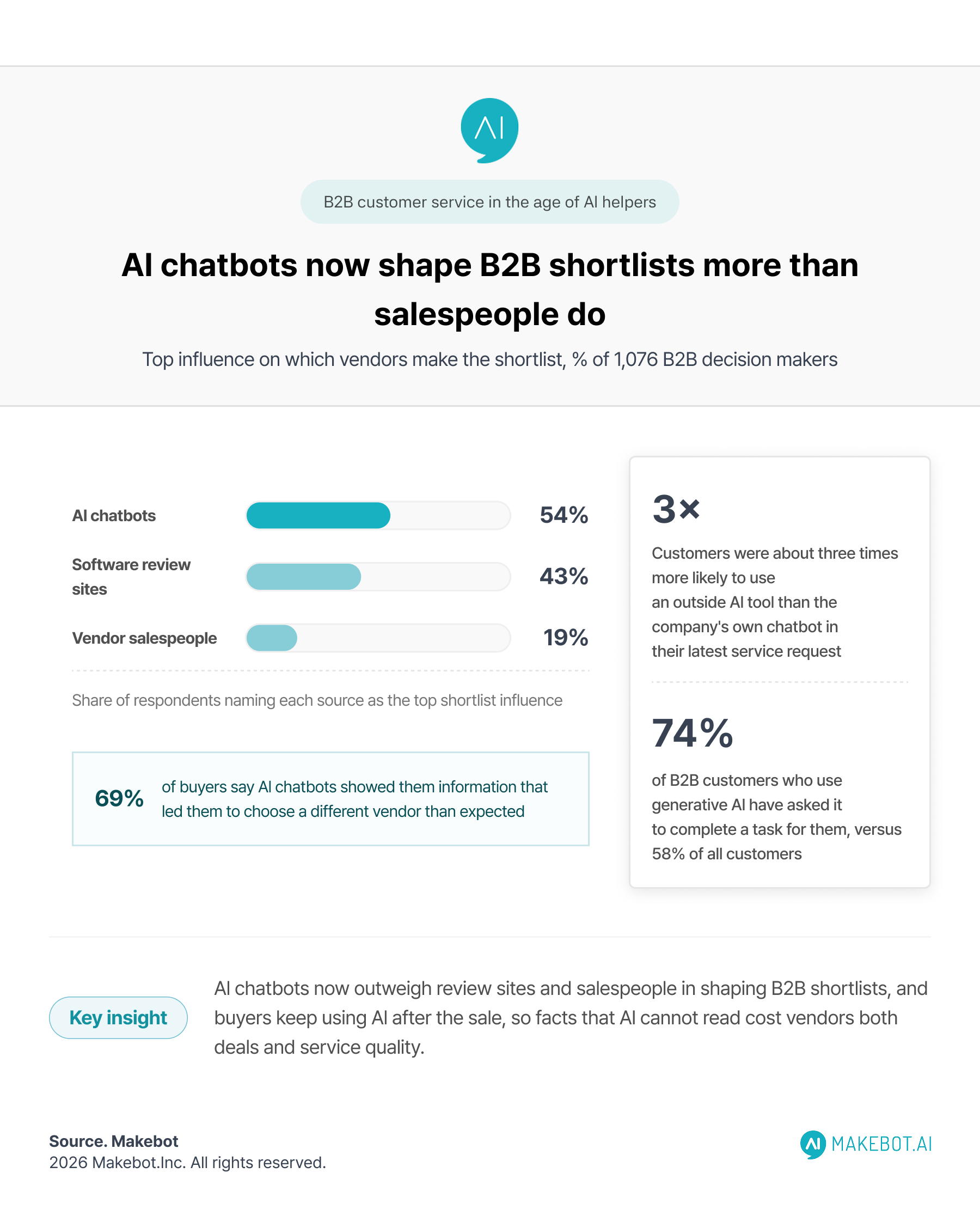
The habit continues after the sale. Gartner found that 58% of customers who use generative AI have used it to complete a task for them, rising to 74% for B2B customers. Among technology buyers, Responsive's Inside the Buyer's Mind study found that 80% use generative AI at least as much as search for vendor research, 21 points higher than other industries.
Clear, open content is what lets AI tools describe your company correctly. When information is unclear or locked in PDFs, AI tools may miss it or repeat it wrongly.
What Is Customer Self-Service When an AI Assistant Asks the Questions?
Customer self-service, when an AI assistant asks, means help tools that buyers and their AI can both use.
B2B customer self-service means portals, knowledge bases and chatbots that let buyers solve problems without an agent.
A Gartner survey of 645 B2B buyers found that 70% prefer a fully digital, self-service buying experience, and 67% prefer to buy without a sales rep. With AI involved, three things matter:
- Clear facts: Prices, service levels and policies state exact numbers and conditions.
- Actions AI can take: Common jobs, like checking an order, work through secure connections, not only web forms.
- Content AI can find: Answers appear as normal page text, not only inside PDFs or images.
Your own chatbot still matters for account tasks, but it now works alongside general AI tools, as our article on why customers turn to third-party AI shows.
How Can B2B Companies Make Their Service Easy for AI to Use?
B2B companies make service easy for AI by publishing clear facts and opening secure, low-risk actions.
Content comes first, which is the job of AI search optimization.
What Does AI Search Optimization Need for Support Content?
Google's guidance on AI features says pages need no special setup or AI text files to appear in AI Overviews or AI Mode, Google's AI-generated search answers. Crawlable pages, text content, internal links and structured data (code that labels page content) that matches the visible text matter most.
Help centers often explain how to do something but skip what it costs or what happens when it fails. To close those gaps:
- Write headings as the questions customers actually ask.
- Keep one dated, versioned answer for each policy.
- Publish service tiers, response times and escalation rules on public pages.
- Make sure AI tools fetching pages for users are not blocked by default.
The 2025 Cloudflare Radar Year in Review found that "user action" crawling, where a bot visits a site because someone asked a chatbot a question, grew more than 15 times in 2025. It also found that AI crawlers were the bots most often fully blocked in robots.txt files (files that tell bots which pages they may visit). A broad bot block meant to stop AI training can also stop the assistant your customer is using right now.
When Should a Company Let AI Agents Take Actions?
Start with tasks that happen often, follow clear rules and carry little risk, such as order status, invoice copies and renewal dates. The Model Context Protocol (MCP) is an open standard that lets AI tools connect to outside software and data. According to the Linux Foundation, Anthropic contributed MCP to its new Agentic AI Foundation in December 2025, when more than 10,000 MCP servers had been published. One MCP connection can serve many compatible AI tools.
If messy data is holding you back, see why data readiness matters for enterprise AI agents.
How Do AI Agents Change the B2B Customer Experience After a Sale?
After a sale, AI agents raise B2B customer experience expectations by handling quotes, orders and renewals.
AI agents for business can request quotes, check orders and manage renewals for customers. That raises expectations for the B2B customer experience: fast, consistent answers at any hour.
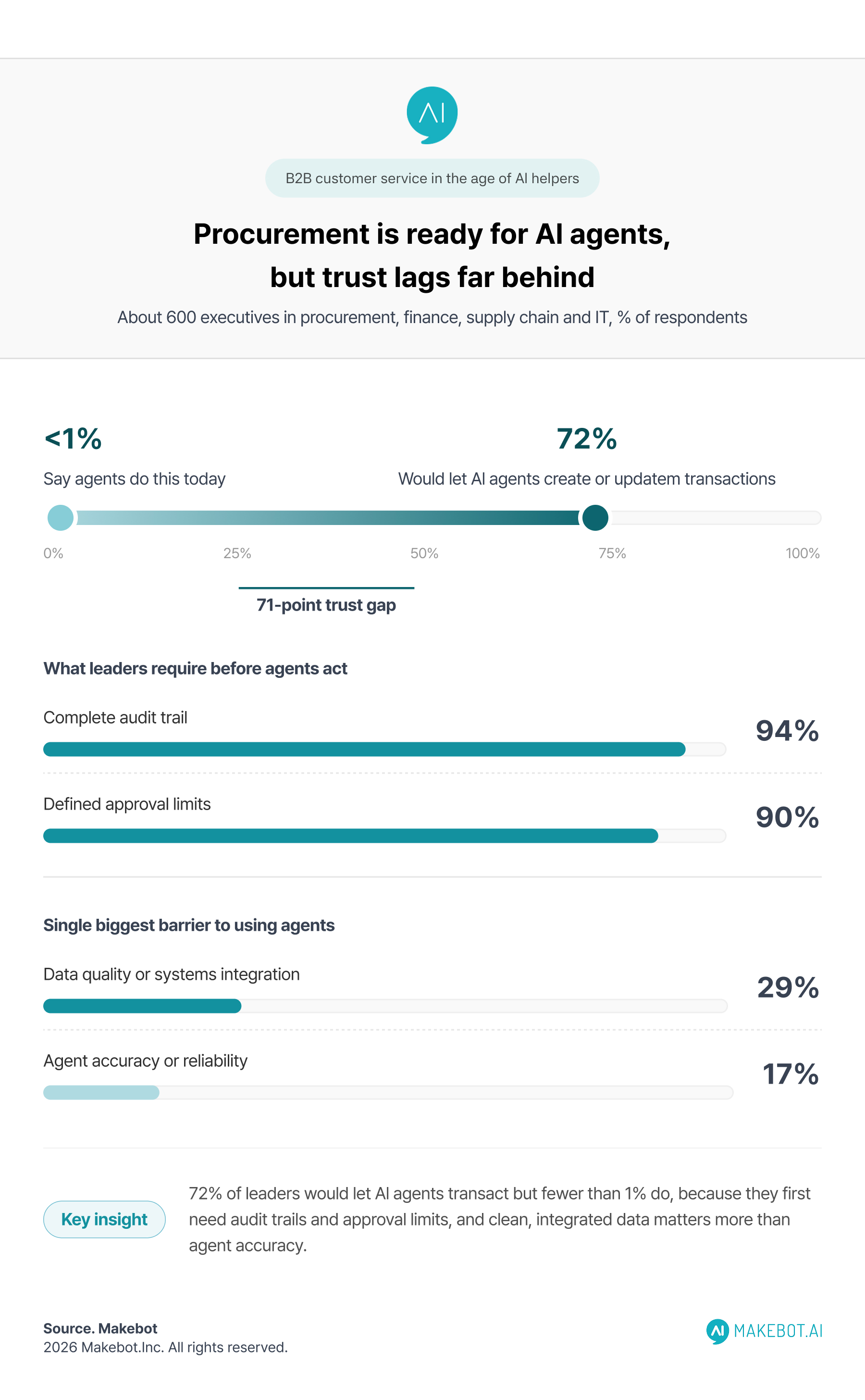
Coupa's State of Agentic Procurement 2026 survey of about 600 executives found that 72% are open to AI agents creating or updating transactions, while fewer than 1% say agents do this today. Closing that gap comes down to trust: 94% want a complete audit trail, and 90% want defined approval limits. So a reply to a buyer's AI agent should be structured, traceable and fast.
Which Service Tasks Should Be Automated First?
Begin with common requests that have one correct answer in your own systems: order and shipping status, invoices, contract dates and license counts. The same approach works for claim status in financial services. Leave price exceptions and billing disputes to people. Coupa's data supports this order: 29% of respondents said data quality or systems integration was the single biggest barrier to using agents, compared with 17% who named agent accuracy or reliability.
Should B2B Companies Still Offer Human Support When Using AI?
Yes, B2B companies using AI should still offer human support, since people handle cases that need judgment.
AI customer service works best for simple, repeat requests, while specialists handle complex deals and disputes.
Gartner's 2026 survey found that 87% of customers say companies using generative AI must offer a way to reach a human agent. In Gartner's May 2026 release, 69% of B2B buyers said they prefer to check AI-generated insights with sales reps. G2 found that 64% of buyers notice AI inaccuracies at least a few times a month, and that 85% think more highly of a vendor cited in an AI answer. Accurate public content and an easy route to a person both build that trust.
The key is a smooth handoff. A case moving to a person should carry the history and what the AI already tried, as explained in how AI chatbots make it easier to reach human support.
People add the most value in renewals, pricing exceptions, disputes and outages. AI frees staff for these moments, as our article on what high-performing AI contact centers do differently explains.
How Do You Measure Customer Effort When AI Does Some of the Work?
When AI does some of the work, measure customer effort across every channel, including unfinished AI tasks.
Track four connected measures: customer effort score (CES, how easy customers say it was to get help), time to resolution, self-service success rate and repeat contacts. A 2010 Harvard Business Review study of more than 75,000 customers found that reducing effort did more for loyalty than trying to impress customers.
A wrong AI answer followed by a short support call still means high effort across the customer journey.
The clearest signal to watch is repeat contacts after AI conversations. Gartner found that customers who are forced through several failed AI interactions are less likely to use that tool again, so every AI path should offer an easy route to a person.
Which Steps Should B2B Service Teams Take First?
B2B service teams should first check what AI says about them, then fix their core facts before anything else.
- Check what AI says about you. Ask major assistants your 20 most common support questions and note wrong answers.
- Fix your core facts. Publish dated pages for pricing, service levels and renewal terms.
- Review crawler rules. Separate training bots from assistants fetching pages for users.
- Open one secure action, such as order status, through an API (application programming interface) or MCP.
- Plan the handoff so every AI path ends with a person.
- Measure effort before and after each change.
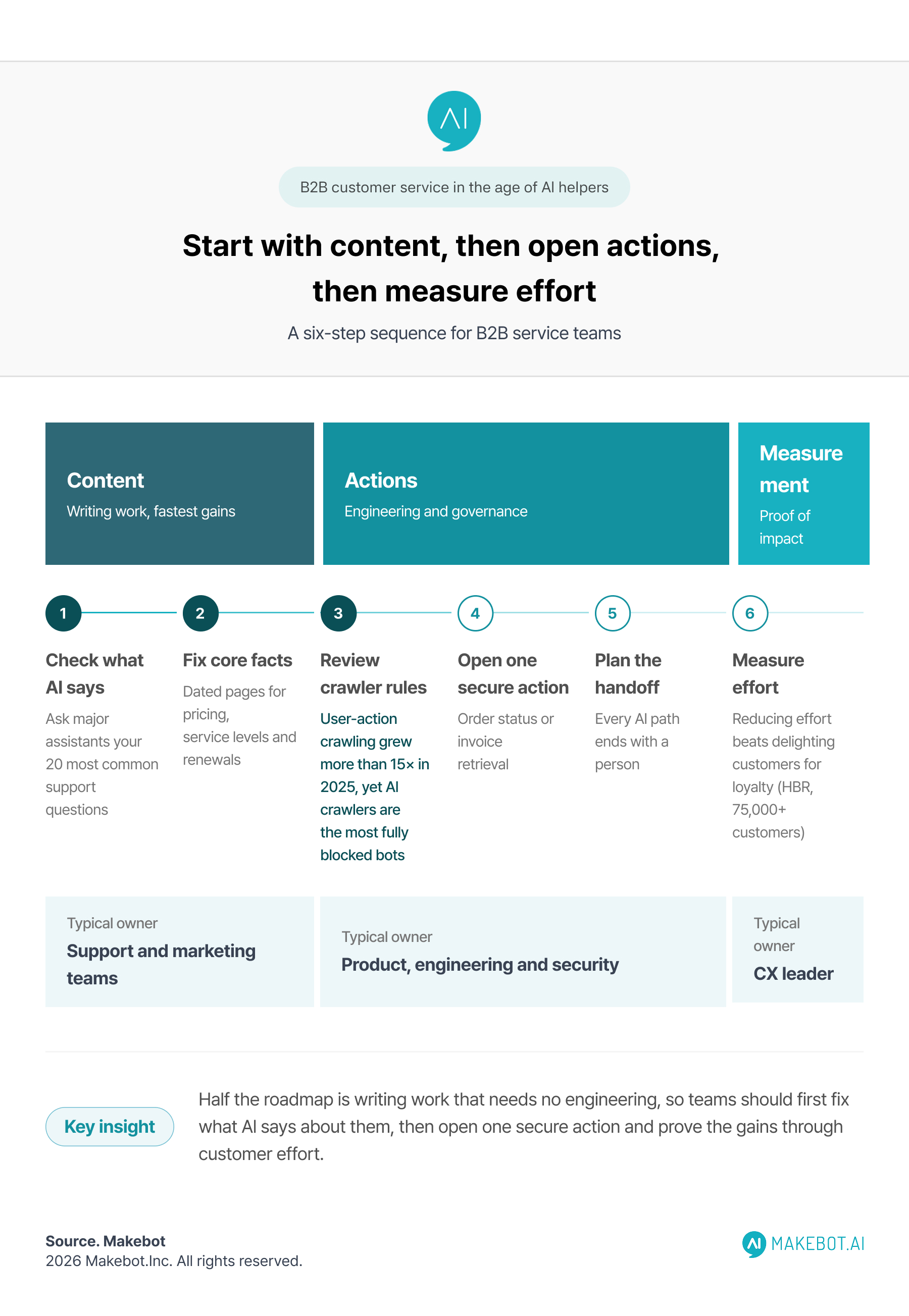
Steps 1 to 3 are quick writing work. For more, see our guide to the move from rule-based chatbots to LLM-powered intelligence.
Conclusion
The winners in B2B customer service will be the easiest companies to work with, for busy people and for the AI helpers acting for them. Clear content raises AI search visibility, callable actions extend customer self-service to AI agents, and strong handoffs protect trust.
A practical first step is to ask the major AI assistants your 20 most common support questions this week, note every wrong or missing answer, and fix those facts on dated public pages.




































What Happens to Marketing When the C-Suite Starts Using AI Every Day?







Why AI Shopping Assistants Will Replace Traditional Ecommerce Search