Why Customers Prefer Third-Party AI Over Retail Chatbots and How Retailers Can Respond
61M US shoppers use AI first for retail research. Retail chatbot use has been flat since 2022.


Key Takeaways
- Outside AI gets the first question. Use of third-party GenAI for service nearly doubled in a year, while company chatbot use has been flat since 2022.
- People research with AI but still buy in familiar places. 23% of U.S. consumers start retail research with AI, yet Amazon closed about 60% of shoppers' latest AI-assisted purchases.
- A retailer's own checkout still sells better. Walmart said purchases completed inside ChatGPT converted at one-third the rate of click-throughs to its own site.
- AI struggles to read many store pages. Retail product pages averaged a 66% score on Adobe's test of how much page content AI can read. That leaves about a third of the content unreadable by AI.
- Retailers need both. They need clean product data for outside assistants and their own AI shopping assistant connected to live product, stock and order systems.
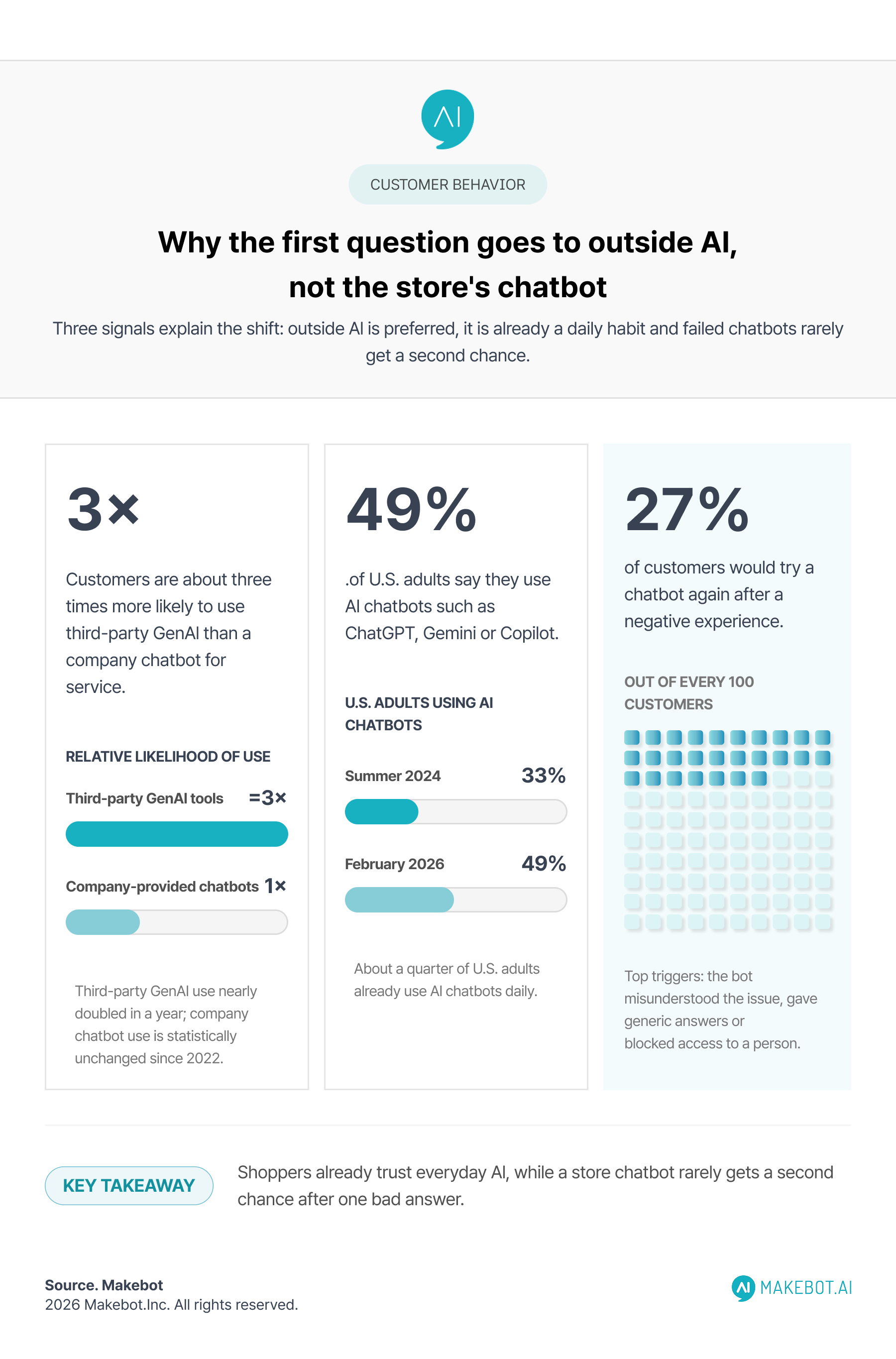
Many retailers added chatbots to their websites, but shoppers mostly took their questions elsewhere. Gartner found that people are about three times more likely to use a third-party generative AI tool than a company-provided chatbot to fix a service problem. A "third-party" tool is one made by another company, such as ChatGPT, Gemini or Copilot.
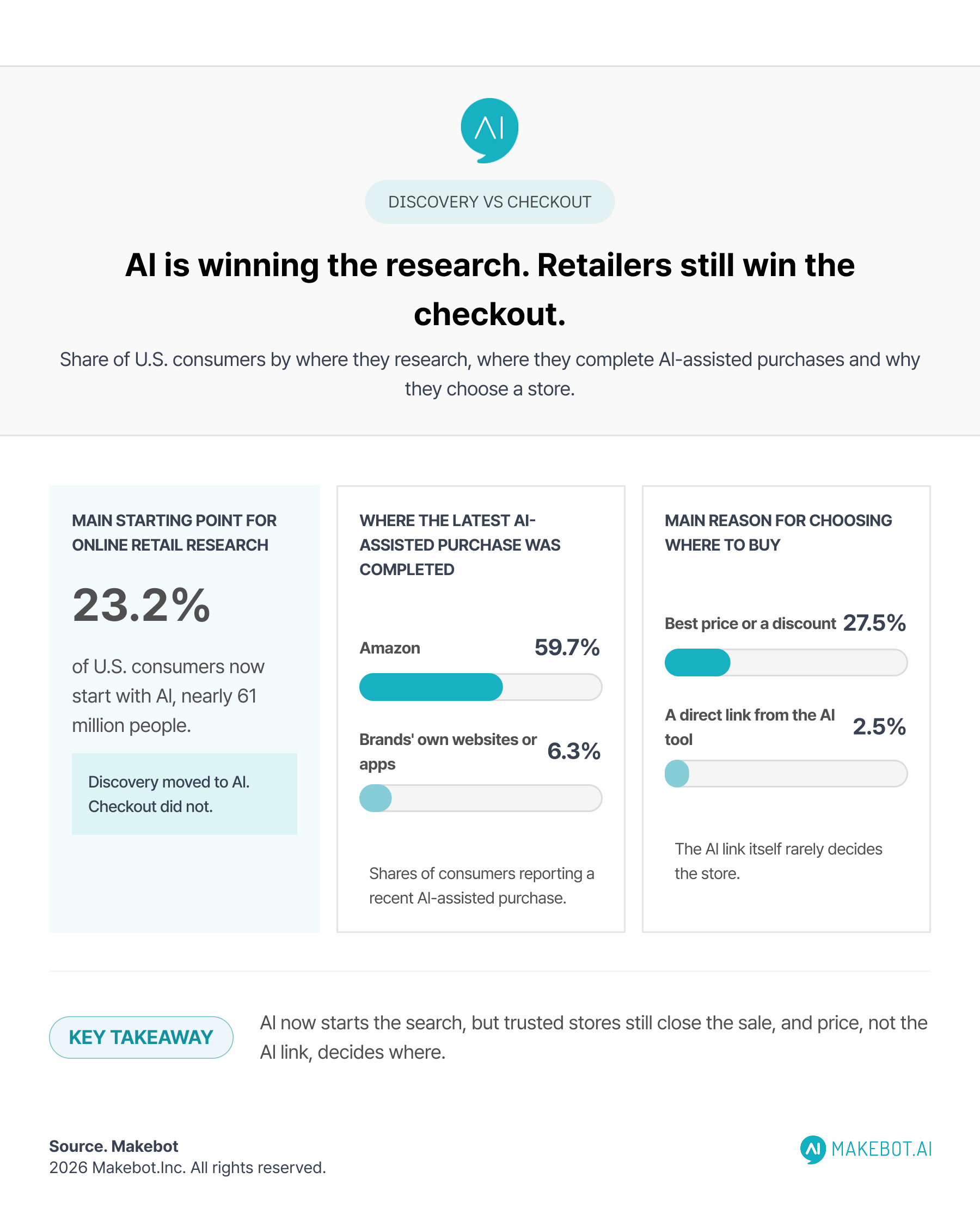
According to PYMNTS Intelligence, nearly 61 million U.S. consumers now name AI as their main starting point for online retail research. That makes the AI shopping assistant a major business decision, not a small website feature.
Why Do Customers Prefer Third-Party AI Over Retail Chatbots?
Customers prefer third-party AI over retail chatbots because it compares brands and can feel more neutral.
A store's chatbot only knows that store's products and usually follows a narrow script. Third-party AI compares brands and stores, handles open questions and has no inventory to push. That matters, because a question like "Which running shoe works for wide feet under $150?" is rarely about one store.
Habit matters too. Pew Research Center found that 49% of U.S. adults said they use AI chatbots in a February 2026 survey, up from 33% in summer 2024. Many people bring shopping questions to the AI shopping assistant they already trust instead of a retail chatbot they rarely open.
Still, in Accenture's survey of 4,048 U.S. holiday shoppers, three in five said they prefer retailer- or brand-specific AI tools over public platforms. Shoppers seem to want a trusted store's accuracy inside the assistant they already use. Solving that puzzle is the main retail customer experience challenge ahead.
What Are the Main Weaknesses of Retail Chatbots Today?
The main weaknesses of retail chatbots are narrow scripts, missed questions and no ability to act.
Many retail chatbots struggle with complex questions, and many cannot act. Gartner's Eric Keller notes that many company-provided chatbots are still designed primarily to answer questions, even though customers increasingly expect AI to take action for them.
And shoppers rarely forgive: only 27% of customers say they would try a chatbot again after a negative experience.
What happens when a retail chatbot gives a wrong answer?
It can become a legal problem. In Moffatt v. Air Canada (2024), the airline argued it was not responsible for its chatbot's wrong advice on bereavement fares (discounts after a family death). British Columbia's Civil Resolution Tribunal ruled that Air Canada was responsible for all information on its website and ordered it to pay C$812.02.
Does Losing the First AI Conversation Mean Losing the Sale?
Losing the first AI conversation does not mean losing the sale; shoppers still buy at trusted stores.
A PYMNTS Intelligence survey of 2,191 U.S. consumers in August 2026 shows that AI is changing where people research faster than where they buy:
- Research has moved: 23.2% name AI as their main starting point for online retail research.
- Buying has not: 59.7% completed their latest AI-assisted purchase on Amazon, compared with 6.3% on brands' own sites.
- Price beats links: only 2.5% chose a store mainly because the AI tool linked to it, while 27.5% cited price or discounts.
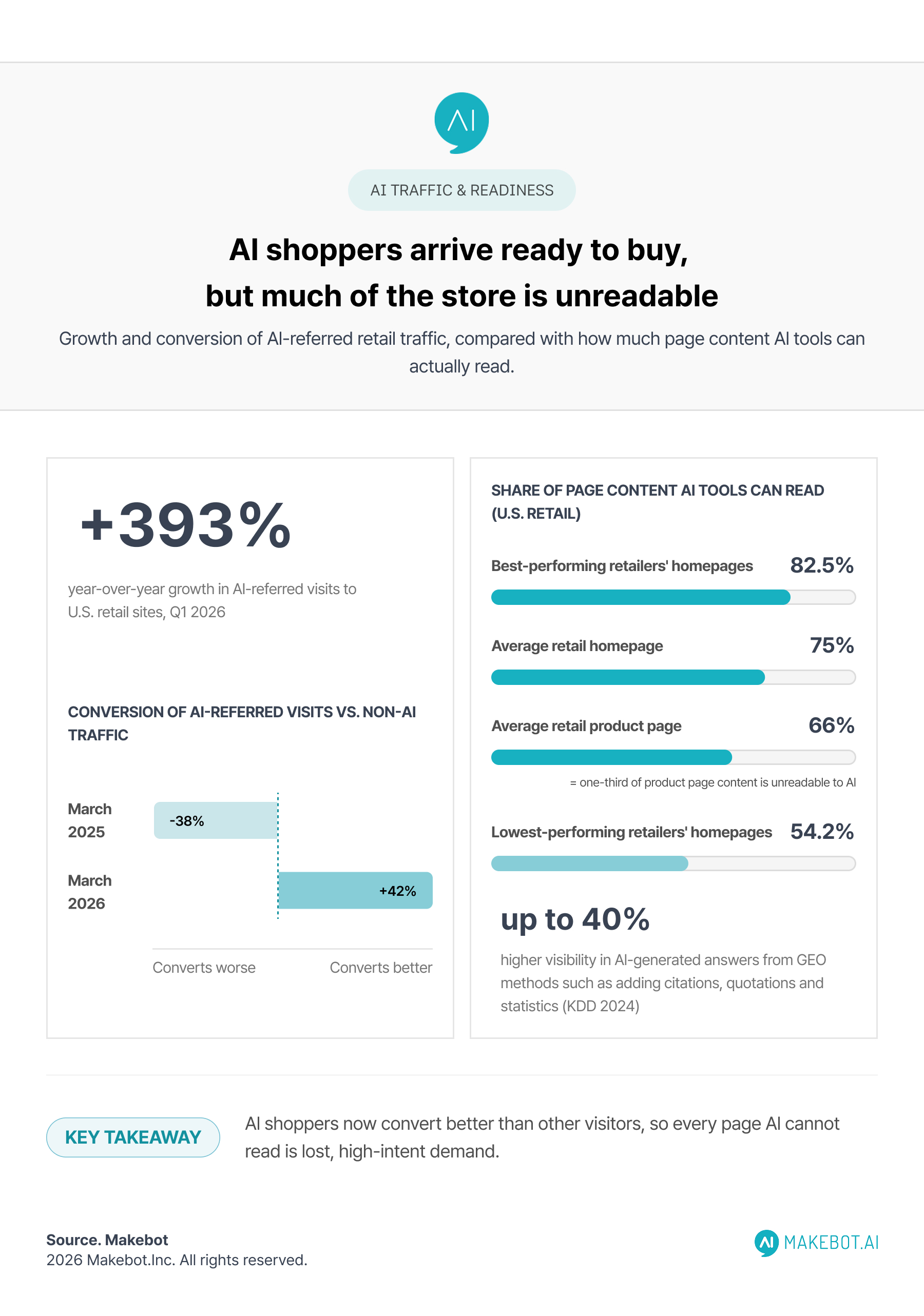
Shoppers who click through from AI are also valuable. Adobe found AI-referred visits to U.S. retail sites rose 393% year over year in Q1 2026, and in March 2026 those visitors converted 42% better than non-AI traffic, a reversal from 38% worse a year earlier.
Owned assistants can work too: Amazon CEO Andy Jassy said 300 million customers used its Rufus assistant in 2025 and were about 60% more likely to complete a purchase, a company-reported link rather than proof of cause.
Why did in-chat checkout disappoint retailers?
Buying directly inside ChatGPT disappointed. Walmart's Daniel Danker told WIRED that purchases completed inside ChatGPT converted at one-third the rate of click-throughs to Walmart's site, as reported by Axios. OpenAI admitted that the first version of its Instant Checkout lacked the flexibility it wanted, and Walmart switched to an in-ChatGPT app that supports account linking, loyalty and Walmart payments. The lesson: let shoppers discover products in the assistant, but keep checkout under the retailer's control.
How Can Retailers Make Their AI Chatbot for Ecommerce More Useful?
Retailers can make an AI chatbot for ecommerce useful by linking it to live product and order data.
One common method is Retrieval-Augmented Generation (RAG): the AI looks up the store's current facts before answering, instead of relying on memory. With APIs (connections that let systems share data and trigger actions), it can also check stock and change orders.
This is where a store's own AI chatbot for ecommerce has an edge. Only the retailer knows the shopper's order history, local stock, loyalty points and return eligibility. A grounded assistant, one that answers from real store data, needs:
- Current data: live product, stock, price and order information, so the LLM (the large language model that writes answers) works from facts.
- Action tools and safety rules: secure functions to track, change or return orders, plus one official source per policy.
- A path to a human: an easy way to reach a person when the bot is unsure.
Keller says the small pop-up chatbot in the bottom corner is starting to feel dated. Leading companies are turning the whole site into a conversational "front door," moving conversational commerce (shopping through a back-and-forth chat) to the center.
How Can Retailers Show Up in ChatGPT and Other AI Assistants?
Retailers show up in ChatGPT and other AI assistants by publishing clear, structured product data.
Structured data is information in a consistent, labeled format (price, size, color) that machines read easily. Retailers should send complete product feeds through OpenAI's Agentic Commerce Protocol and Google Merchant Center. This practice is called generative engine optimization (GEO). It helps decide whether a store makes an AI assistant's shortlist.
Many are not ready. On Adobe's test of how much page content AI can read, product pages averaged 66%, and the best-performing retailers' homepages averaged 82.5% versus 54.2% for the lowest performers. Google has also announced dozens of new Merchant Center attributes for AI Mode and Gemini.
The KDD 2024 paper that coined the term generative engine optimization found that GEO methods could raise a source's visibility in AI-generated answers by up to 40%. Adding citations, quotations from relevant sources and statistics were among the strongest tactics.
What Is Agentic Commerce and Why Does It Raise the Stakes?
Agentic commerce is shopping where AI agents search, compare and buy for customers across retailers.
In agentic commerce, an AI "agent" does the shopping for a person. OpenAI and Google released open protocols, shared rules that let agents read catalogs and hand off checkout:
- Universal Commerce Protocol (UCP): launched by Google in January 2026 and co-developed with Shopify, Etsy, Wayfair, Target and Walmart. Google said it would power checkout in AI Mode and Gemini, with the retailer as the official seller.
- Agentic Commerce Protocol (ACP): an open standard that OpenAI built with Stripe. In March 2026 it was expanded from checkout to product discovery.
Brand trust still matters: Accenture found nearly three-quarters of U.S. shoppers want agents to buy only from preferred or familiar brands and retailers, while 15% of shoppers will go wherever the agent recommends based on price and availability.
Can retailers simply block third-party shopping agents?
Blocking is legally unclear and risky. On March 9, 2026, a federal district court granted Amazon a preliminary injunction, a temporary court order, against Perplexity's Comet browser agent. In August 2026, the Ninth Circuit vacated that injunction, holding that under federal and California anti-hacking laws it was the Comet user, not Perplexity, who accessed Amazon's computers. A better plan is to publish agent-readable feeds and require agents to identify themselves.
Should Retailers Replace Their Chatbot With a Third-Party AI?
Retailers should not replace their chatbot with third-party AI; they should optimize for both.
Third-party AI wins more early research, while the retailer's own assistant protects checkout, loyalty and customer data, which still shape the wider retail customer experience. Each job needs different investments:
The two jobs need different investments.
Showing up in third-party AI assistants is about getting on the shortlist while shoppers research. The main tools are generative engine optimization (GEO), good product feeds and setting up the ACP and UCP protocols, and success is measured by AI traffic, answer accuracy and AI revenue. Your own retail AI shopping assistant has a different job: turning visits into sales and repeat customers.
It relies on RAG, the ability to take actions and an easy handoff to a human, and its success shows up in problems solved, sales and repeat use.
Conclusion
Shoppers like third-party AI because it answers their real question: which product, from which brand, at which store. But losing the first conversation is not losing the sale. First, make your catalog easy for every AI shopping assistant to read, using structured feeds, protocol support and generative engine optimization. Second, rebuild your own assistant on live product, stock and order data so it can actually get things done.
Meet Shoppers Where Their AI Takes Them
As AI shopping assistants reshape where consumers start their buying journey, retailers need tools that keep their brand visible and their conversations converting. Makebot builds enterprise AI solutions that help businesses engage customers through the channels they already use, so your brand stays in the conversation wherever it happens.
Makebot’s AI Strategic Whitepaper Vol.01, From Limits to Possibilities: The Shift from Rule-Based Automation to LLM-Powered Intelligent Conversation, explains why the old retail chatbot is losing to outside AI. It shows how keyword-driven bots lead to high failure rates, frustrated customers and lost brand trust, and how LLM-based conversational AI and agentic LLMs move a chatbot from answering questions to completing tasks.
For retailers rebuilding their own AI shopping assistant, download the whitepaper to see how conversational AI becomes a strategic asset instead of a cost-cutting tool.

































What Happens to Marketing When the C-Suite Starts Using AI Every Day?






Why AI Shopping Assistants Will Replace Traditional Ecommerce Search