How AI Chatbots Can Make It Easier for Customers to Reach Human Support
64% of customers prefer no AI in service. An AI chatbot should speed the path to a human agent.

Key Takeaways
- The handoff is part of the product now. People judge an AI chatbot less by what it can do alone and more by how fast it gets them to a person when it cannot help.
- A good bot makes the human queue shorter. It confirms who the customer is, figures out what they need and sends them to the right team, so the agent can start solving the problem right away.
- Access to a human is turning into a legal requirement. California AB 1609, the EU's updated rules for financial services sold at a distance and AI disclosure rules in the EU and Korea all push the same way: be open about AI and keep a person within reach.
- AI agent assist makes each handoff count for more. A peer-reviewed study of 5,172 support agents found that AI help raised the number of issues solved per hour by 15%, and less experienced staff became both faster and better.
- Containment is a misleading score. Containment is the share of chats that never reach a person. First contact resolution, handoff wait time and repeat contacts tell you much more about whether automation solves problems or just pushes them to later.
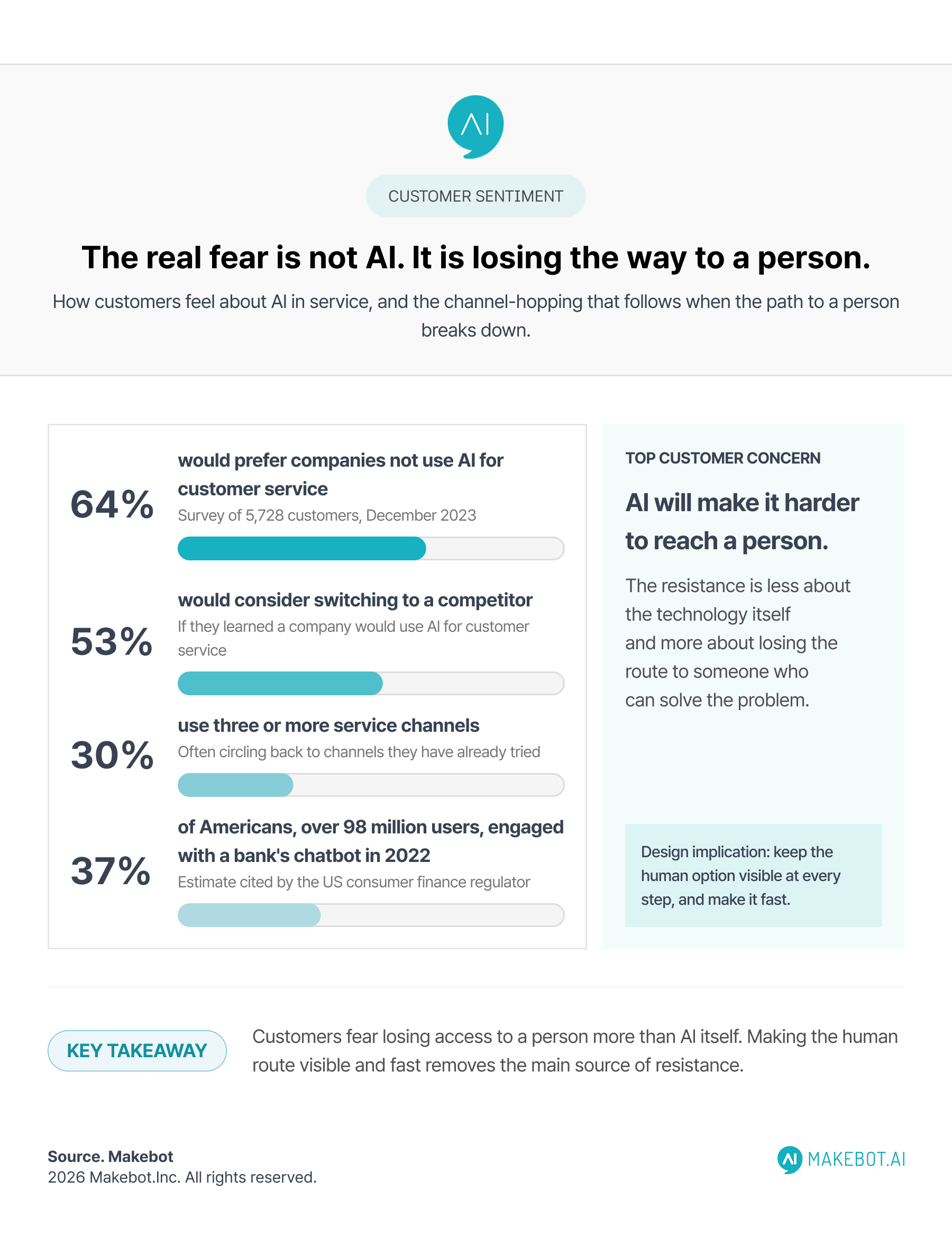
Companies added an AI chatbot to handle simple, repetitive questions, such as order, delivery and return inquiries. For many customers, it now feels like a wall between them and a person who can help. In a Gartner survey of 5,728 customers carried out in December 2023, 64% said they would rather companies did not use AI for customer service. Their top worry: AI would make it harder to reach a human.
California has enacted a law that guarantees a clear route to a human agent, and in June 2026 the EU began applying a right to request human intervention in online financial services. The real question is how to design customer service automation so that reaching a person gets faster, not slower.
Why Do Customers Feel an AI Chatbot Keeps Them From Reaching a Human?
Customers feel blocked when a chatbot is built to keep people away from agents instead of solving problems. When the bot hides the human option or misses requests it cannot handle, customers fall into doom loops: the same scripted replies with no way out.
The US Consumer Financial Protection Bureau estimated, citing an Insider Intelligence figure, that more than 98 million users, about 37% of Americans, used a bank's chatbot in 2022. Gartner reports that 30% of customers use three or more service channels, often circling back to ones they already tried, a sign of many channels without real omnichannel customer service.
In July 2025, Commonwealth Bank (CBA) planned to cut 45 service jobs, saying an AI voice bot had reduced calls. The Finance Sector Union said calls were rising, and the bank reversed the cuts in August, telling Finextra it "should have been more thorough in our assessment of the roles required."
These are chatbot design mistakes, not limits of the technology, and one reason many companies are moving from rule-based chatbots to LLM-powered systems.
How Can AI Chatbots Help Customers Reach Human Support Faster?
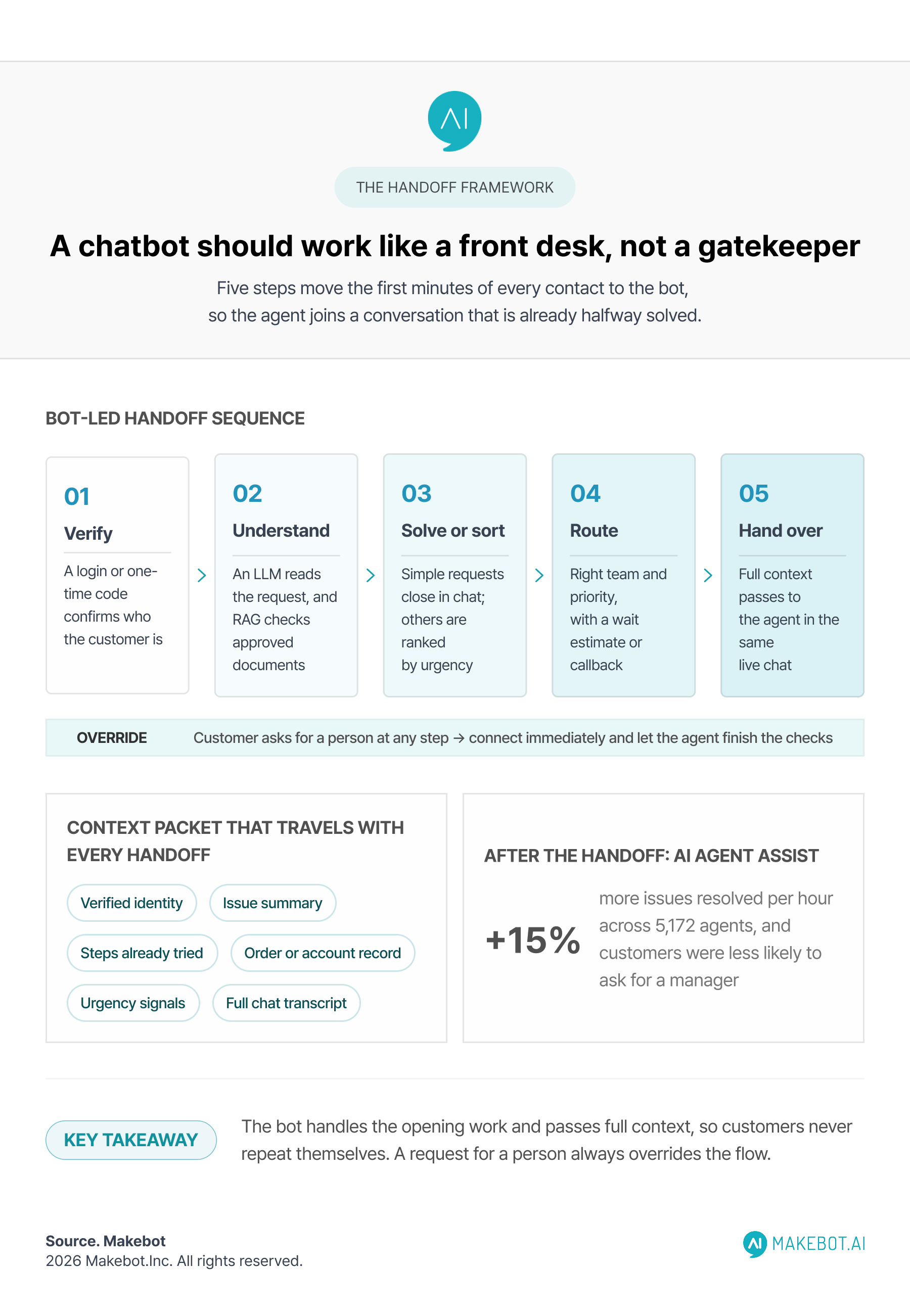
An AI chatbot speeds up human support by doing the work that usually fills the first minutes of a call. It confirms who the customer is, records the problem and routes the case to the right agent with the full chat attached.
In a traditional IVR-based contact center, agents start by checking identity. A good handoff moves that work to the bot:
- Verify the customer with a login or one-time code.
- Understand the request. A Large Language Model (LLM) reads everyday language, and Retrieval-Augmented Generation (RAG) lets the bot check approved company documents before it answers.
- Solve or sort. Simple requests end in the chat; others are ranked by urgency and complexity.
- Route and set expectations with a wait estimate or callback.
- Hand over the full story in the same live chat support window.
If a customer asks for a person at any step, connect them right away.
When Should a Chatbot Hand Off to a Human Agent?
A chatbot human handoff should happen when an issue is complex, emotional, high-value or legally sensitive, when the bot still cannot understand the request after one honest try, and immediately when the customer asks for a person.
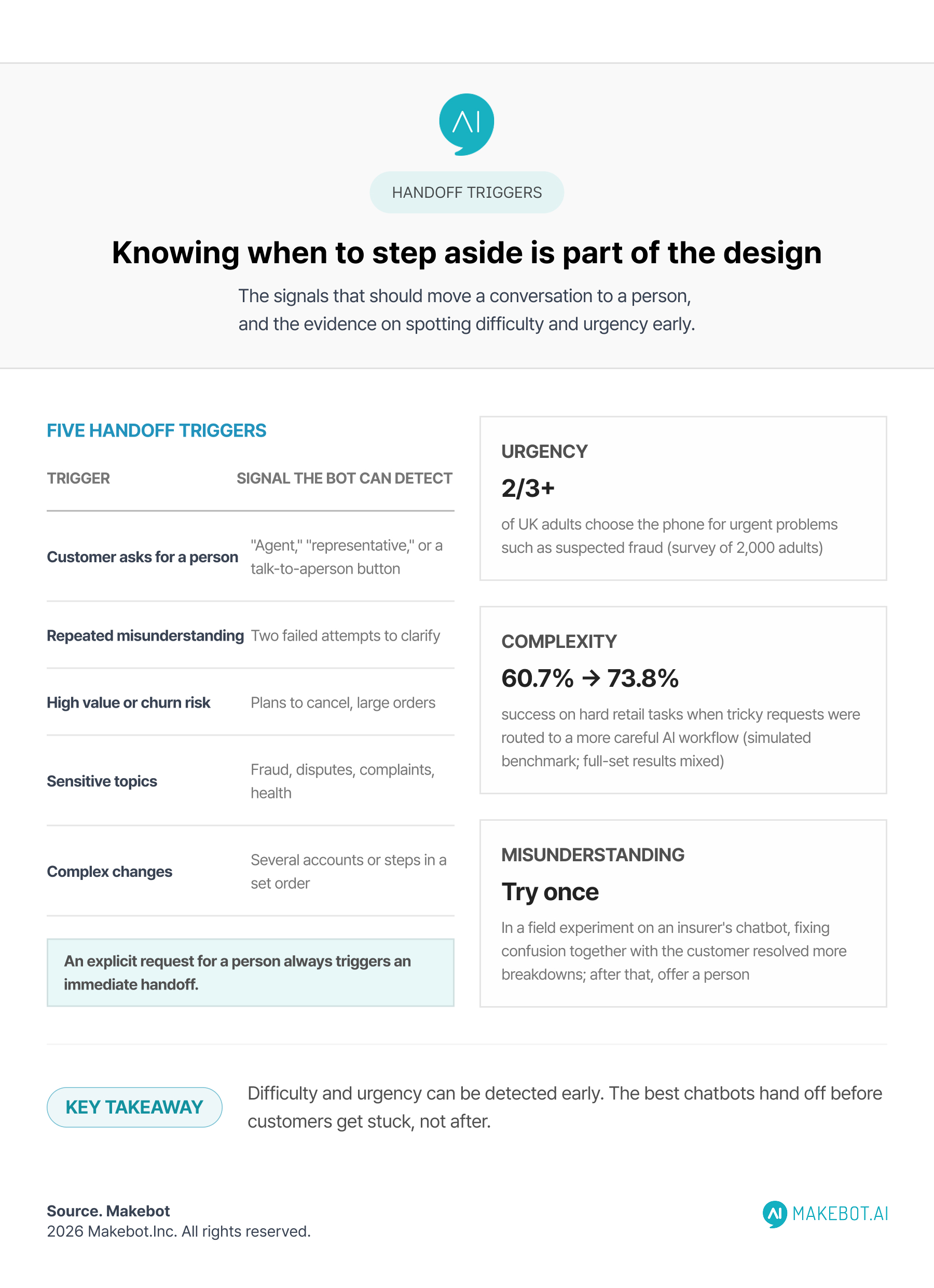
Complexity can be spotted early. In a July 2026 Penn State preprint, routing tricky requests to a more careful process raised success on hard retail tasks from 60.7% to 73.8% in one setup. The cases went to an AI workflow, not a person, and full-set results were mixed. Urgency is another signal: more than two-thirds of UK adults choose the phone for urgent problems, according to a CCMA survey of 2,000 adults.
Should the bot try to fix a misunderstanding first? Once. A field experiment in MIS Quarterly, run on a large insurance company's customer service chatbot, found that when bot and customer worked together to clear up confusion, more breakdowns were fixed. After that one try, offer a person.
What Makes a Chatbot to Human Handoff Seamless for Customers and Agents?
A seamless chatbot human handoff passes the full chat, verified identity and account details to the agent in the same conversation, so the customer never repeats themselves.
This warm transfer only works when the bot, routing system and agent tools share one conversation record. Four details help:
- Same channel: customers who start in chat finish in chat.
- Full context: agents see the whole chat, not just a summary.
- Honest wait times: a callback option means fewer people give up.
- A way back: routine steps, like payment confirmation, return to the bot.
This is how unified human and AI agent teams save human time.
Should Customers Always Have the Option to Talk to a Human?
Yes. An easy route to a person protects trust, and it is becoming law. In the same Gartner survey, 53% of customers said they would consider switching to a competitor if they learned a company would use AI for customer service.
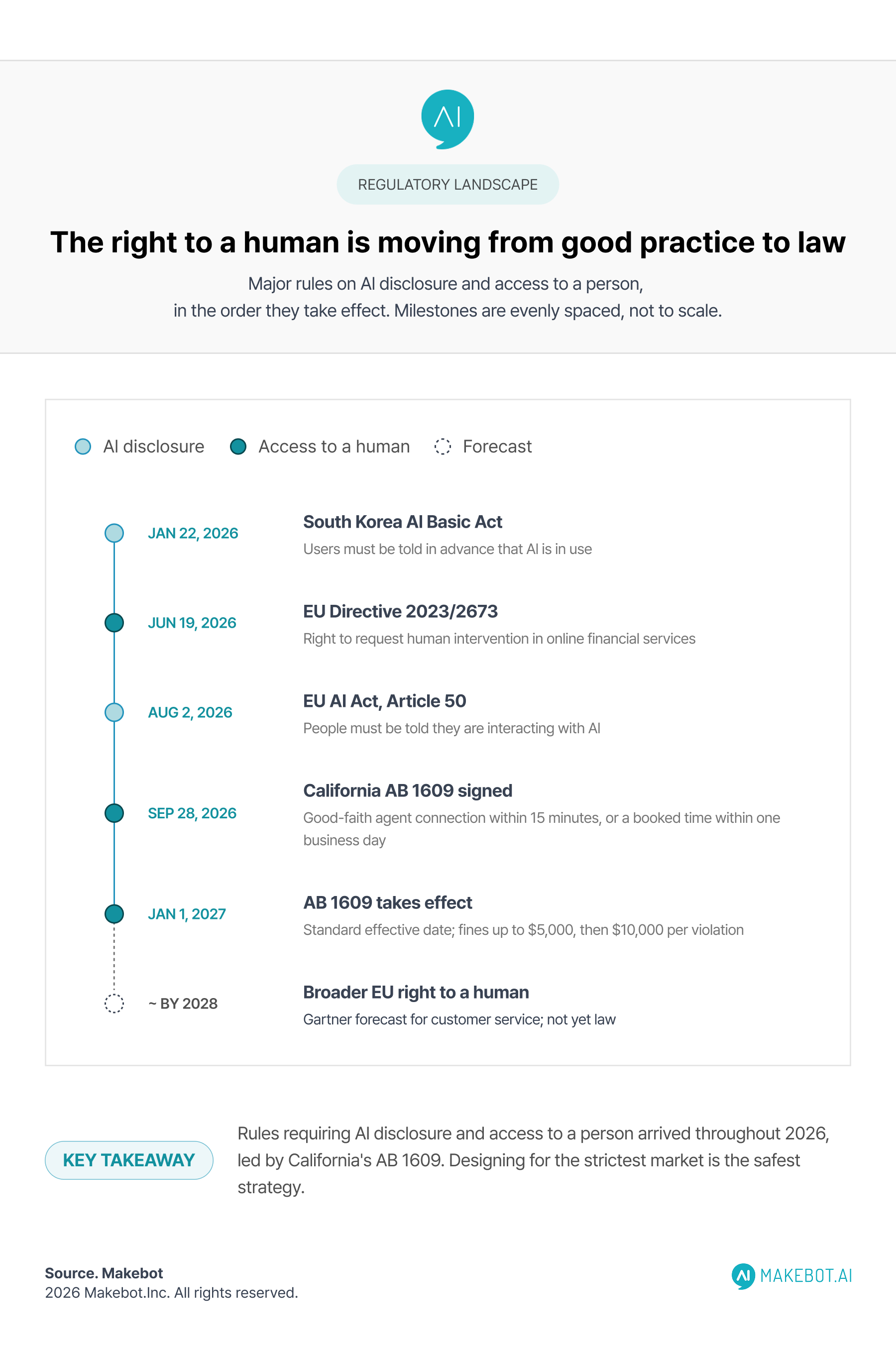
AB 1609 allows fines of up to $5,000 for a first violation and $10,000 for each one after, and only public prosecutors can bring a case (Senate analysis). Gartner predicts the EU will require a broader "right to talk to a human" by 2028, still a forecast. Designing for the strictest market also helps close the governance gap many enterprises face with AI agents.
How Does AI Agent Assist Help Human Support Teams Resolve Issues Faster?
AI agent assist keeps working after the handoff. It suggests replies, pulls up records and summarizes conversations so agents resolve issues faster.
In a study published in The Quarterly Journal of Economics in 2025, Erik Brynjolfsson, Danielle Li and Lindsey Raymond analyzed data from 5,172 customer support agents using an AI assistant. Issues resolved per hour rose 15% on average, less experienced workers improved in both speed and quality, and customers were less likely to ask for a manager.
The agent stays in charge. This human-in-the-loop approach is what the highest-performing AI contact centers use.
Which Metrics Show Whether Chatbot Handoffs Are Actually Working?
Track first contact resolution, handoff wait time, repeat contacts and satisfaction after escalation. Together, they show whether the AI chatbot solves problems or just delays them. Containment, the share of chats that never reach a person, can rise while customers quietly call back.
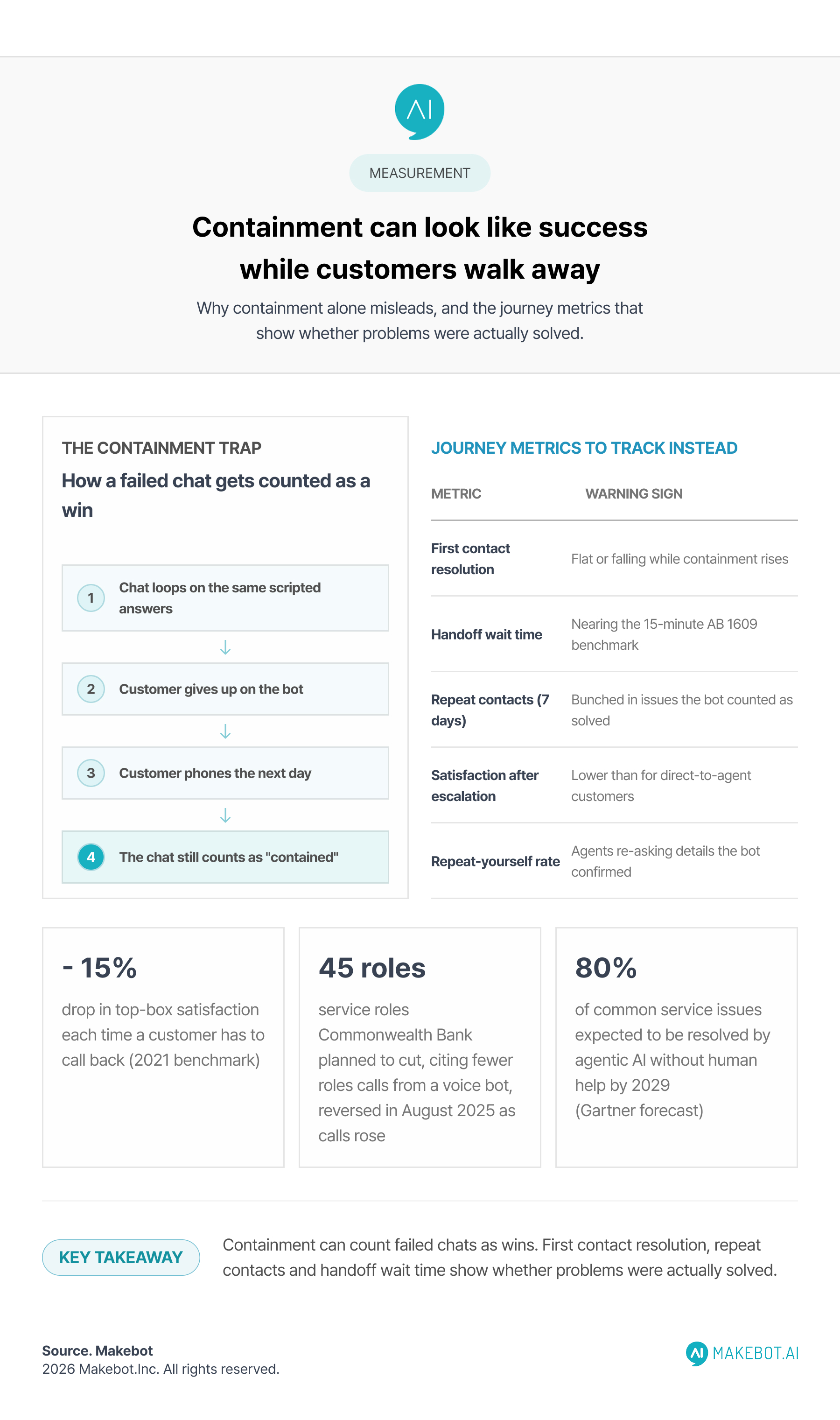
First contact resolution matters most. Benchmarking by SQM Group found that top-box satisfaction drops about 15% each time a customer has to call back, though the 2021 figures lack a published sample. Gartner predicts that agentic AI will resolve 80% of common customer service issues without human help by 2029, so as agentic AI takes on more customer problems, whole-journey metrics will be the clearest test.
Conclusion
Often, the most useful thing an AI chatbot can do is step aside quickly. That is not giving up on automation; it is how companies move chatbots from pilot to production without losing customer trust. A bot that verifies, sorts and passes along the full story removes the slowest part of human support, and AI agent assist makes the rest faster.
Start with an audit: count the clicks to reach a person, check what reaches the agent, and compare first contact resolution for bot-only and escalated chats.
Ready to improve your chatbot human handoff? Makebot builds LLM-powered chatbots and contact center AI that connect customers to the right person. Talk to us about your customer service automation plans.
AI That Knows When to Hand Off
The best customer service automation is designed around the customer, not the cost savings. Makebot builds enterprise AI solutions where chatbots and human agents work as one system, so customers get fast answers when AI can help and seamless handoffs when they need a person.
Makebot’s AI Strategic Whitepaper Vol.02, From Scattered AI to a Single Core: CX·EX Innovation with a Unified Intelligence Core, explains why the handoff is an operating model decision, not a technical detail. It argues that the AI performance gap comes from how humans and AI share roles, responsibility and control, and that Human-in-the-Loop should be the standard execution structure across high-value workflows. It also shows how bringing chat, voice, documents and internal work into one intelligence core connects customer and agent experience in a single flow.
For teams redesigning how their chatbot and agents work together, download the whitepaper for the full framework.

































What Happens to Marketing When the C-Suite Starts Using AI Every Day?






Why AI Shopping Assistants Will Replace Traditional Ecommerce Search