Key Questions Hospitals Should Ask Before Investing in AI Callbots and Chatbots
94% of practice leaders named access as their top 2026 problem. Key questions for hospital AI.


Key Takeaways
- Connecting to hospital systems comes first. A bot needs two-way EHR integration, meaning a live link to the electronic health record. With it, the bot can book, change and confirm visits, not just chat with patients.
- Smooth handoffs to people are a core feature. In a Mount Sinai study published in npj Digital Medicine, about 12% of AI calls were correctly passed to a person, so patients who need human help reach it quickly.
- The phone still matters. A meta-analysis in BMJ Open found that voice reminders worked at least as well as text reminders, so phone channels deserve automation of their own.
- Clear rules make planning easier. If finalized, a proposed HIPAA update from the US Department of Health and Human Services would require encryption and multi-factor authentication, with limited exceptions. Korea's AI Basic Act names health and medical service systems as high-impact AI areas.
- Start with a small pilot and measure it. Test the bot on one busy task and track completions, handoffs and patient feedback. That shows more than any sales demo.
Introduction
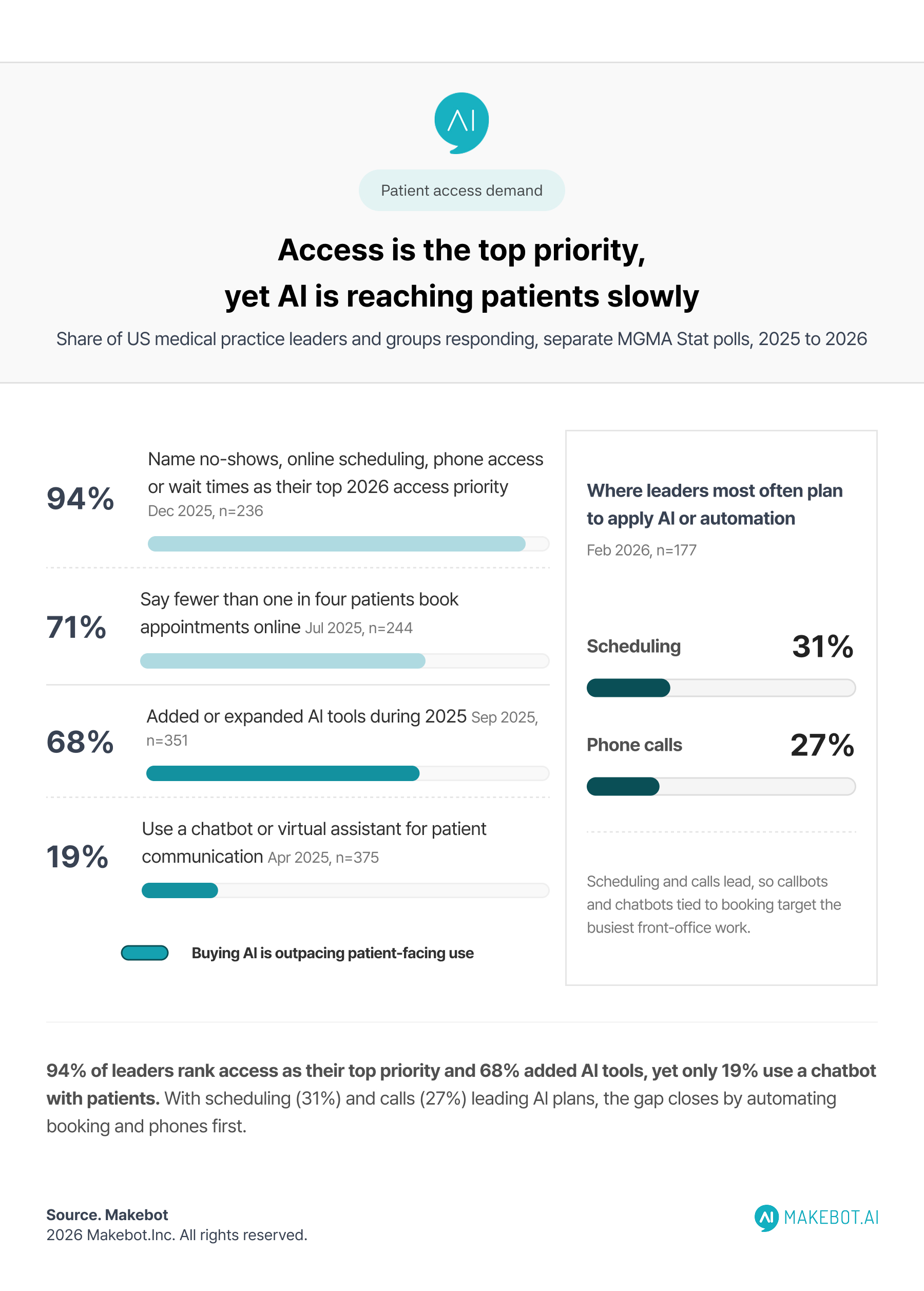
For many patients, the phone is still the main way into a hospital. In a December 2025 MGMA Stat poll of 236 practice leaders, the top patient access priorities for 2026 were no-shows (27%), online scheduling (24%), phone access (22%) and wait times (21%). Two months later, another MGMA Stat poll found that scheduling (31%) and calls (27%) topped the list of front-office areas where practices were focusing on AI and automation.
That is why interest in conversational AI in healthcare keeps growing. An AI callbot answers and makes phone calls, while a chatbot does similar work by text on websites, apps and messaging.
The key to getting value is choosing a bot that connects to the scheduling system and hands patients to a person smoothly, not one that only takes messages.
Why Are Hospitals Turning to Conversational AI in Healthcare Now?
Hospitals are turning to conversational AI now because faster phone access and fewer missed visits protect both patient access and hospital capacity.
Long hold times, missed appointments and low use of online booking all use up clinical capacity at once. AI callbots and chatbots can handle repetitive requests 24 hours a day, helping hospitals manage growing demand without adding front-office staff.
Many hospitals have room to grow here. In a July 2025 MGMA Stat poll, 71% of medical groups said fewer than one in four patients booked online. An April 2025 MGMA Stat poll found that 19% of practices used a chatbot or virtual assistant, while a September 2025 MGMA Stat poll found that 68% of medical groups added or expanded AI tools in 2025.
Speed of answer matters to patients. A study in The American Journal of Managed Care of 252,145 Veterans Health Administration patients found that when the average speed of answer (how long callers wait) was slower, patients were less likely to feel they could get urgent care quickly. The call abandonment rate showed no significant link.
A hospital call center needs tools that get patients what they need sooner. A bot connected to hospital systems can do this, which a basic phone menu cannot.
What Should Hospitals Look for in a Callbot or Chatbot?
Hospitals should look for EHR integration, language support, 24/7 booking, data security and staff handoff.
With all five, an AI chatbot for healthcare can finish the patient's request instead of sending it back to the front desk.
- EHR and scheduling integration. A bot that cannot write data only collects requests for staff to retype.
- Handoff to staff. The bot should transfer the conversation with context, so patients do not have to repeat themselves.
- Data security. Identity checks, encryption and audit trails (records of who viewed or changed what) must be built in.
- 24/7 booking. This works only if the bot can see and confirm open slots.
- Language support. Cover the languages your patients speak. In the United States, a letter from the HHS Office for Civil Rights says a qualified human translator must check machine translations of important content, though court orders have affected parts of the underlying rule.
Start with integration, because everything else depends on it. Language support usually brings the next biggest gain.
Should a Hospital Choose a Callbot, a Chatbot, or Both?
Most hospitals should choose both a callbot and a chatbot, run from one shared scheduling system.
Callbots serve patients who prefer the phone, and chatbots serve those who would rather help themselves.
A BMJ Open meta-analysis found that text reminders lowered no-show rates from 21% to 15%, pooled across 16 randomized studies. In six studies that compared channels, voice reminders did as well as text or slightly better, although the difference was borderline. Automated appointment reminders clearly help, and the channel should match each patient.
Do outbound AI calls need patient consent?
In the United States, usually yes. A February 2024 FCC ruling confirmed that AI-generated voices count as an "artificial or prerecorded voice" under the Telephone Consumer Protection Act (TCPA). Callers need the patient's prior express consent (clear permission given in advance) unless an emergency purpose or exemption applies, and each message must say who is calling. Check consent and exemptions with your lawyers before launch.
For a closer look at voice automation, see how a 24/7 hospital callbot handles reservations, changes and cancellations at peak hours.
Why Does EHR Integration Matter for a Hospital Chatbot?
EHR integration matters because it lets a hospital chatbot book, change and confirm visits in real time.
The EHR (electronic health record) holds patient records. With a live connection, routine requests are completed by the bot instead of becoming tasks for staff.
The vendor-neutral IHE Scheduling profile, a standard from Integrating the Healthcare Enterprise, describes the steps: find open appointments, hold a slot, book or change it, and look up existing visits. It uses the Schedule, Slot and Appointment resources of FHIR (Fast Healthcare Interoperability Resources), standard building blocks for calendars. Participants in the CMS Modern Scheduling initiative from the Centers for Medicare & Medicaid Services pledge real-time booking through open FHIR APIs (standard connections between software systems).
What breaks when integration is shallow?
With read-only access or nightly updates, the bot may offer a slot taken an hour ago or miss a rule such as a referral. Ask vendors for a live booking in a test copy of your patient scheduling software, including a cancellation and a double-booking attempt. Scheduling is also a common starting point for AI returns, as our guide to AI scheduling agents explains.
How Can Hospitals Keep Patient Data Safe With an AI Chatbot?
Hospitals keep patient data safe with encryption, MFA (multi-factor authentication), role-based access, audit logs and clear contracts.
Vendors should encrypt data in storage and in transit and follow local privacy and AI laws. Contracts should cover data retention, model training and breach reporting.
The HIPAA Security Rule proposal from the US Department of Health and Human Services would require encryption and multi-factor authentication with limited exceptions, plus a compliance audit at least once every 12 months. HIPAA is the US law that protects patient health information. As of November 2026 the proposal is listed as a long-term action, with final action targeted for July 2027 in the federal regulatory agenda.
Korea's AI Basic Act took effect on January 22, 2026, according to Korea.net. The official English translation of the Act lists health and medical service systems among its high-impact AI areas, though, as Cooley notes, operators must check whether their system qualifies. Users must be told when AI is used, and high-impact systems need human oversight. Hospitals can use the grace period of at least one year to prepare.
Our guide to securing patient-access AI agents against PHI (protected health information) and identity risk covers storage and caller identity checks.
What Questions Should Hospitals Ask Chatbot Vendors Before Signing?
Before signing, ask vendors about integration, accuracy, languages, security, handoff, pricing and results.
Expect proof such as a live demo, error rates and reference hospitals.
How should hospitals judge vendor accuracy claims?
Ask what counted as an error and whether the figure came from testing or live traffic. Good vendors separate technical failures from content failures, explain how they reduce hallucinations (confident but wrong AI answers) and show how the bot handles off-script questions. That is where retrieval-augmented generation (RAG) matters: the AI looks up answers in the hospital's own approved policies before it replies.
For the financial case, see how to measure hospital callbot and chatbot ROI.
How Can a Hospital Test a Callbot Before Full Rollout?
A hospital should test a callbot with a 90-day pilot on one busy, low-risk task before full rollout.
Track completion, call deflection, handoffs, errors and patient feedback, and fix weak spots before you scale beyond the pilot.
In a Mount Sinai study in npj Digital Medicine, an AI voice assistant made pre-procedure calls for a cardiac lab. After a 90-day tuning phase came a 90-day nurse-led phase covering 800 calls. In that phase:
- 87.9% of calls were completed, and 42.6% needed no human callback.
- 11.8% were correctly switched to a human call, and 33.5% triggered a nurse callback required by protocol.
- 3.0% did not complete because of AI system issues, down from 6.0% in the first phase.
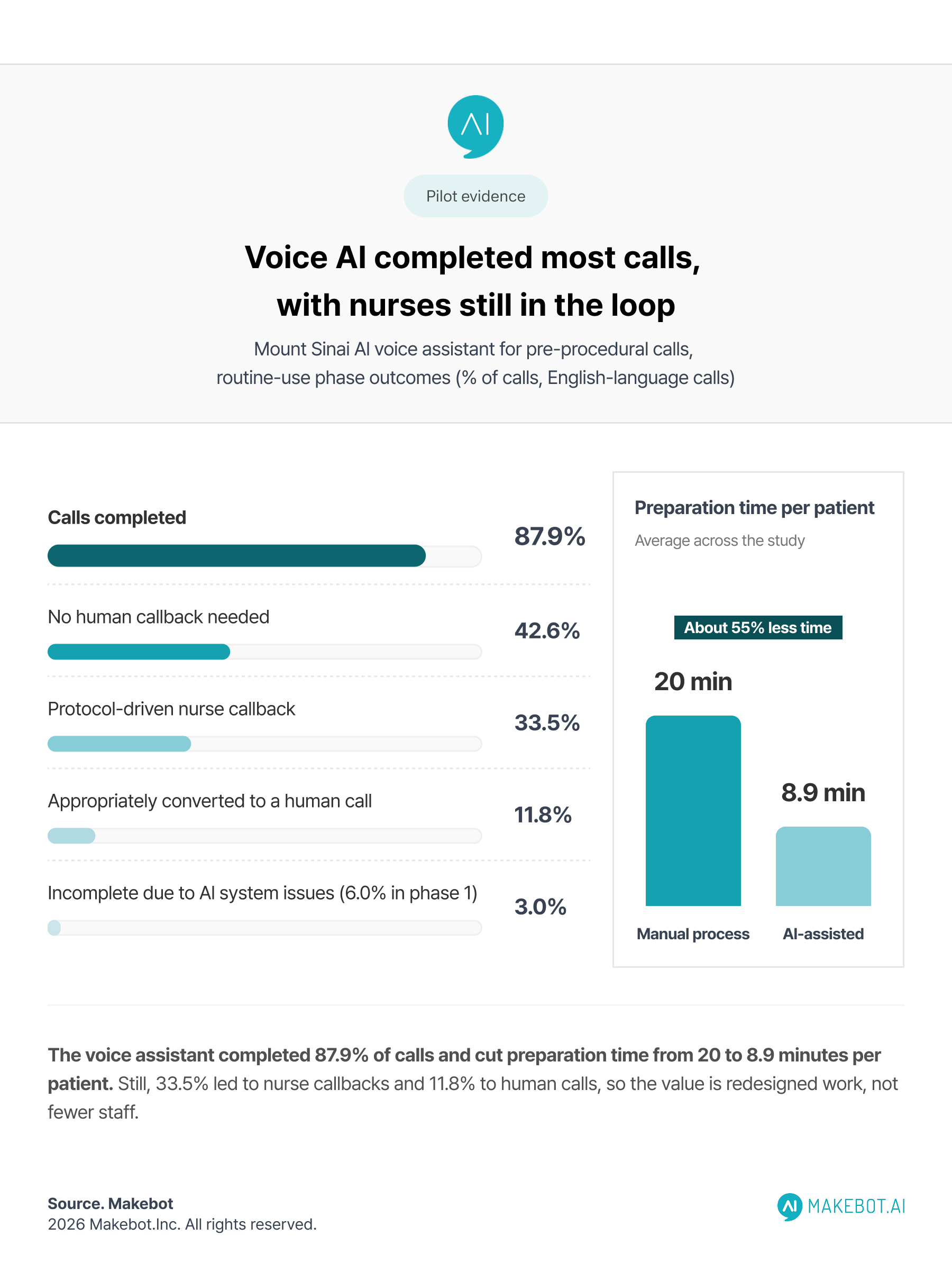
Preparation took about 8.9 minutes per patient, compared with 20 minutes by hand. Weekly completion rose from 58.3% to 92% after simple fixes: asking for name and date of birth separately, texting before the call and calling from a hospital number. The calls were English-only, and the satisfaction survey had not been validated before the study.
Which metrics should a pilot track?
- Completion and containment rate: calls resolved without staff.
- Escalation reasons: including patients who prefer a person, the most common reason in the first phase of the Mount Sinai study.
- Errors by type: technical, speech and content.
- Staff time saved against the manual baseline.
- Patient feedback, keeping in mind that responses tend to come from patients who finished calls.
For handoff design, see how AI chatbots can make it easier for customers to reach human support.
Conclusion: What Should Hospitals Do Next?
Hospitals that get value from conversational AI in healthcare treat it as an access system, not a talking front end. A bot that books directly in the EHR, hands patients to staff with full context and protects patient data can help a hospital meet growing call volume while giving staff more time for patients who need a person.
A practical first step is a 90-day pilot on one busy, low-risk task, such as pre-visit calls or rescheduling. Before you sign, ask the vendor to book a real appointment in your healthcare call center test environment. If the bot can do that, it is ready to start helping your patients.


































What Happens to Marketing When the C-Suite Starts Using AI Every Day?







Why AI Shopping Assistants Will Replace Traditional Ecommerce Search