How AI-Powered Chatbots Improve Order Tracking in E-Commerce
US e-commerce hit $347B in Q3 2026. An AI chatbot cuts WISMO tickets with live carrier data.


Key Takeaways
- Most WISMO questions come from missing information, not from a lack of staff. A chatbot helps most when it reads live order and shipping data instead of using pre-written replies.
- The technology behind tracking changed in 2026. USPS shut down its old Web Tools APIs in January, and carriers such as FedEx offer webhooks that send updates automatically instead of waiting to be asked.
- Shoppers value correct answers most. In a March 2026 survey of 493 online shoppers published in Frontiers in Psychology, information quality had the biggest effect on satisfaction with AI chatbots.
- Keep people reachable. Klarna reported that its AI assistant handled two-thirds of customer service chats in its first month, and the lasting lesson is to automate routine questions while keeping a clear path to a person.
- Delay messages are also a legal matter. U.S. shipping rules, EU rules on telling people they are talking to AI, and a Canadian tribunal ruling on an airline's chatbot all shape what a chatbot should say.
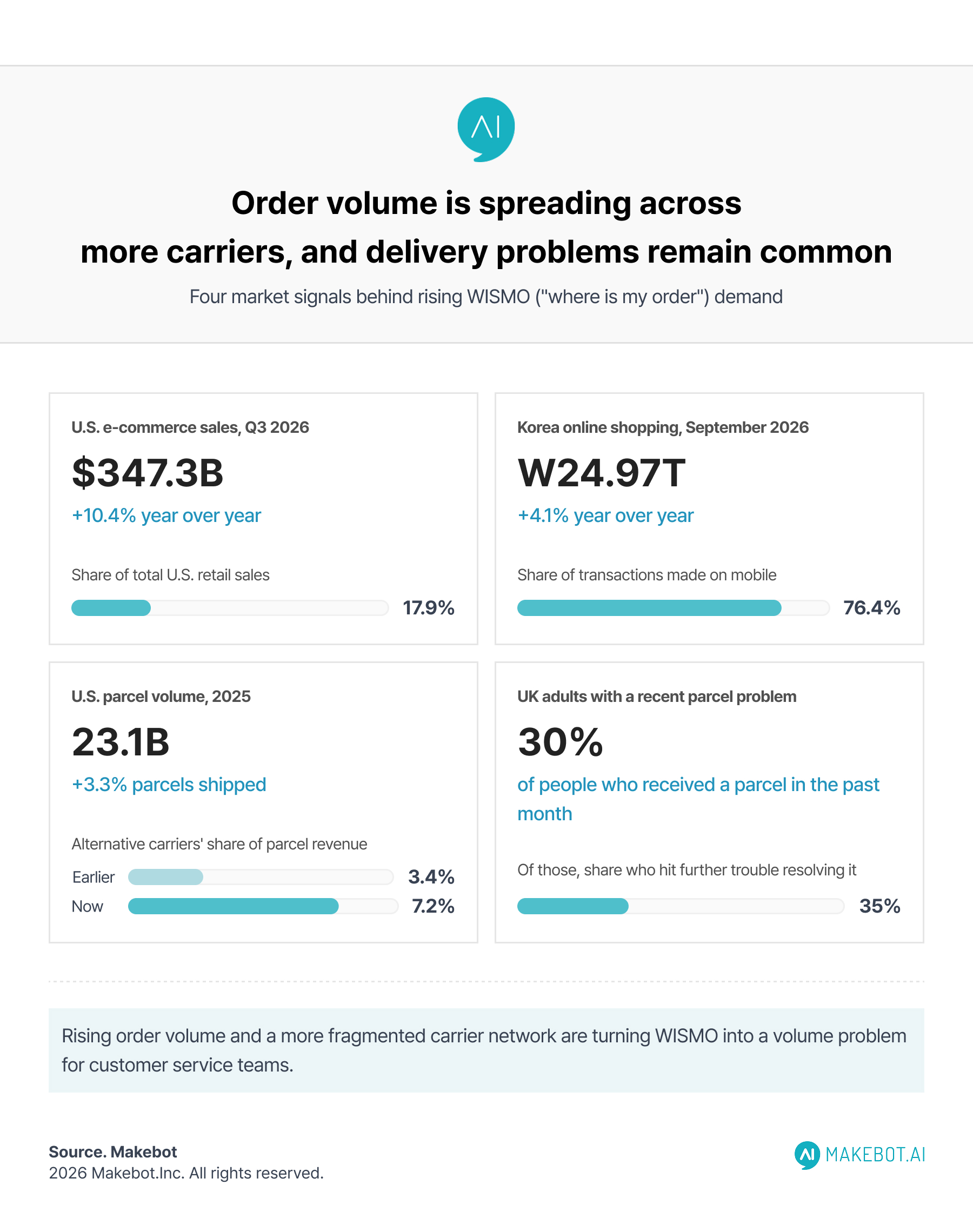
U.S. shoppers spent $347.3 billion online in the third quarter of 2026, up 10.4% from a year earlier, according to the Census Bureau's latest estimate. Many of them will eventually ask, "Where is my order?" Support teams call this WISMO, and it keeps ecommerce customer service teams answering the same question all day.
An AI chatbot for ecommerce can answer it in seconds when it is connected to live order and carrier data. Here is how that works for ecommerce order tracking, what the research shows, and how to measure results.
Why Does WISMO Keep Flooding Ecommerce Customer Service Teams?
WISMO floods ecommerce support teams because orders, carriers and delivery problems keep growing.
More orders now travel through more delivery companies, and delivery problems are still common. When shoppers cannot find a clear update, they contact support, pulling agents away from refunds, damaged items and harder cases.
The Pitney Bowes Parcel Shipping Index counted 23.1 billion U.S. parcels in 2025, up 3.3%, and alternative carriers more than doubled their revenue share, from 3.4% to 7.2%. In Korea, online shopping reached ₩24.97 trillion in September 2026, up 4.1%, according to the Ministry of Data and Statistics' monthly report, as summarized by the KDI Economic Information and Education Center.
In the UK, a November 2026 Citizens Advice survey of 10,000 adults found that 30% of people who received a parcel in the past month had a problem, and 35% of them hit further problems trying to fix it, including frustrating automated systems. A chatbot that can see the order and give a clear answer turns that frustration into a quick resolution, especially during peak-season rushes.
WISMO comes in two types:
- On-track questions: the order is on schedule, but the customer lacks a trusted delivery date. These are the best fit for ecommerce automation.
- Problem orders: a stalled scan, a failed delivery or a customs hold. These need a person to make a decision.
What Happens Inside an AI Chatbot When a Shopper Asks Where Their Order Is?
When a shopper asks where an order is, the chatbot verifies them, checks live data and replies.
The chatbot confirms who the shopper is, looks up the order, pulls the latest carrier updates and writes a reply using only that data. The AI model handles the conversation; your systems supply the facts. That split keeps answers current and stops the bot from inventing delivery dates.
- Check identity with a login, or an order number plus email.
- Look up the order. On Shopify, shipment status updates on its own for supported carriers.
- Get carrier events through an API (a connection that lets systems share data) or a webhook that pushes news instantly, like FedEx's Advanced Integrated Visibility webhook.
- Write the answer. A large language model (LLM) turns the data into a plain reply with the tracking link and next step.
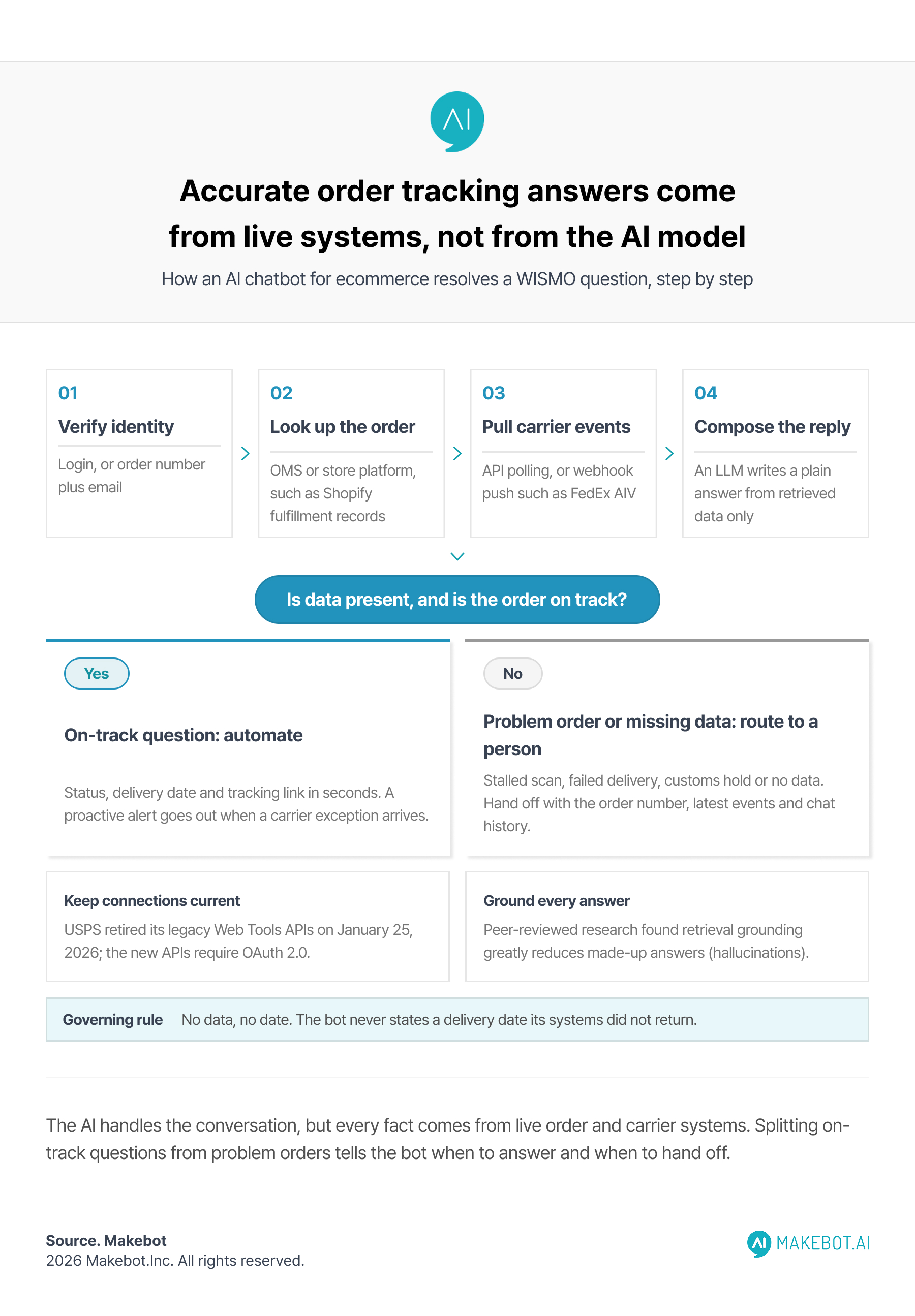
These connections need upkeep. USPS retired its old Web Tools APIs on January 25, 2026, and its release notes describe the new APIs' OAuth 2.0 authentication (a standard secure sign-in method for software). Any chatbot or order tracking software still on the old setup may be answering from broken data.
Retrieval-augmented generation (RAG) makes the AI look up real data before answering, and a peer-reviewed study at EMNLP 2021 found that retrieval greatly reduced made-up answers, called hallucinations. The rule: no data, no date. If a system returns nothing, the bot hands the question to a person.
How Do AI Chatbots Compare With Tracking Pages and Email Alerts for WISMO?
AI chatbots stand out from tracking pages and email alerts on WISMO by answering each shopper's own question.
Tracking pages and shipping emails show everyone the same update. An AI chatbot answers each shopper's exact question, in plain words, at any hour, and knows when to bring in a person. The best results come from using all three together.
In the table, a rules-based chatbot is one that follows a fixed script.
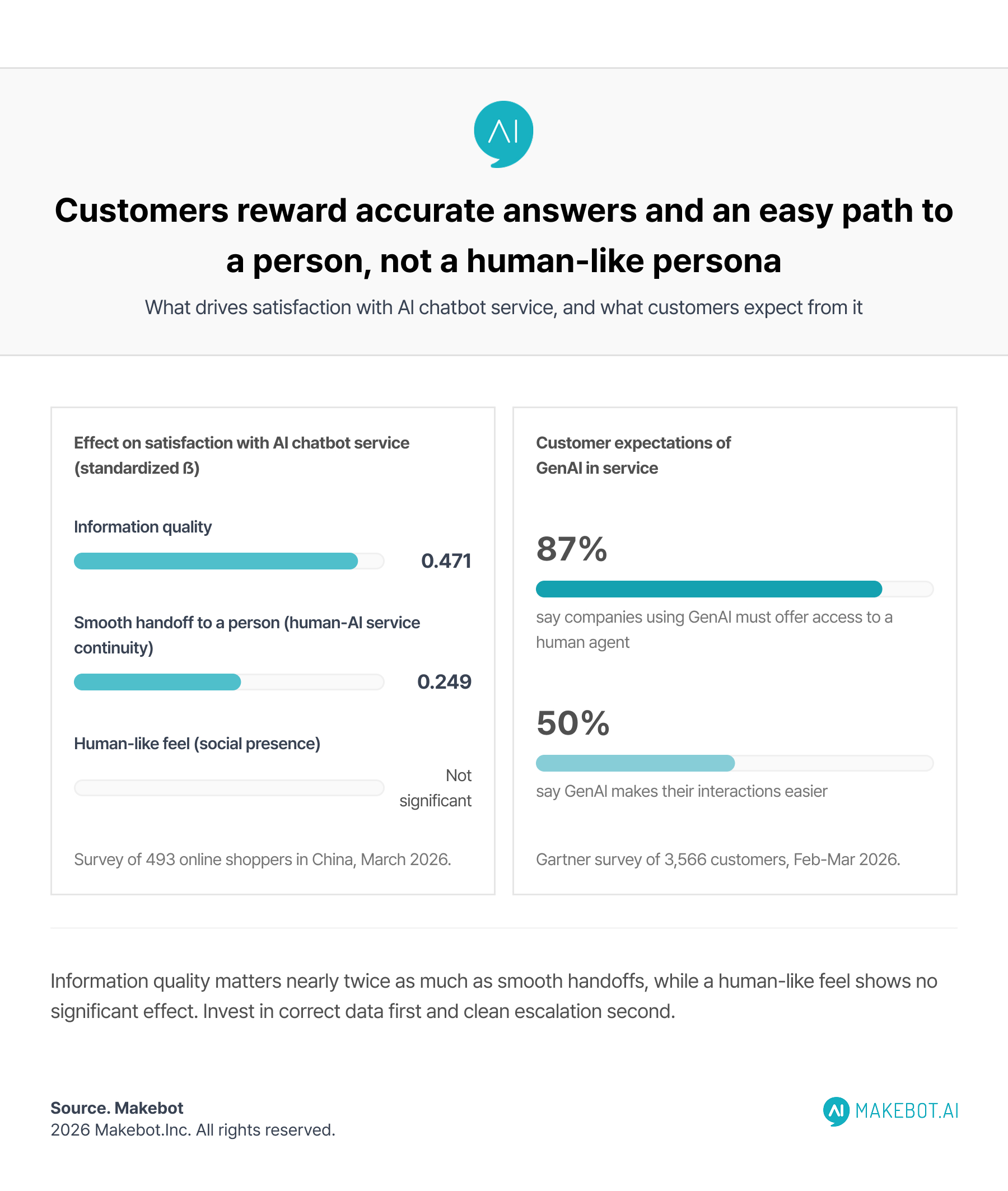
Accuracy matters most. A peer-reviewed 2026 study in Frontiers in Psychology of 493 online shoppers in China found that information quality had the biggest effect on chatbot satisfaction (β = 0.471). Smooth service continuity between AI and human agents also helped (β = 0.249), while social presence, the feeling of talking with a human-like partner, had no significant direct effect on satisfaction. Shoppers can now compare store bots with outside tools, which helps explain why customers turn to third-party AI.
What Do Real Deployments Teach About Ecommerce Automation?
Real deployments show that ecommerce automation handles routine questions well when people stay reachable.
AI chatbots can take over most routine questions quickly. The lasting approach automates status questions and routes problems to people.
Klarna's February 2024 announcement reported that its AI assistant handled two-thirds of chats, or 2.3 million conversations, in its first month, resolved chats in under two minutes instead of 11, and matched human agents on customer satisfaction. These are company figures, and the assistant handles refunds, payments and disputes rather than tracking. The lesson still applies: automate routine work, and keep people available on purpose.
Customers agree. In a Gartner survey of 3,566 customers from early 2026, 87% said companies using generative AI must offer a way to reach a human agent. For order tracking, let customers reach a person at any time, and pass along the order number and chat history.
How Do Shipping Rules, AI Laws and Legal Rulings Affect Chatbot Design?
Shipping rules, AI laws and legal rulings require chatbots to be timely, accurate and transparent.
They turn delay messages into a duty. U.S. sellers that cannot ship on time must offer a wait-or-cancel choice, the EU requires telling people they are talking to AI, and a Canadian tribunal held a company responsible for its chatbot's wrong answer.
- U.S. shipping delays. Under the FTC's Mail, Internet, or Telephone Order Merchandise Rule, a seller that cannot ship on time must send a delay option notice with a new date and the right to cancel for a full refund. A note on an order-status page alone does not count, so pre-shipment delays need an automatic outbound message. The rule covers the seller's shipment, not every carrier delay after dispatch.
- AI disclosure. Article 50(1) of the EU AI Act, which has applied since August 2, 2026, according to Morgan Lewis, requires providers to make sure people know they are talking to AI unless that is obvious.
- Liability. In Moffatt v. Air Canada, a British Columbia tribunal ruled that a company is responsible for what its chatbot says.
So share only dates your systems provide, pull policy terms from an approved source, disclose the AI up front, and keep records of every delay notice, since the FTC presumes a seller lacked a reasonable basis for its shipping promises if it has no documentation.
Which Numbers Prove an AI Chatbot for Ecommerce Is Paying for Itself?
An AI chatbot for ecommerce pays off when WISMO per order shipped falls and satisfaction holds.
Track your WISMO rate per order shipped, how many status chats the bot solves alone, repeat contacts within 48 hours and satisfaction with bot chats. Fewer tickets with steady satisfaction means it works. Fewer tickets with more complaints means customers are not getting the help they need.
Calculate the WISMO rate as WISMO contacts ÷ orders shipped × 100 so busy seasons do not hide progress. Monthly value equals human contacts avoided times cost per contact, minus platform and upkeep costs, the same logic used in measuring chatbot ROI.
Before launch, make sure you have AI-ready data for orders and carriers, one trusted source for the promised delivery date, automatic delay triggers, enough agents for problem orders and an approved policy knowledge base.
Conclusion: What Should Online Stores Do Next to Improve Order Tracking?
To improve order tracking, online stores should connect live data, automate status questions and send early alerts.
An AI chatbot for ecommerce improves order tracking when it gives customers a reliable view of live data, so agents have more time for refunds, damaged items and other cases that need a person.
A practical first step is to measure your current WISMO rate per order shipped and check every carrier connection, including any USPS integration still on the retired Web Tools APIs. Then automate on-track status questions, send proactive delay alerts and design handoffs so agents get the full story.






































What Happens to Marketing When the C-Suite Starts Using AI Every Day?







Why AI Shopping Assistants Will Replace Traditional Ecommerce Search