How RAG Chatbots Deliver Accurate Answers to Return Policy Questions
RAG chatbots cut AI hallucination to 0 to 6% on return policy questions. Air Canada proves why.


Key Takeaways
- Accurate answers protect the business. A Canadian tribunal held Air Canada responsible for wrong fare advice from its chatbot, so grounding answers in the real policy matters.
- Trusted sources make the biggest difference. In a peer-reviewed JMIR Cancer study, a RAG chatbot with a trusted source erred on 0% to 6% of the questions that source covered, compared with 37% to 40% for chatbots with no lookup step.
- Saying "I do not know" matters as much as search. Research presented at ICLR 2025 found that strong models often guess wrong when the text they retrieve is incomplete, and that a sufficiency check raises correct answers.
- Policy changes do not require retraining. Update and re-index the policy document, and the chatbot follows the new rules from the next question.
- People handle the cases that need judgment. In a November 2025 Adobe Express survey, 60% of U.S. shoppers wanted a human for returns, and Article 50 of the EU AI Act now requires telling people when they talk directly to an AI system.
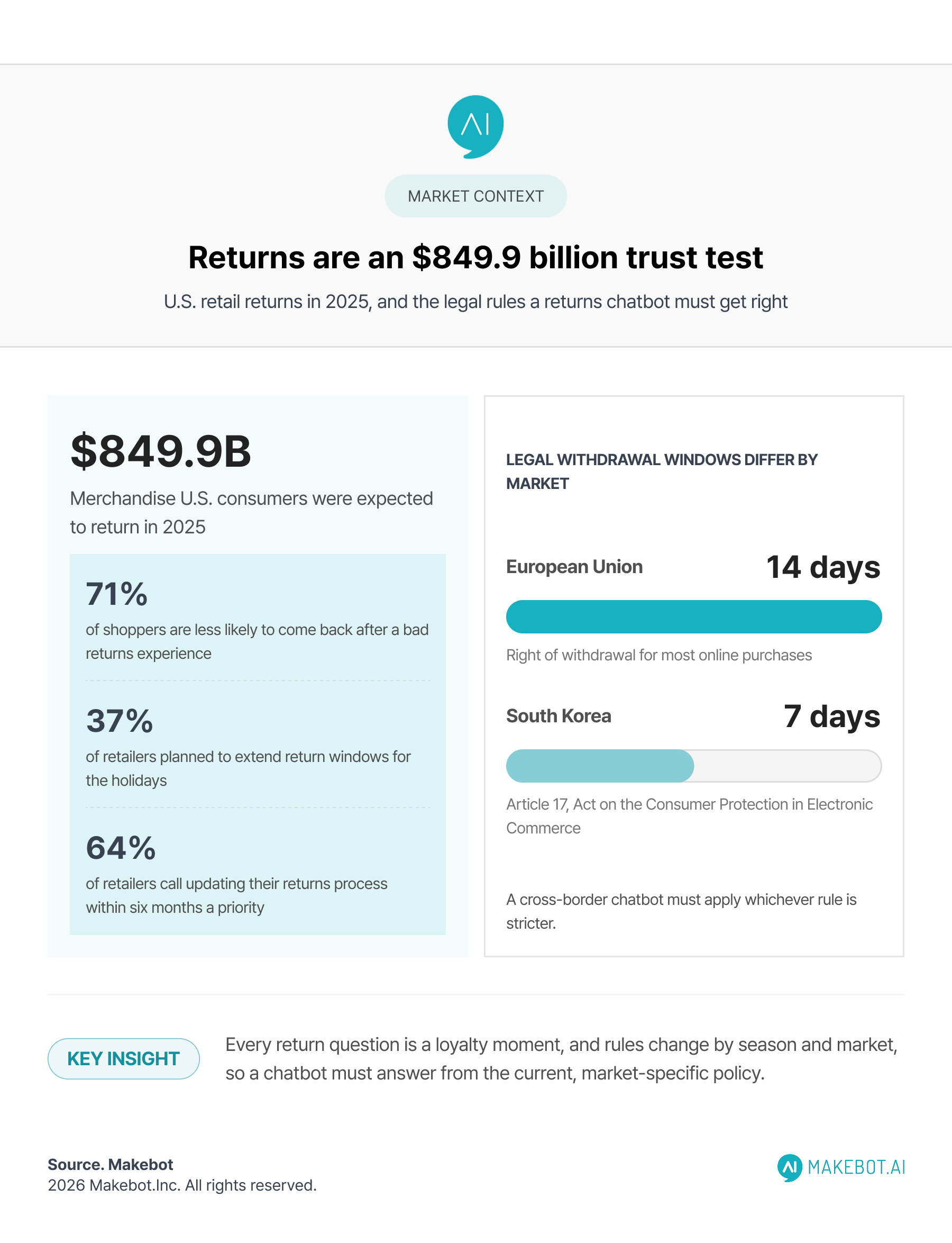
U.S. retailers expected $849.9 billion in returned merchandise in 2025, according to research from NRF and Happy Returns, and the same research found that about 71% of shoppers are less likely to come back after a bad returns experience. A clear, fast answer to the first question, "Can I still return this?", is where a good returns experience starts.
For an AI chatbot, that question is harder than it looks, because a return policy works almost like a contract. A RAG chatbot solves this by looking up the right part of the policy before it answers. Here is how it works, how much it reduces AI hallucination (when an AI makes something up) and where people add the most value in returns management.
What Is a RAG Chatbot, and Why Do Return Questions Need One?
A RAG chatbot answers return questions from your approved policy instead of guessing from memory.
This AI chatbot checks an approved chatbot knowledge base before it replies, which matters because return rules are detailed, change often and carry legal weight.
RAG stands for retrieval-augmented generation: find the right information, then write the answer from it. The 2020 NeurIPS paper by Lewis et al. that formalized it noted that training-only models struggle to show sources or update their knowledge.
A typical ecommerce return policy runs into both. A general-purpose AI chatbot for ecommerce knows what return policies usually say, not what yours says today.
Why Do General AI Chatbots Get Return Policy Questions Wrong?
General AI chatbots get return policy questions wrong because they guess from training patterns.
When your policy differs from what sounds typical, the chatbot fills the gap with a confident guess, a classic case of AI hallucination.
In Moffatt v. Air Canada, the airline's chatbot told a grieving customer they could claim a bereavement discount within 90 days of buying the ticket, even after the trip. The policy page said the opposite. In February 2024, British Columbia's Civil Resolution Tribunal called Air Canada's claim that it was not responsible for its chatbot "a remarkable submission" and ordered it to pay CA$812.02.
In April 2025, according to The Register, a support bot for the coding tool Cursor blamed user logouts on a login policy that did not exist, and no human was behind the reply. A business owns its chatbot's answers, which is why grounding every answer in the real policy is the safest design.
How Does a RAG Chatbot Answer a Return Policy Question Step by Step?
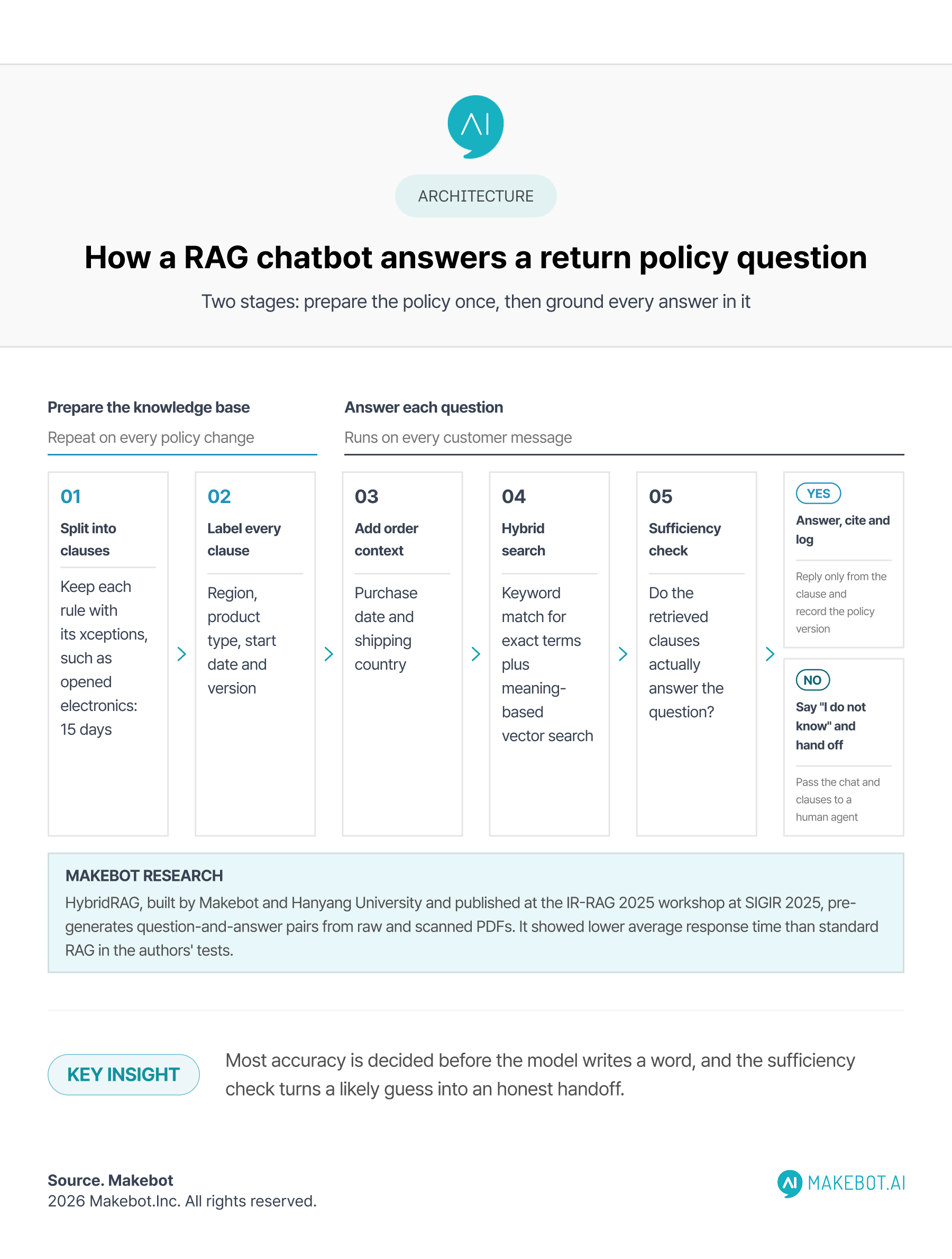
A RAG chatbot answers a return question by finding, checking and citing the clause that applies.
It uses only that text:
- Split the policy into clauses, so a rule like "opened electronics: 15 days" stays with its exceptions.
- Label each clause with region, product type, start date and version.
- Add order details, such as purchase date and shipping country.
- Use hybrid search, combining keyword search for exact terms like "final sale" with meaning-based (vector) search for reworded questions.
- Run a sufficiency check to confirm the clauses answer the question. If not, say so or hand off.
- Answer, cite and log the policy version used.
What Should Go Into the Chatbot Knowledge Base?
Your chatbot knowledge base should hold only approved, current material: the policy, product-specific rules, regional legal notices and approved agent replies. Archive old versions with dates so they cannot be mixed up.
PDFs full of tables are easy to scramble. Makebot's research team and Hanyang University built HybridRAG for this problem, published in the IR-RAG 2025 workshop proceedings at SIGIR 2025. It prepares question-and-answer pairs from raw and scanned PDFs and, in the authors' tests, delivered lower average response time and slightly higher answer quality than standard RAG.
How Is a RAG Chatbot Different From a Regular AI Chatbot?
A RAG chatbot differs from a regular AI chatbot by answering from your current documents.
A regular AI chatbot relies on frozen training data and cannot show sources, while RAG answers can be traced to a clause and updated without retraining.
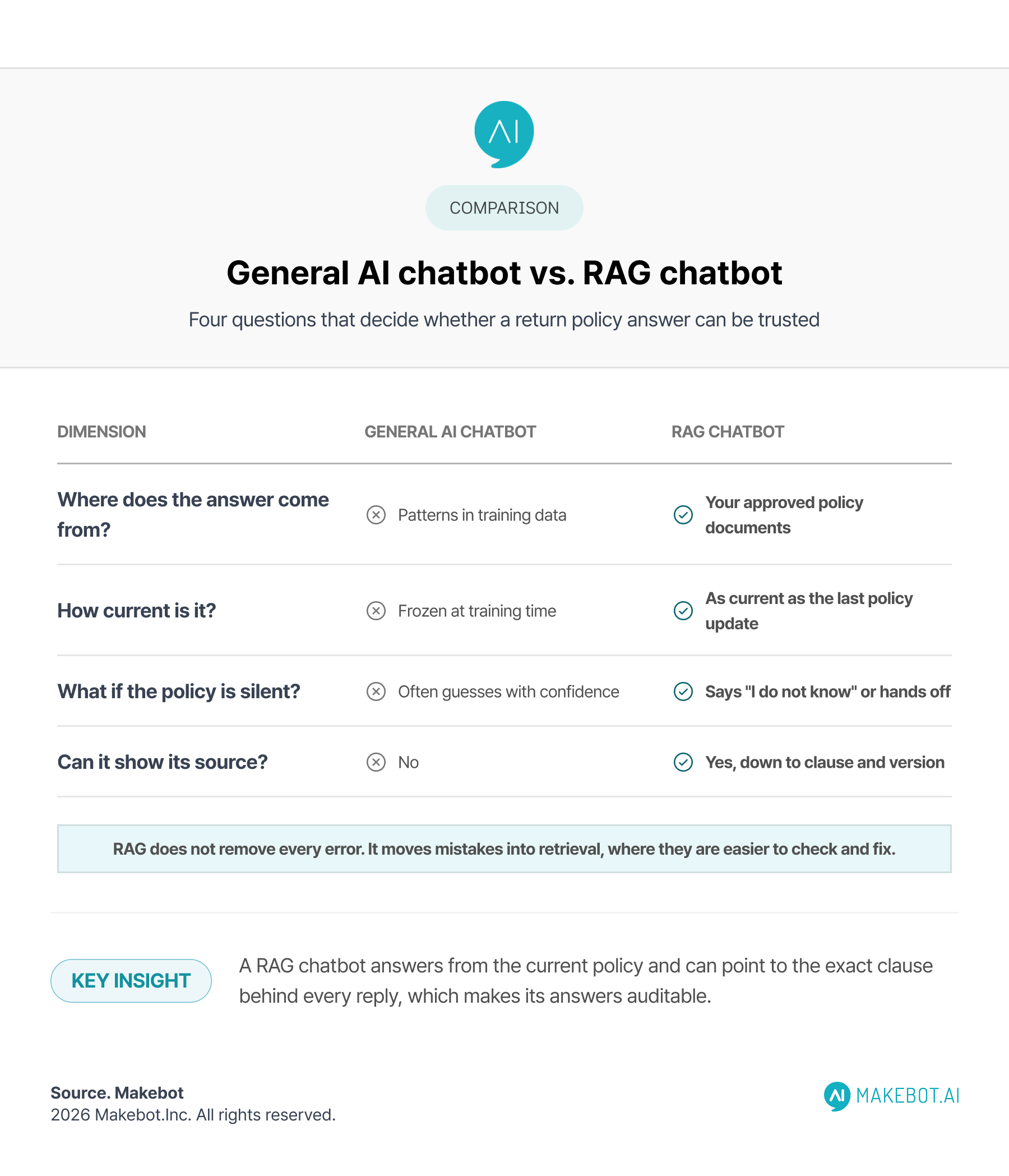
RAG does not remove every mistake. It moves them to retrieval, which is easier to check and fix, a trade-off Makebot explores in whether LLMs can work without RAG.
How Much Does RAG Really Reduce AI Hallucination?
RAG reduces AI hallucination sharply when it uses a trusted source.
Research shows very low error rates with carefully chosen sources and higher rates with messy sources or incomplete information. Source quality and clear abstention rules (rules for when to say "I do not know") decide the result.
A September 2025 JMIR Cancer study from Japan's National Cancer Center tested chatbots on 62 cancer questions:
- RAG with a trusted source: 0% errors with GPT-4 and 6% with GPT-3.5 on questions the source covered
- RAG with web search: 19% and 35% on questions the trusted source did not cover
- No lookup step: 37% and 40% across all questions
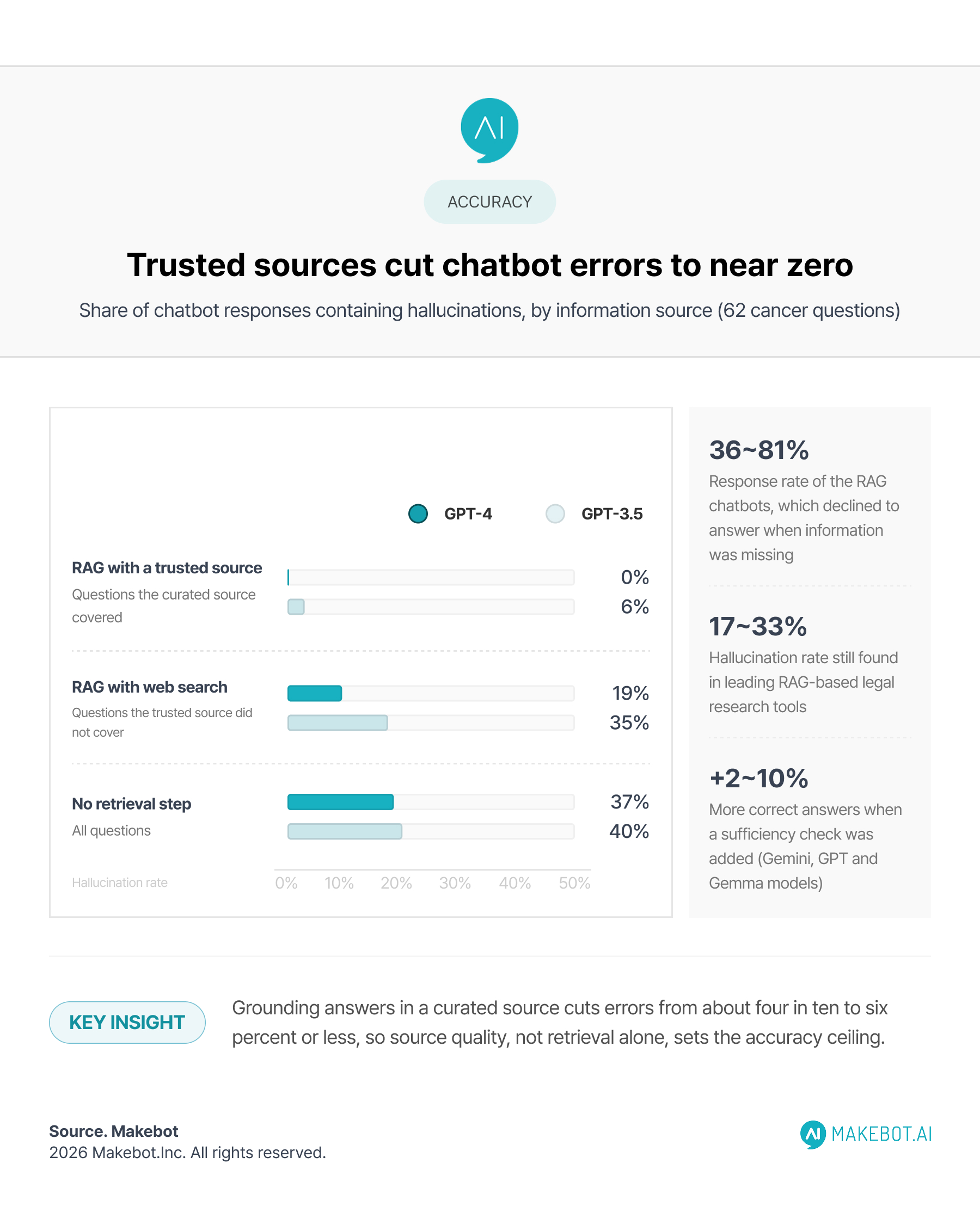
The RAG chatbots also declined when information was missing, answering 36% to 81% of questions, the right trade-off for returns, where a wrong answer becomes a promise. A preregistered study in the Journal of Empirical Legal Studies found the same pattern in law: leading RAG-based legal research tools made fewer errors than GPT-4, though they still erred 17% to 33% of the time, which shows why source quality and abstention rules matter.
Why Does "I Do Not Know" Matter So Much?
In the Sufficient Context paper presented at ICLR 2025, researchers from UC San Diego, Duke University and Google found that larger models often guess wrong when retrieved text is incomplete. A sufficiency check raised correct answers by roughly 2% to 10% for the Gemini, GPT and Gemma models tested. If a customer asks about returning a gift bought with store credit and the policy is silent, a sufficiency check makes the chatbot say so and hand off instead of inventing a rule. Makebot's review of RAG hallucination mitigation in clinical LLMs covers similar safeguards.
What Happens When Your Ecommerce Return Policy Changes?
When your ecommerce return policy changes, a RAG chatbot follows the new rule without retraining.
Update and re-index the source document, and the new rule applies from the next question. You do need version control, clear start dates and removal of outdated text.
In 2025 research from NRF and Happy Returns, 37% of retailers planned to extend return windows for holiday returns, and 64% called updating their returns process within six months a priority. Laws matter too. The EU gives shoppers a 14-day right of withdrawal for most online purchases, while Article 17 of South Korea's Act on the Consumer Protection in Electronic Commerce generally allows seven days. A chatbot that serves several countries should apply the rules for each shopper's market.
When Should a RAG Chatbot Hand a Return Question to a Human?
A RAG chatbot should hand a return question to a human agent when the case needs judgment.
Examples include damaged items, exceptions, possible fraud or questions the policy does not answer. Pass along the conversation and the clauses found so customers do not repeat themselves, as explained in our guide to handing off to a human agent.
In an Adobe Express survey of 1,005 U.S. consumers in November 2025, 60% wanted a human for returns and 36% were open to a chatbot. The same survey found that 61% feel comfortable talking with AI systems, and that retail and ecommerce was the sector where shoppers felt most comfortable using conversational AI. Fraud is another reason to keep people in returns management: NRF estimates that 9% of all returns are fraudulent.
The best results come from balancing AI with human agents: the chatbot answers routine policy questions instantly, and people focus on the exceptions and judgment calls.
How Can You Tell If an AI Chatbot for Ecommerce Handles Returns Well?
You can tell an AI chatbot for ecommerce handles returns well by its accuracy, not its volume.
Appropriate refusals and smooth handoffs matter too. Track five numbers:
- Grounded accuracy: answers matching the cited, current clause
- Made-up claims: terms found in no retrieved clause
- Correct refusals: "I do not know" replies where the policy was silent
- Handoff success: escalations solved without repetition
- Update delay: time for policy changes to reach answers
The European Commission confirms that Article 50 of the AI Act has applied since August 2, 2026, requiring that people be told when they are talking directly to an AI system. In the Adobe Express survey, 91% of shoppers said brands should be required to disclose bots.
Conclusion: What Should Retailers Do Next With RAG for Returns?
Retailers should treat RAG for returns as part of returns management and measure accuracy first.
Return volumes are large, and a Canadian tribunal has ruled that a company is responsible for what its chatbot tells customers. A RAG chatbot closes the gap between what a business publishes and what its assistant says, as long as it may say "I do not know" and people handle the cases that need judgment.
A practical first step is to collect your 50 most common return questions, check that each one maps to a current, dated clause in your policy, and test the chatbot's answers against those clauses before you automate any refunds.





































What Happens to Marketing When the C-Suite Starts Using AI Every Day?






Why AI Shopping Assistants Will Replace Traditional Ecommerce Search